49 works in this view — arrow keys or swipe to move between them.
Dance in Art
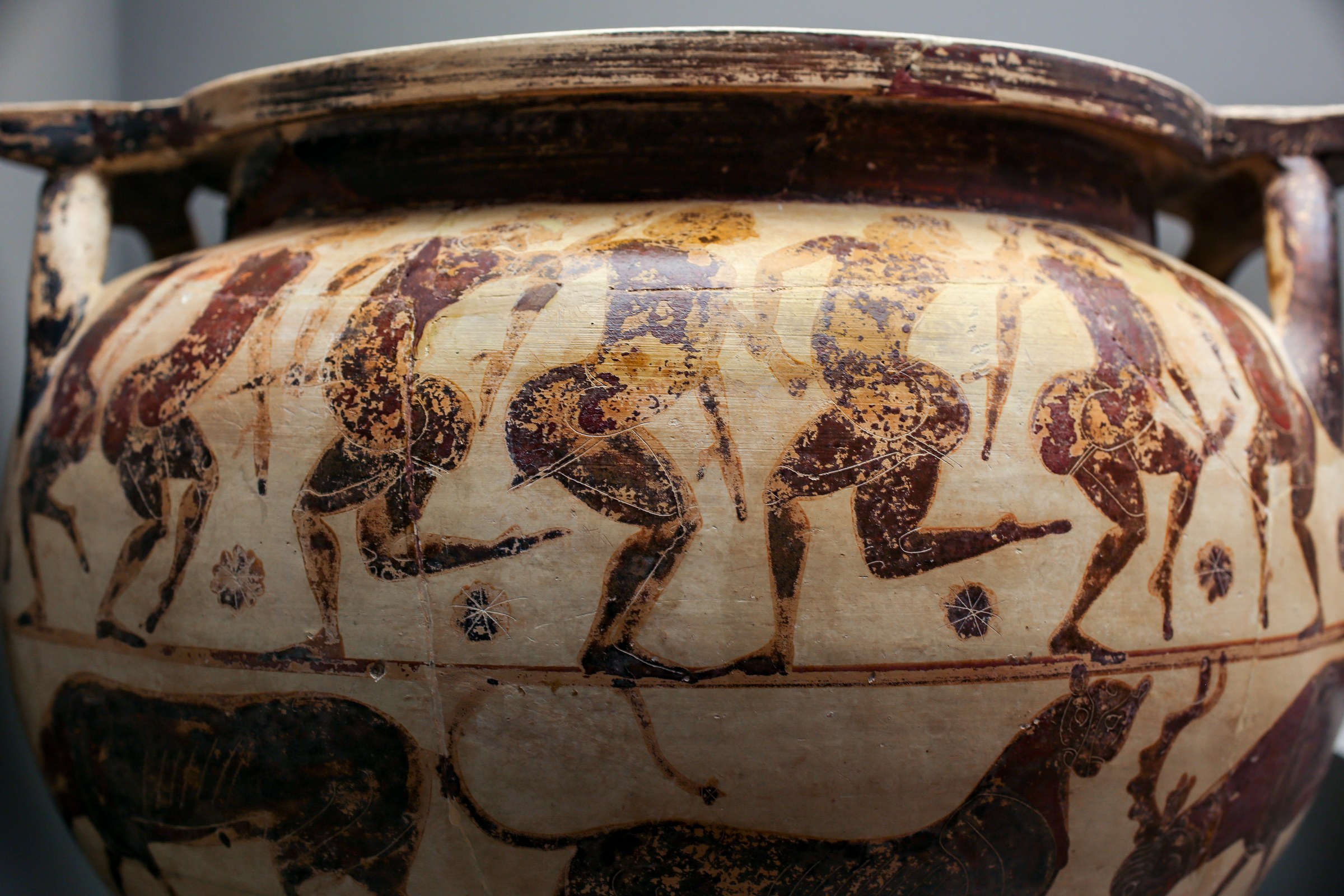
Middle corinthian column-krater - padded dancers - animal friezes - Athens MCA AA0221 - 02
ArchaiOptix
- Source:
- Wikimedia Commons
- Rights:
- Reusable with conditions: credit the creator; share any adaptation under the same licence. Source record ↗
- Recorded as:
- cc by-sa 4.0
This vessel documents the visual conventions of komastic entertainment in Archaic Greece and shows that padded costumes had a recognised place in symposium performance well before later dramatic forms. For dance historians, it provides rare evidence of how revels were imagined and valued by those who witnessed and participated in them, and of the relationship between performance, alcohol, and elite male sociability in the 6th century BCE.
What you are looking at
A ceramic vessel decorated in black-figure technique shows a frieze of padded dancers against a cream ground. Five male figures occupy the upper register, each rendered in profile or three-quarter view with exaggerated musculature emphasised by the dark glaze. They wear short tunics and what appears to be protective padding or a form of body suit covering their torsos and limbs, creating a heavily-lined, segmented silhouette. The dancers are spaced evenly around the vessel's circumference, separated by small floral ornaments (eight-petalled rosettes). Below this frieze runs a band of animals—visible are parts of what may be lions or mythological creatures. The vessel itself is a column-krater, a large mixing bowl with a distinctive wide mouth and sturdy cylindrical handles. The surface shows the warm, honey-coloured clay typical of Corinthian pottery, with the black figure work now somewhat worn and patchy from age.
The dancing
The five dancers are posed in isolation rather than interaction. Each figure stands with legs slightly bent, weight distributed evenly, arms raised or extended in various attitudes—some with both arms lifted, others with one arm raised and the other lowered. The padded costumes obscure the underlying anatomy, but the gestures suggest a buoyant, upright carriage. The bodies show no interlocking or partnering; this is a sequence of individual performers rather than a coordinated group. All face the same direction around the vessel, creating a processional or parade effect rather than a social dance formation.
The dance depicted
These are komasts—revellers or merrymakers depicted in a symposium or processional context. Komoi were a feature of Archaic Greek social gatherings, particularly among the aristocracy, and this depiction is characteristic of the period. The padded costumes are notable: they may represent both comic exaggeration and actual performance wear, possibly padding worn for protection in vigorous movement or to create a grotesque comic effect. The isolated spacing and individual postures suggest movement without formal structure—a celebration or entertainment rather than a choreographed ritual dance. The style and subject are typical of Corinthian black-figure pottery from the 6th century BCE, when such vessels served both functional and decorative purposes in elite dining contexts.
How it was made
This is a clay vessel formed on a potter's wheel and decorated using the black-figure technique, in which figures are painted with a slip that turns black in the kiln while the background remains the natural clay colour. The technique demands that designs be planned as negatives—details are scratched away through the black layer to reveal the lighter surface beneath, as visible in the incised lines defining muscles, padding patterns, and facial features. This labour-intensive process limited production to specialised workshops and made each vessel a craft object of considerable value. The black-figure style was the dominant decorative mode in Corinth during the 6th century and was exported widely throughout the Mediterranean, making it a form of prestige trade goods.
About this work
This is a Corinthian column-krater dating to the middle Corinthian period (ca. 590–570 BCE), likely produced in a Corinthian workshop for use in an elite Greek household. The upper frieze depicts five padded komasts in various attitudes of celebration or performance, separated by small ornamental flowers. The work is significant as documentary evidence of how revellers were understood and represented in Archaic Greek visual culture—particularly the role of padded costumes in comedic or vigorous entertainment. The vessel itself served a practical function as a wine-mixing bowl in symposium settings, making the decoration both decorative and contextually meaningful to its audience of aristocratic men.
How to look at it
Examine the five padded figures individually to understand the range of postures the artist recorded: note which arm is raised, where the weight appears to rest, and how the padding creates a visual rhythm around the vessel. The eight-petalled flowers that separate each figure serve to punctuate the frieze and reinforce the idea of distinct performers rather than a unified dance. The wear and loss of the black glaze is part of the object's authentic surface—look through these gaps to the underlying clay to understand the technique. Turn your attention to the lower animal frieze: though less complete, it provides context for understanding the vessel's decorative hierarchy and the importance of the human figures above.
The artist
The vessel is unattributed, as is common for Corinthian black-figure pottery. It was produced by a workshop potter and painter whose identities are lost, though their adherence to standardised compositional and technical practices allows scholars to group their work within the broader Corinthian tradition. The style and subject matter indicate a trained hand familiar with the conventions of representing the human figure and the specific demands of the black-figure technique applied to the curved surface of a large vessel.
The period
The Archaic period (ca. 750–480 BCE) saw the flourishing of the Greek city-state and the development of formal symposium culture among the elite. Wine, music, dance, and entertainment were central to male bonding and the performance of aristocratic identity. The black-figure technique was the dominant decorative style of Corinthian pottery in the 6th century and was exported throughout the Mediterranean, making Corinthian vessels prestigious markers of taste and wealth. This vessel was made at a time when komos—revelling—was an established and celebrated form of entertainment, often featuring young men in comic or grotesque dress performing for the amusement of the gathering.
Where it lives
The vessel is held in the Museum of Cycladic and Archaic Art in Athens (accession AA0221). It was photographed by ArchaiOptix in 2014. The findspot is unknown, limiting what can be said about its original context, though its high quality suggests it belonged to a wealthy household.
Questions about this work
What are the padded costumes the dancers are wearing?
The padding may have served multiple purposes: protection during vigorous movement, visual exaggeration for comic effect, or a costume convention for revelling entertainment. Similar padded costumes appear in later Greek comedy, where they were used to create a grotesque silhouette. In the context of symposium entertainment, padding would have made the performers more visually distinctive and perhaps more physically imposing.
What is a komast?
A komast is a reveller or merrymaker, typically depicted in Greek art as a young man participating in a komos—an entertainment or procession, often part of a symposium or drinking party. Komasts were associated with merriment, music, dance, and often depicted in a state of revelry or intoxication. They represent the celebratory and performative aspects of elite male sociability in ancient Greece.
What is a column-krater?
A krater is a large bowl used for mixing wine and water—a practical vessel for symposium hospitality. The column-krater is a specific type with a distinctive cylindrical body and sturdy handles shaped like columns rising from the rim. These vessels were often decorated with figural scenes and were both functional and display objects, demonstrating the owner's wealth and taste.
Why are the figures separated by flowers?
The eight-petalled rosettes serve both a compositional and symbolic purpose: they help divide the frieze into clear sections, emphasising the individual performers, and they add an ornamental refinement to the design. They also suggest a formal or ceremonial quality to the scene, framing the revelry within a structured decorative field.
More dance artwork





