49 works in this view — arrow keys or swipe to move between them.
Dance in Art
KX Painter - ABV 25 24 - padded dancers - Cambridge FWM GR-126-1892 - 02
ArchaiOptix
- Source:
- Wikimedia Commons
- Rights:
- Reusable with conditions: credit the creator; share any adaptation under the same license. Source record ↗
- Recorded as:
- cc by-sa 4.0
Komastic dance is one of the oldest documented secular dance forms in Western history, yet it left no treatises, notation, or formal training system—only fragments preserved on pottery. This vessel is direct visual evidence of how a real performance tradition looked, how performers dressed, and what kind of space and audience it occupied. For dancers and historians, it bridges the gap between mythological dance imagery and the actual social dance of everyday life in Classical antiquity.
What you are looking at
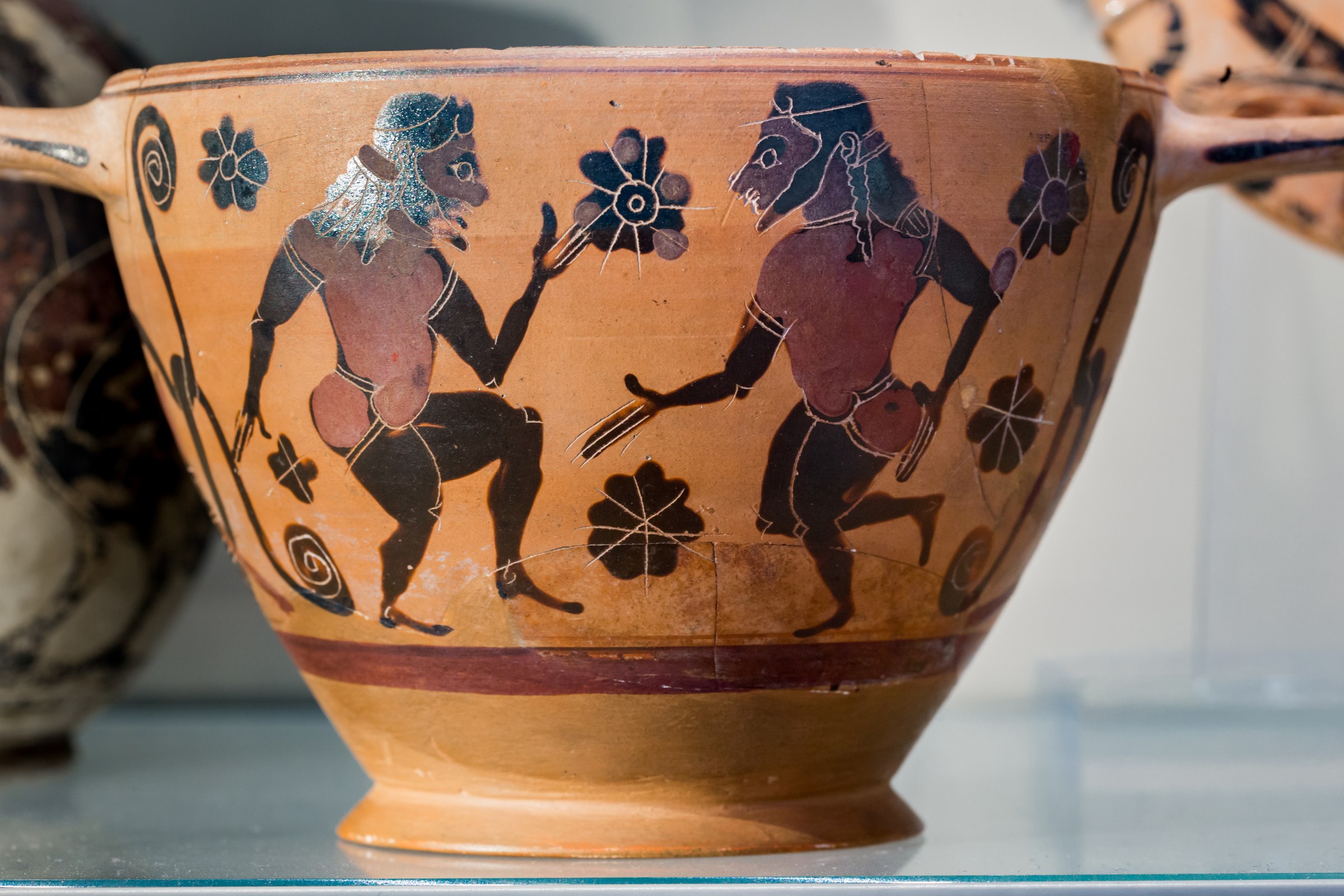
A terracotta skyphos (drinking cup) decorated in the Attic black-figure technique shows two bearded male dancers in padded costumes facing each other across the vessel's body. Both wear thick, bulbous padding that exaggerates the torso and limbs—a style of comic costume instantly recognizable as komastic (reveling) dress. The figures are rendered in glossy black silhouette against the warm orange-red clay. The man on the left holds a flowering plant or branch in one hand; the man on the right raises his arm in an animated gesture. Between them and scattered around the composition are small flowering plants rendered in the same black gloss, suggesting an outdoor or garden setting. A reserved band of the natural clay runs horizontally around the vessel's body, creating a visual frame for the dancers. The rim and base show typical Athenian black-figure ornament: concentric circles and radiating lines. The vessel's small size (9.5 cm high) and two-handled form indicate it was made for drinking wine at a symposium—a masculine social gathering where such padded dance performances would have been entertainment.
The dancing
Both dancers are shown in a lively contrapposto stance with bent knees and leaning torsos. The padding creates a grotesque silhouette: swollen bellies, thick legs, and exaggerated shoulders visible beneath draped garments tied at the waist with cord or binding. The left figure extends his arm horizontally holding a plant; the right figure raises his arm upward in a celebratory or inviting gesture. Neither wears a standard dance pose of the classical period—instead, both bodies suggest spontaneous, unbounded movement, with weight shifted and limbs at active angles. The frontal orientation and wide spacing between the figures suggest they are facing each other in an improvised exchange rather than moving in unison.
The dance depicted
This depicts komastic dance, a type of comic, often obscene entertainment that was performed at Greek drinking parties (symposia) in the Archaic and Classical periods. Komoi (singing revelers) wore padded costumes with exaggerated body shapes to mock and entertain their male audience. The padded belly in particular carried both comic and phallic connotations; the costume was designed to provoke laughter and crude delight. The dancing was improvisational, uninhibited, and often bawdy—a sharp contrast to the formal, codified movements of chorus or court dance. Komastic scenes are common on drinking vessels and appear frequently in Athenian black-figure pottery of the 6th century BCE, indicating this was a well-established entertainment form. The choice to decorate a drinking cup with a komastic scene directly referenced the context of its use: these vessels would have circulated through the very symposia where such performances occurred.
How it was made
This is a terracotta skyphos (a shallow two-handled drinking cup) painted in the Attic black-figure technique, in which figures and details are rendered in glossy black slip against the reserved orange-red clay body. The black-figure method involved painting the desired shapes in a refined clay slip, then firing the vessel in a reducing atmosphere that turned the slip jet-black while leaving reserved areas the natural clay color. Fine incised lines and added details (here visible in the flowering plants and decorative elements) were added before firing. This technique required careful control of kiln conditions and was labor-intensive, making black-figure vessels prestige objects. The small size and drinking function suggest this piece was made for a prosperous Athenian household or symposium. The apparent wear and gloss variation suggest the vessel saw actual use rather than remaining purely decorative.
About this work
This is a 6th-century BCE Athenian black-figure skyphos decorated with two komastic (comic reveling) dancers in grotesquely padded costumes. The komoi were entertainers at male drinking parties, and their padded dress—exaggerating belly, hips, and limbs—was designed to provoke laughter through the grotesque and the ribald. The vessel's form and decoration are inseparable: a skyphos was made to be passed hand to hand at a symposium, and the dancing scene depicted on it references the very entertainment the drinkers would witness. The work preserves evidence of a performance tradition that was widespread and popular in Archaic Athens but left few other traces, since komastic dance was informal, improvisational, and performed by amateurs or hired entertainers rather than formally trained dancers or choral performers. The work sits at the intersection of visual art, material culture, and performance history: it tells us not what the dance *should* have been, but what the dance *was* in the lived experience of an ancient Greek drinking party.
How to look at it
Look first at the padding: the exaggerated belly, the swollen arms and legs, the thick bands of fabric. This is not a real body; it is a costume designed to be visually absurd. The padding carries multiple layers of meaning—it is funny, it is obscene (the belly suggests both gluttony and fertility/phallicity), and it is instantly recognizable to the viewer. Next, attend to the gesture and stance: neither figure stands in a composed or courtly pose. Both have bent knees, shifted weight, and arms moving in different directions—this is improvisation captured mid-moment, not a codified dance form. The flowers scattered around them are not naturalistic; they are decorative, but they also suggest a festive or outdoor setting. Finally, remember that you are looking at an object: this is a drinking cup meant to be held in the hand during a symposium. The scene wrapped around its body would have been visible to the drinker and to those around him as the cup circulated. The decoration and the use are one.
The artist
This vessel is attributed to the KX Painter, a painter active in Athens around 580–570 BCE during the height of the black-figure technique. The KX Painter is known for komastic scenes and was part of the Komast Group, a collective designation for painters who specialized in komastic imagery on drinking vessels. The Komast painters decorated small vessels (cups, skyphoi, and kylixes) intended for wealthy clients and their drinking parties. The KX Painter's style is characterized by lively, energetic figures with crisp incised detail and animated poses. The painter is known through connoisseurship—the attribution is based on style analysis by Beazley and other specialists—rather than through signed work or literary record.
The period
In the Archaic period (ca. 700–480 BCE), Athens was developing the formal structures of civic life, including the symposium as a defined male social ritual. By the 6th century BCE, when this vessel was made, the symposium was an established institution where elite men gathered to drink, converse, and be entertained. Komastic entertainment—rough, physical, comic dance—was a fixture of these gatherings. This was before Greek tragedy and comedy were formalized as civic festivals (which came in the 5th century); komoi represented the living, informal entertainment tradition. Simultaneously, black-figure pottery was at its peak as a medium of artistic expression and a vehicle for narrative imagery. The fact that painters like the KX Painter chose komastic scenes for a substantial portion of their output suggests these performances held cultural significance and audience appeal. The very existence of these vessels—decorated, portable, functional—tells us that the symposium was a commercial occasion: potteries produced vessels specifically to be sold to men who hosted drinking parties.
Where it lives
The vessel is held by the Fitzwilliam Museum, Cambridge (accession GR.126.1892), where it is catalogued in their Greek and Roman antiquities collection. It was discovered in Tamassos, Cyprus, a site with strong connections to Athenian trade and cultural influence in the Archaic period. The presence of Athenian black-figure pottery in Cyprus indicates the distribution networks and markets for these prestige vessels.
Questions about this work
What is komastic dance?
Komastic dance was a type of comic, often obscene performance at Greek drinking parties. Komoi (revelers) wore grotesquely padded costumes and performed improvisational, unbounded movements designed to entertain and provoke laughter. It was informal, participatory entertainment—very different from formal choral or tragic dance. These performers were not elite dancers; they were often amateurs or hired entertainers, and the dance was known for being bawdy and transgressive.
Why are the dancers wearing padding?
The padding exaggerated the body in multiple ways: it created a grotesque, funny silhouette (a swollen belly), and it carried obscene connotations of fertility and the phallus. The padding made the costume instantly recognizable and visually distinctive, allowing the performers to embody a licensed form of transgression and vulgarity that would have been shocking in other contexts. The padding also constrained movement and altered the way the body moved, creating a distinctive physical comedy.
Why would someone decorate a drinking cup with dancing figures?
A skyphos is a drinking cup meant to be passed around a symposium (a formal male drinking party). Decorating it with dancers directly referenced the entertainment that would occur at such a gathering. The imagery created a connection between the object's use, the social occasion, and the performers who entertained: the drinker would see the dancing figures as he held the cup. This made the vessel itself a participant in the symposium experience.
How much do we really know about how komastic dance was performed?
Very little beyond what pottery shows us. Komastic dance left no written descriptions, notation, or formal training system. We know it was improvised, physical, and comic; we can see the costumes and the rough energy of the poses. But we cannot know the precise steps, rhythms, or music. Pottery is our primary evidence, which is why images like this one are so valuable—they are direct documentation of a performance tradition that otherwise would be invisible to history.
More dance artwork





