49 works in this view — arrow keys or swipe to move between them.
Dance in Art
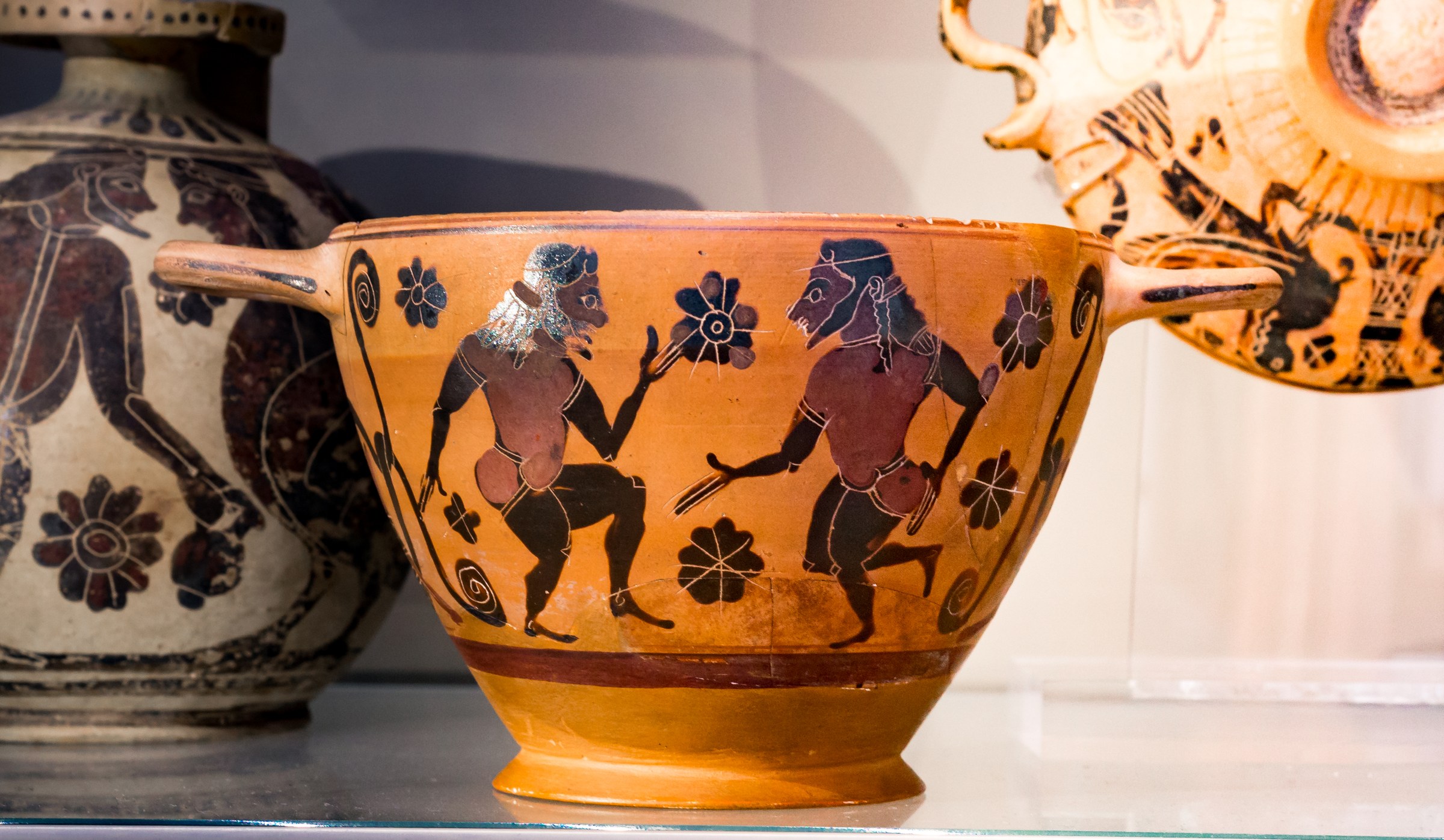
KX Painter - ABV 25 24 - padded dancers - Cambridge FWM GR-126-1892 - 01
ArchaiOptix
- Source:
- Wikimedia Commons
- Rights:
- Reusable with conditions: credit the creator; share any adaptation under the same license. Source record ↗
- Recorded as:
- cc by-sa 4.0
The komos is a precursor to Western theater and one of the few surviving images of Greek male social dance outside military or religious contexts; it shows dance as play, transgression, and intoxication rather than discipline or piety. For historians of performance, the padding and posture preserve rare detail about how komast bodies were shaped and moved—evidence that would otherwise be lost to text alone.
What you are looking at
A terracotta skyphos (drinking cup) painted in the Attic black-figure technique shows two bearded male dancers in a moment of energetic performance. Both wear padded costumes—the characteristic armor of komast dancers—and face each other in dynamic posture. Their bodies are rendered in the dark silhouette technique against the warm orange clay, with incised details marking musculature and costume seams. Between and around them bloom small geometric flowers, suggesting either a festive setting or a decorative rhythm that matches the movement. The composition is frontal and symmetrical, the dancers mirroring each other's energy across the vessel's surface. The cup itself is modest in scale (9.5 cm tall) and would have been held and passed during symposium gatherings where komoi—riotous processions of revelers—were performed.
The dancing
Both figures stand in a wide, grounded stance with bent knees and forward-leaning torsos, their padded bodies creating a squat, powerful silhouette. Their arms are raised and bent, suggesting active gesture rather than contact with each other. The thick padding of their costumes—visible as dark outlines against the silhouette—defines the komast body type: compressed, muscular, almost clownish in proportion. The incised lines within the black figures suggest individual anatomical detail; their bearded faces are shown in profile. The composition implies call-and-response or face-to-face engagement rather than synchronized movement or partnered hold.
The dance depicted
This depicts the komos, a Greek male revelry dance performed at symposia by groups of intoxicated men in costume and often in disguise. The komast dancers wore padded suits of this kind—exaggerated in girth and genitalia as a comic convention—and performed with acrobatic energy, often including elements of mimicry and obscene gesture. The image captures the vigor and body-focused spectacle of the form: not a courtly or military dance, but a carnival of appetite and disorder. This particular skyphos may have been used during the very kind of event it depicts, creating a recursive moment where the drinker held in their hands an image of the drinking-and-dancing culture they were participating in.
How it was made
This is a hand-thrown terracotta vessel painted in black-figure technique, a method dominant in Attic pottery of the archaic period. The artist incised fine lines into the black glaze to add anatomical and costume detail before firing; the orange-red clay was left exposed to form the background and the figures' warm outer edge. Black-figure technique required mastery of both brush and incising tool and produced vessels with considerable visual impact even at small scale. Skyphoi were functional drinking vessels made for symposia, meaning this image circulated among the drinking elite of Athens, reinforcing their cultural identity through the very object they used.
About this work
This is a small Athenian drinking cup from the early archaic period (ca. 580–570 BCE) decorated with a scene of komast dancers—revelers in padded costumes locked in the anarchic, body-focused dancing of the Greek male symposium. The Komast Group painter has captured the explosive energy of the komos through mirroring poses, exaggerated padding, and dynamic stance. The work is both documentary and participatory: it records a real cultural practice while serving as an object through which that practice was enacted. The komos was foundational to Greek male culture and would eventually be formalized into comedy and satyr drama, but on this cup it appears in its raw, symposial form—transgressive, comic, and carnivalesque. The vessel was likely made in Athens and found in Cyprus, suggesting the reach of Athenian ceramic trade and cultural influence across the Mediterranean.
How to look at it
Notice the padded bodies first: the artist has rendered the komast suit as a dark, bulbous shape that exaggerates the torso and genitals. This is not realistic anatomy but costume convention—a sign that these are performers in disguise, playing a role rather than showing their true selves. Then observe the stance: the bent knees and forward lean suggest explosive energy held in check, as if the figures are about to leap or thrust. The incised lines within the black add musculature and detail, proving the artist was skilled at anatomical work but chose exaggeration for comic effect. The small flowers scattered around them may be purely decorative, but they also suggest a moment of celebration, abundance, and disorder—a visual equivalent to the chaos of the komos itself.
The artist
The Komast Group was a collective of Athenian black-figure painters active in the early archaic period (ca. 600–550 BCE), identified by John Beazley's systematic study of signed and attributed vases. The group specialized in scenes of revelers, musicians, and symposium culture, documenting the aesthetics and social practices of their time. The KX Painter, responsible for this work, was one of the group's prolific members. Little is known of individual painters beyond their stylistic signatures and the vessels they decorated; their identity as independent artists or workshop members remains debated. The fact that they chose komast scenes repeatedly suggests either strong demand for such imagery or deep investment in recording male festive culture.
The period
In early archaic Athens (ca. 580–570 BCE), the komos was a vital institution of male peer bonding and social hierarchy. Participation marked adult male status; the costumes and obscene gestures were ritualized forms of transgression that reinforced group identity through shared breaking of ordinary rules. This was the era before democratic reforms and before tragedy and comedy became formalized theatrical genres; the komos was amateur, participatory, and embedded in the symposium rather than in public festivals. Visually, black-figure technique was at its height of technical refinement and popularity; by the next generation, red-figure technique would begin to supplant it, allowing finer line work and greater realism in depicting the body.
Where it lives
This skyphos is held by the Fitzwilliam Museum at the University of Cambridge (accession GR.126.1892, recorded as X.5 in their system). It was discovered during excavations at Tamassos in Cyprus, suggesting it was either made for trade with the eastern Mediterranean or valued enough to be carried there. The Fitzwilliam's vase collection is one of the finest in the world and is extensively documented in the Beazley Archive Pottery Database, the standard reference for Athenian black-figure and red-figure ceramics.
Questions about this work
What is a komos and who performed it?
The komos was a riotous procession or performance of dancing and singing by groups of adult men (usually 12 or more), often masked and in costume, during Greek symposia. Participants were elite males celebrating, courting, or honoring a host. The performance was transgressive by design—featuring obscene gesture, mimicry, and inversions of normal social order—and served as a pressure valve for male bonding and the expression of appetites and mockery that formal society otherwise suppressed.
Why are the dancers wearing padded costumes?
The padded suit (known as a kordax costume) exaggerated the dancer's body, particularly the genitals and belly, for comic effect and as a sign of theatrical disguise. The padding made the wearer unrecognizable and freed them to perform obscene and transgressive movements without direct social consequence. The suit was thus a technology of anonymity and permission.
What does black-figure technique mean?
Black-figure is a method of decorating clay vessels in which the figure is painted in black glaze, leaving the orange-red clay body as background. Fine details (hair, musculature, costume seams) are then incised with a sharp tool through the black glaze to expose the red clay beneath. This technique was labor-intensive and required steady hands, but produced images of high contrast and durability.
How do we know this cup was actually used for drinking?
Skyphoi were functional drinking vessels with two handles and a wide, shallow bowl—the shape is perfect for holding and passing wine at a symposium. Wear patterns and residue traces on archaeological examples confirm use. The choice to decorate this particular skyphos with komast dancers suggests it was used in exactly the social context it depicts, creating a recursive culture where the image reinforced the practice.
Is this the only evidence for the komos?
No. The komos appears in Greek literature (Aristophanes, Xenophon) and in many other black-figure and red-figure vessels. However, images like this one preserve bodily details and spatial composition that texts cannot: the exact posture, the costume construction, the rhythm of mirroring poses. The komos eventually formalized into Greek comedy (komodia), which is documented in far greater detail.
More dance artwork





