49 works in this view — arrow keys or swipe to move between them.
Dance in Art
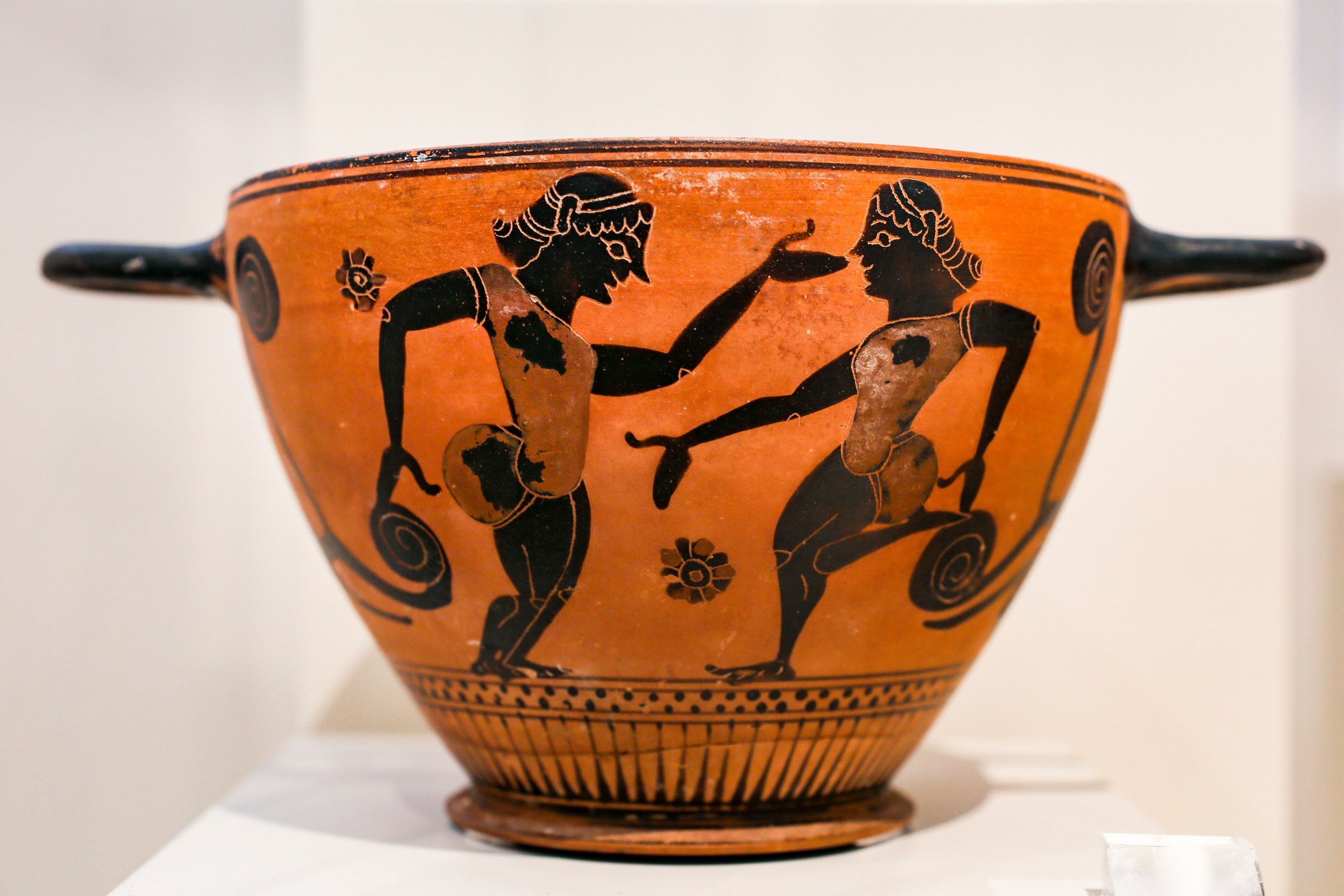
KY Painter - ABV 31 7 - padded dancers - Athens NM 1109
ArchaiOptix
- Source:
- Wikimedia Commons
- Rights:
- Reusable with conditions: credit the creator; share any adaptation under the same licence. Source record ↗
- Recorded as:
- cc by-sa 4.0
This is one of the clearest surviving images of komast dancing, a social and performative practice central to archaic Greek aristocratic life that would eventually evolve into theatrical comedy. It shows us not just what people wore and how they moved, but the values they attached to uninhibited bodily expression, humor, and festivity—values that shaped Greek culture. For historians of performance, this is primary evidence: a functional object that documents a living practice.
What you are looking at
A terracotta skyphos (drinking cup) painted in the black-figure technique shows two youthful male dancers in padded costumes facing each other in animated movement across the orange ground. Both wear the distinctive thick, bulbous padding that marks them as komasts—revelers in the aristocratic drinking parties of early archaic Athens. The figure on the left leans back with one leg extended, arms raised in an exuberant gesture; the figure on the right mirrors this energy, weight shifted, one arm reaching across his body. Between them floats a small decorative flower motif. The composition wraps around the bowl, with spiral ornaments at the sides and a geometric band of parallel lines circling the foot. A third figure—an aulos player—appears on the reverse (side B), accompanying the dancers. The gloss is lustrous black against the warm clay body, with fine incised lines defining the musculature, costume seams, and curled hair of both figures.
The dancing
The two dancers are rendered in the striding, off-balance poses characteristic of komast scenes: both have one leg sharply bent and one extended, creating a sense of dynamic forward and backward motion. Their upper bodies twist and reach; the gestures are uninhibited and celebratory rather than controlled. The heavy padding on torso and thighs is clearly articulated through the black silhouette, making the wearers appear squat and robust. Their proportions—short legs, exaggerated breadth—are deliberate, rendering the costume rather than the dancers' actual bodies. Both figures are bearded young men. The aulos player (on side B) stands in a more stable, frontal pose, piping while the dancers perform.
The dance depicted
This is a komast scene, depicting the ecstatic, often obscene dancing that occurred in the drinking parties (komasoi) of the Athenian aristocracy in the 6th century BCE. Komasts were young men—sometimes revelers at symposia, sometimes professional or hired performers—who danced in padded costumes, often grotesquely exaggerated, as part of comic and festive ritual. The padded belly and thighs were essential to the costume's humorous and phallic character. The aulos (double-piped wind instrument) was the standard accompaniment. What the image captures is not the technique of a trained dance form but the uninhibited physicality of improvised, wine-fueled revelry: the open-legged strides, the reaching arms, the twisted torsos all signal abandon rather than discipline. These dances were performed at private gatherings and later became codified in theatrical comedy (komedia), but here we see them in their symposial context.
How it was made
This is a ceramic vessel—a skyphos or drinking cup—decorated in the black-figure technique, in which figures are rendered as black silhouettes against the natural orange clay, with anatomical and costume details incised into the black gloss with a sharp instrument. This technique, dominant in Athens from circa 620 to 480 BCE, required the painter to plan the composition in reverse and execute it with precision; corrections were impossible. The skyphos was a functional drinking vessel used at symposia—the very gatherings depicted on it—making it both document and participant in the social world it represents. The durability of fired clay and gloss meant these images circulated and survived; they were affordable enough for regular use but fine enough to be valued.
About this work
This skyphos belongs to the Komast Group, a workshop of Athenian black-figure painters active in the early 6th century BCE, and was painted by the artist known as the KY Painter. It depicts the komasts—revelers in padded costumes—who performed dances at sympotic gatherings. The vessel itself is a drinking cup, meaning it was used in the very social context it illustrates. The image preserves not a formal, trained dance but the exuberant, improvised physicality of aristocratic festivity, a world that would later be mythologized and formalized in comic drama. This work is of major importance to understanding the visual culture of early Greek symposium and the roots of dramatic comedy.
How to look at it
Look at the arrested moment: the artist has frozen the dancers mid-stride, at the point of maximum extension and imbalance, capturing energy rather than a posed position. Notice how the padding makes the figure abstract and almost mask-like—we are seeing costume and role rather than individual bodies. The incised details—the curled beards, the seams of the padding, the anatomical lines—show the painter's attention to the texture and construction of the performance. The presence of the aulos player on the reverse reminds us that this was not silent dancing but a coordinated musical and corporeal event. Finally, consider the vessel itself: this was a drinking cup used at symposia, so the image would have been seen by the very social class who participated in komast performances, making it both a record and a form of celebration.
The artist
The KY Painter was a prolific workshop artist active in Athens circa 580–570 BCE, belonging to the Komast Group—a loose association of black-figure painters who specialized in symposial and komast scenes. These were not famous individuals in the modern sense; their names are modern reconstructions based on the Beazley Archive method of grouping hands by stylistic consistency. The Komast Group painters were responding to a vigorous market for decorated drinking vessels among the Athenian elite, and their repertoire—komasts, symposiasts, mythological revelers—reflects the clients' interests and the occasions on which the pots would be displayed and used.
The period
The early archaic period (c. 750–620 BCE) in Athens saw the rise of the symposium as a defining institution of aristocratic male identity and bonding. Drinking parties were ritualized gatherings where men reclined, drank wine mixed with water, and were entertained by music, poetry, and dancing. The komasts—exuberant, padded dancers—were a fixture of these events, their grotesque costumes and uninhibited movements offering comic relief and transgressive pleasure. In visual culture, the 6th century BCE saw the full development of the black-figure technique and a growing appetite for narrative scenes that documented daily and festive life. By the 5th century, komast dancing and imagery would be absorbed into the developing genre of theatrical comedy (komedia), but in this period it remained primarily a sympotic phenomenon.
Where it lives
This skyphos is held in the Athens National Archaeological Museum (inventory 1109, also catalogued as CC 632). It was documented and attributed by John D. Beazley in his foundational 1956 study Attic Black-Figure Vase-Painters, the standard reference for the period. The piece exemplifies the Komast Group's output and is one of the key sources for understanding early symposial dance imagery.
Questions about this work
What is a komast?
A komast was a reveler, typically a young aristocratic male, who danced at drinking parties (komasoi) in archaic and classical Greece. Komasts wore padded costumes that exaggerated the belly and thighs, often to comic or obscene effect. They danced to the aulos (pipes) and their performances were uninhibited, improvisational, and central to sympotic entertainment.
Why does the padding look so exaggerated?
The heavy, bulbous padding was deliberately grotesque and often had phallic associations. It was part of the comic, transgressive character of komast performance—not a realistic representation of the body, but a costume that invited laughter and created distance between the dancer's actual self and the role being performed.
Was this a professional dance form?
No. Komast dancing was part of aristocratic sympotic culture, performed at private drinking parties. While some komasts may have been hired professionals, the practice was fundamentally tied to the symposium as a social institution rather than to theatrical or trained dance traditions. It was improvisational and festive, not choreographed or formalized.
How do we know what this scene depicts?
The padded costume is the key identifier. The distinctive padding on the torso and legs is shown consistently in black-figure images of komast scenes from this period and is referenced in literary sources about sympotic practice. The presence of the aulos player further confirms this is a komast scene, since the pipes were the standard musical accompaniment.
More dance artwork





