49 works in this view — arrow keys or swipe to move between them.
Dance in Art
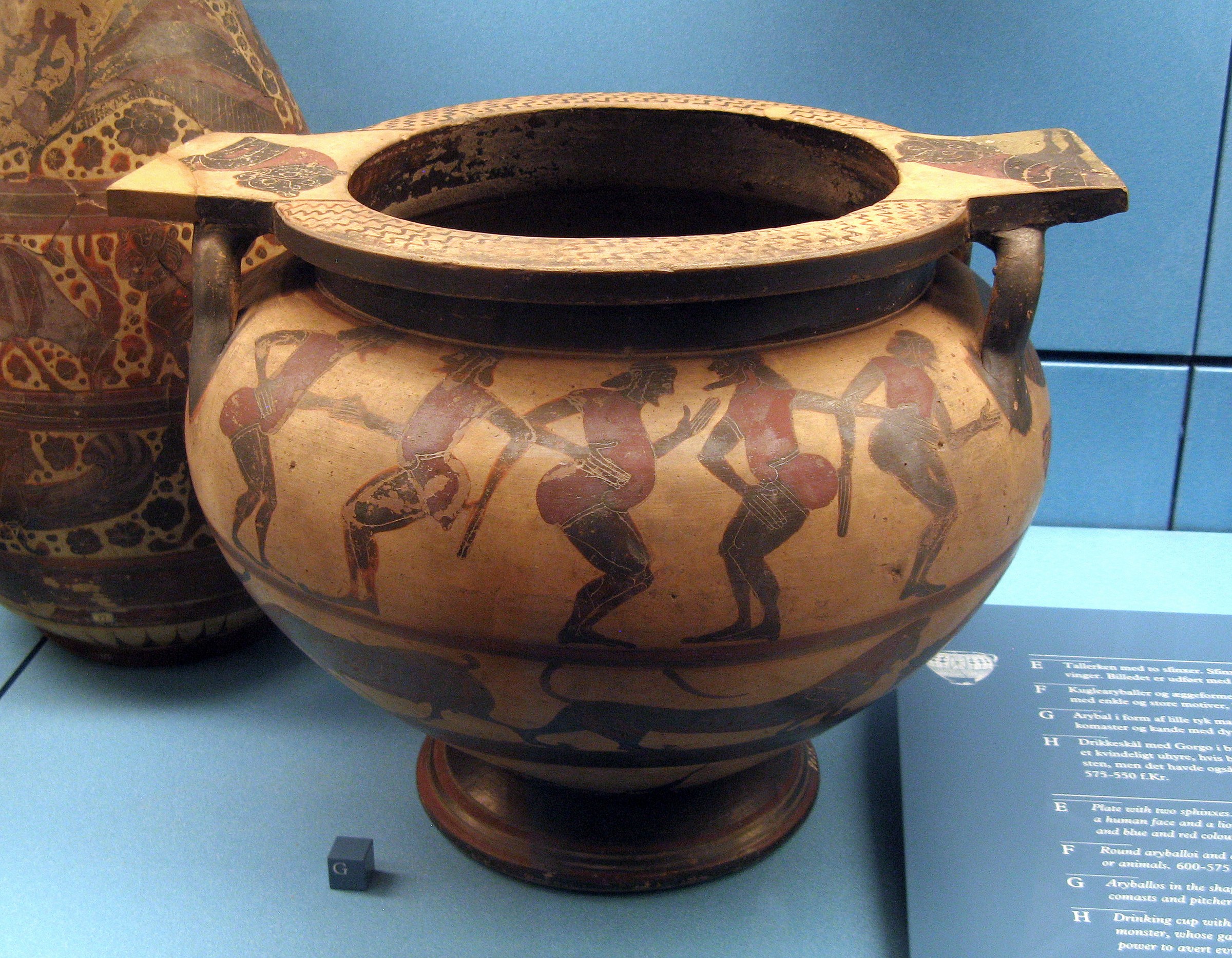
Corinthian krater with padded dancers (Copenhagen, Nat Mus 9075)
Mark Landon
- Source:
- Wikimedia Commons
- Rights:
- Reusable with conditions: credit the creator. Source record ↗
- Recorded as:
- cc by 4.0
This work is among the few surviving visual records of ancient Greek comic dance, preserving specific body positions and the social context in which such dance occurred. For historians of dance, it provides concrete evidence of posture, spacing, and apparent synchronization in a genre that left no choreographic notation and is known mainly through fragmentary ancient texts.
What you are looking at
A terracotta krater with a wide, open mouth and two horizontal handles displays a frieze of male figures in red-figure technique against the natural clay ground. The rim is decorated with a band of geometric patterns in dark glaze. Around the body, five nude or lightly dressed male figures are depicted in a continuous narrative scene. Each figure is rendered in profile or three-quarter view, with dark glaze defining musculature, facial features, and anatomical detail. The figures appear to be in vigorous motion, bent forward at the waist with legs in wide stances, suggesting active physical exertion. The interior of the vessel shows the characteristic black glaze of Corinthian pottery. The vessel sits on a pedestal base and retains the warm ochre and cream tonality typical of ancient Greek ceramic ware.
The dancing
Five male figures occupy the frieze, each depicted with pronounced forward flexion at the hips and knees in a squat or deeply bent posture. The bodies are anatomically detailed, showing defined abdominal musculature, and the legs are splayed in wide, stable stances. The arms appear to hang or gesture at the sides and front of the body. No figure touches another; each occupies its own space in the frieze. The consistent posture across all five figures suggests they are performing the same action in unison or sequence, rather than interacting.
The dance depicted
This appears to depict the kordax or some related form of comic male dance from ancient Greece, characterized by exaggerated flexion, low postures, and vigorous physical comedy. The repeated squat position with forward lean is consistent with ancient descriptions of the kordax, a satirical or burlesque dance performed by men, often in dramatic contexts or symposia. The nudity or minimal dress, the anatomical emphasis, and the comic exaggeration are hallmarks of this genre. The vessel's form—a large krater used for mixing wine at symposia—reinforces the context of social drinking and entertainment where such dances occurred.
How it was made
This is a ceramic vessel executed in the red-figure technique, where dark glaze is applied to leave figures in the red clay color, with internal detail added by incision or dilute glaze lines. This technique, which replaced black-figure ware in the 6th century BCE, allowed for finer anatomical detail and more naturalistic rendering of musculature and movement. The krater form itself—large and ceremonial—was a high-status object used in elite symposia. The durability of fired clay meant such imagery could circulate widely and survive, making decorated pottery a primary historical source for understanding ancient Greek dance and entertainment.
About this work
This Corinthian krater documents a comic male dance form of ancient Greece, likely the kordax, through the red-figure technique that preserves anatomical detail and movement quality. The five identically posed figures bent in deep squats suggest a choreographed ensemble performing a satirical or burlesque routine. As a vessel designed for wine-mixing at elite male gatherings, it records both the dance itself and its social context—a form of entertainment integral to symposia culture. The image survives as one of the most direct visual records we have of how Greeks understood comic dance in the body and how they chose to commemorate it in their material culture.
How to look at it
The viewer should attend to the uniformity of posture across all five figures—the repeated deep squat with forward lean—which signals choreography or at least a shared movement vocabulary rather than random gesture. Notice the artist's anatomical emphasis: the musculature is rendered with care despite the comic exaggeration of the pose. The choice to show the figures in profile or three-quarter view maximizes the visibility of the body's flexion and the effort implied in the posture. The continuous frieze format, with figures arrayed around the vessel without interaction or variation, suggests this is documentation of a performance tradition.
The artist
The record attributes this work to Mark Landon with a date of 2014, which is implausible. The vessel itself is an ancient Greek ceramic of the 6th–5th century BCE. Mark Landon may be the photographer, publisher, or cataloguer responsible for the image on Wikimedia Commons rather than the artist who created the krater. The krater's actual artist remains unknown, as is typical for ancient Greek pottery.
The period
In the 6th and 5th centuries BCE, red-figure pottery flourished in Corinth and Athens, allowing artists to depict dance, athletics, and mythological narrative with unprecedented anatomical precision. Comic male dances like the kordax became increasingly popular in dramatic contexts, particularly in satyr plays and comedies. Decorated pottery of this period was not merely functional; it documented elite male leisure, symposium culture, and the performance traditions that entertained the Greek citizen body. The choice to depict the kordax on a krater suggests the dance held sufficient cultural significance and entertainment value to merit preservation in ceramic form.
Where it lives
The krater is held in the Copenhagen National Museum (accession 9075). The image appears in Wikimedia Commons, suggesting it is documented as a public-access object in the museum's collection. The vessel's original context and excavation history are not provided in the catalogue record available here.
Questions about this work
What is the kordax?
The kordax was a comic male dance of ancient Greece characterized by exaggerated hip and knee flexion, physical comedy, and often performed nude or in minimal costume. Ancient texts describe it as burlesque or satirical, and it appears in satyr plays and comedies. This krater provides one of the most direct visual records of the posture and ensemble structure of the kordax.
Why are all five figures in the same pose?
The repetition suggests either that the dance involved multiple performers executing the same move in unison, or that the artist chose to show a single canonical pose that defined the dance. In Greek red-figure pottery, repetition of this kind often signals choreography or a recognized performance vocabulary rather than naturalistic variation.
What was a krater used for?
A krater was a large ceramic vessel used to mix wine with water at symposia—formal drinking and entertainment gatherings of elite Greek men. Decorated kraters were high-status objects that documented the culture of these gatherings, including music, dance, and athletic display. The choice to depict a comic dance on a krater reinforces its role as entertainment in this social context.
More dance artwork





