49 works in this view — arrow keys or swipe to move between them.
Dance in Art
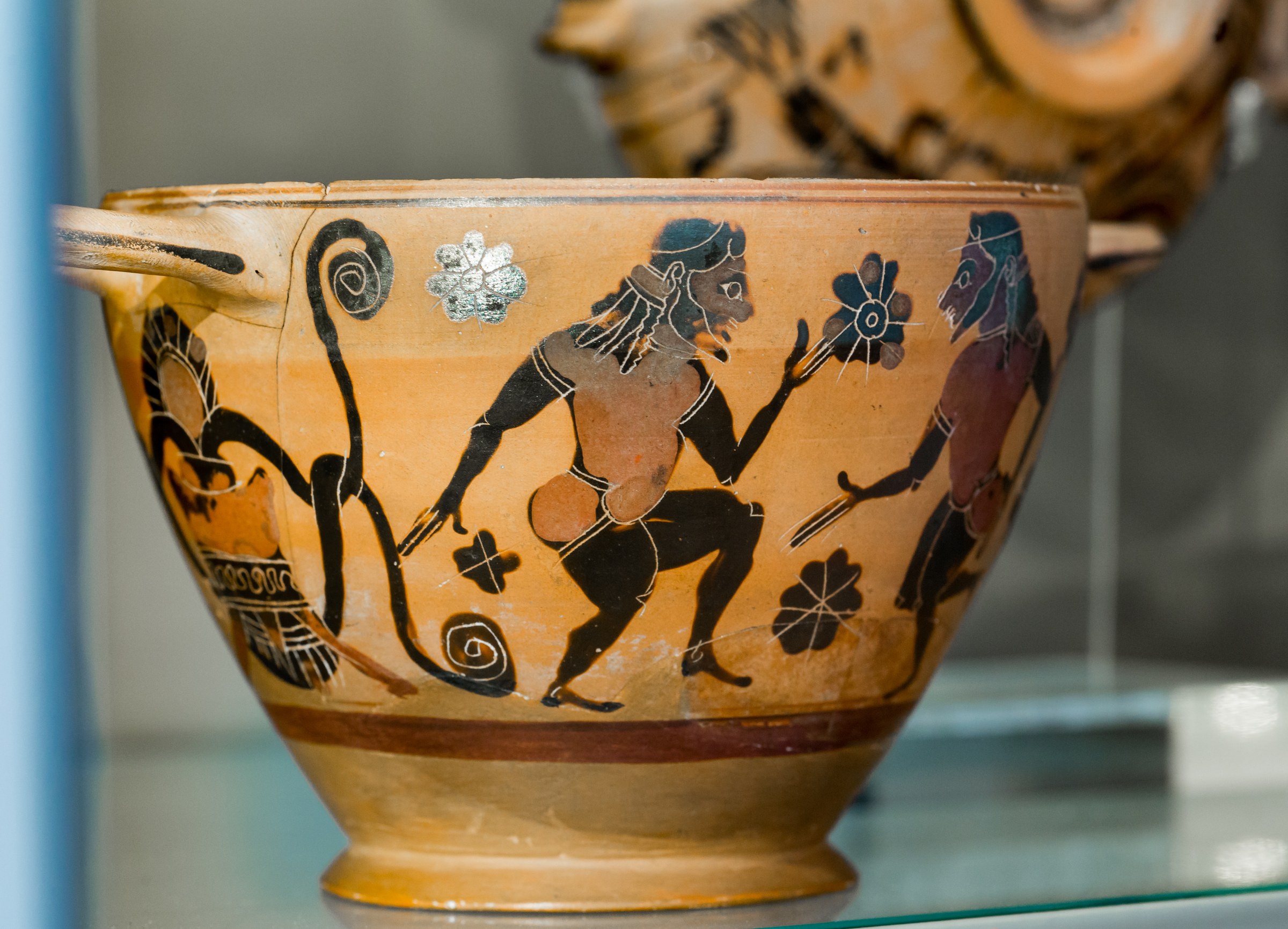
KX Painter - ABV 25 24 - padded dancers - Cambridge FWM GR-126-1892 - 03
ArchaiOptix
- Source:
- Wikimedia Commons
- Rights:
- Reusable with conditions: credit the creator; share any adaptation under the same license. Source record ↗
- Recorded as:
- cc by-sa 4.0
This is one of the earliest visual records of any dance tradition in the Western archive. The komos depicted here is not ballet, not courtly, not codified—it is ritual and carnival combined, and it shows that the history of Western dance includes exaggeration, grotesquerie, and transgressive physicality from its documented beginnings. The image is also direct evidence that performance traditions were sufficiently valued in ancient Athens that they were commemorated on vessels made for consumption in the most prestigious male gathering space, the symposium.
What you are looking at
A shallow terracotta drinking cup (skyphos) decorated in the black-figure technique shows a scene of ritualistic or comic dancers in padded costumes. The primary side depicts a central bearded male figure in a dark padded suit performing an exaggerated stance with bent knees and splayed legs; his upper body is bare or lightly clothed, and he gestures expressively with one arm raised. To his right stands a bearded companion in similar padded attire, also in an active pose. Between and around the figures are decorative floral elements—eight-petaled flowers and spiral motifs—rendered in the reserved orange clay against the black glaze. A third figure appears on the reverse side in comparable dress and posture. The figures' grotesque proportions, emphasized muscularity in the torso, and the padded leg coverings (phalloi or komastes' costumes) signal a comic or ritual performance tradition. The vase is small (9.5 cm tall) and would have been held during drinking, making the viewer an intimate witness to this scene of bodily exaggeration and theatrical movement.
The dancing
Both visible dancers occupy a wide, splayed stance with knees sharply bent and legs thrust apart—a posture of exaggerated physicality that reads as either comic excess or ritual intensity. The torsos are upright and the arms are positioned freely, one figure with his arm raised as if in song or proclamation. There is no formal frame or partner hold; the dancers occupy separate spatial zones within the composition. The padding on the legs and the emphasis on the genitalia (characteristic of komast imagery) indicate a performance vocabulary centered on bodily transgression and carnivalesque display rather than grace or formal technique.
The dance depicted
This is almost certainly a depiction of the komos or komast dance—a ritual or semi-ritual performance tradition of ancient Athens, typically associated with processions, symposia, and fertility rites. Komasts were often elderly, bearded men or youth in comic or grotesque dress, and the padded costumes shown here are the iconic markers of the form. The exaggerated stance and spatial freedom suggest a dance that emphasized individual virtuosity or comic business rather than synchronized partnering. The wine cup itself is a 'skyphos'—a drinking vessel used in the symposium, the all-male drinking party where such dances were performed. The artist has captured not refined movement but emphatic, bold gesture: the wide-legged stance and raised arm suggest shouting, singing, or declarations alongside movement. This was a democratic, participatory tradition, distinct from the formal court dances of later periods.
How it was made
This is an Attic black-figure vase, a technique in which figures are rendered in glossy black glaze against the reserved orange-red clay, with details incised into the glaze. The skyphos form—a shallow, two-handled drinking cup—was the standard vessel for the symposium. The black-figure technique was labor-intensive and required a skilled potter and painter working in tandem; the precision of the incised details (the spiral curls of the hair, the linear patterns on the costume) demonstrates practiced craftsmanship. This technique was dominant in Athens from roughly the 7th to the early 5th century BCE and was prized for export throughout the Mediterranean. The small scale and functional purpose of the skyphos meant that this image of the komos was directly encountered during the act of drinking—the dancer's exaggerated posture met the drinker's eye repeatedly.
About this work
This is a black-figure skyphos from early archaic Athens (circa 580–570 BCE), attributed to the KX Painter of the Komast Group. It documents the komos, a ritualistic or semi-ritual performance tradition that was central to Athenian male culture, particularly at the symposium. The figures in their padded costumes and exaggerated stances embody a dance tradition antithetical to the formalized ballet or court dance traditions of later European art. The work is valuable not as an aesthetic object but as archaeological evidence: it is among the earliest detailed records we have of how Greek bodies moved in ritual and festive contexts, and it shows that the Western tradition of dance performance included wild, grotesque, comic modes long before it codified grace.
The skyphos itself—a drinking vessel—is the medium through which this image circulated: it was handled, viewed, used, and broken. The Fitzwilliam Museum's example was found in Cyprus (Tamassos), indicating the reach of Athenian export pottery. As part of the Komast Group's output, it belongs to a specific workshop's documentation of a now-vanished performance tradition. For dance historians, it is irreplaceable; for art historians, it exemplifies the way Greek potters used narrative and figural decoration to encode social practice.
How to look at it
Attend to the legs and the stance: the wide, bent-knee, splayed posture is the signature of the komos, distinct from any other Greek dance form shown in vase painting. Notice how the painter has prioritized the lower body and the genitalia (shown via the padding and phalloi)—this is not an art tradition concerned with grace or the lifted line of later ballet, but with earthiness and transgression. The incised details in the black glaze show the artist's effort to define the costume: follow the spiral patterns and the linear marks that suggest armor, padding, or ritual dress. The placement of the figures on the shallow interior of the cup means that a drinker holding the vessel at eye level would see them at a slightly vertiginous angle, the dancers' wide stances seeming to loom. The floral motifs interspersed among the figures are not merely decorative; they were a convention in Athenian vase painting for marking sacred or ritual space, so the flowers may signal that the komos itself was understood as a sacred or liminal performance.
The artist
The KX Painter is an anonymous Athenian potter-painter active in the early archaic period, circa 580–570 BCE. He is identified by the connoisseurship of John D. Beazley, the foundational scholar of Attic black-figure pottery, and named (like many unidentified ancient artists) from a catalogue designation. The Komast Group, to which the KX Painter belonged, specialized in scenes of the komos and the symposium, and their work is a primary source for understanding male performance and ritual in archaic Athens. The painter's hand is recognizable in the treatment of the padded costume, the spiral incisions of the hair, and the characteristic proportions and gestures of the komasts. He worked within a collective workshop tradition, but the consistency of his style across multiple vessels suggests a distinctive artistic personality.
The period
The early archaic period (circa 580–570 BCE) was a moment of formal innovation in Greek pottery and also of consolidation in Athenian civic and ritual life. The black-figure technique itself was relatively new and was being rapidly refined; Athenian potters were beginning to dominate Mediterranean trade. This was also the period in which the symposium was becoming the primary venue for elite male social performance, music, and dance. The komos was both ancient (possibly derived from fertility rites or shamanic traditions) and contemporary—it continued to be performed throughout the classical period and beyond. The Komast Group's focus on this subject suggests both that the komos was a significant social marker and that Athenian workshops found the audience for such vessels among the very men who participated in these performances. In terms of wider dance history, this is pre-classical Greece, before the codification of choral dance in tragedy and comedy, before the formalized traditions documented by later writers like Lucian.
Where it lives
The skyphos is held in the Fitzwilliam Museum, Cambridge (accession GR.126.1892, also catalogued as X.5 in the museum's Greek pottery collection). It was discovered in Tamassos, Cyprus, indicating that it was exported from Athens in antiquity. The Fitzwilliam Museum permits photography of this object for educational and non-commercial purposes.
Dance in this work
Questions about this work
What is a skyphos and why does it matter that this is one?
A skyphos is a shallow, two-handled drinking cup used in the Greek symposium, the formal all-male drinking party where elite men gathered for conversation, performance, and ritual. The fact that the komos is depicted on a drinking vessel means that the image was directly integrated into the social practice it represents—the drinker saw the dancers while participating in the very context in which such performances occurred. This makes the vase a document of lived practice, not merely an artistic record.
What is the komos and is it the same as comedy (komodia)?
The komos is a ritualistic or festive performance tradition involving dance, music, and often grotesque costume and behavior. It is etymologically related to komodia (comedy), and the two traditions influenced each other, but they are not identical. The komos as shown on vases like this one appears to predate formal dramatic comedy and to draw on older fertility rites and symposial entertainment. It persisted as a distinct tradition throughout the classical period.
Why are the figures so grotesque and padded?
The padded costume, especially the exaggerated genitalia (phalloi), marks this as a comic or transgressive performance tradition. The padding also made the body appear larger and more imposing, emphasizing physicality and bodily presence. In ancient Greek performance contexts, grotesquerie and bodily transgression were ritual and comedic tools; they were not seen as opposed to 'serious' performance but as a distinct and valued mode of expression. The exaggeration is intentional and meaningful.
Who was the KX Painter and how do we know about archaic Greek painters?
The KX Painter is an anonymous artist identified through the connoisseurship of John D. Beazley, the 20th-century scholar who catalogued and named thousands of ancient Greek vase painters based on stylistic analysis. We know nothing about the painter's biography, only that his hand can be recognized across multiple vessels through consistent choices in composition, figure style, and decorative detail. This method, while imperfect, is the primary way we trace individual artistic identities in ancient pottery.
More dance artwork





