49 works in this view — arrow keys or swipe to move between them.
Dance in Art
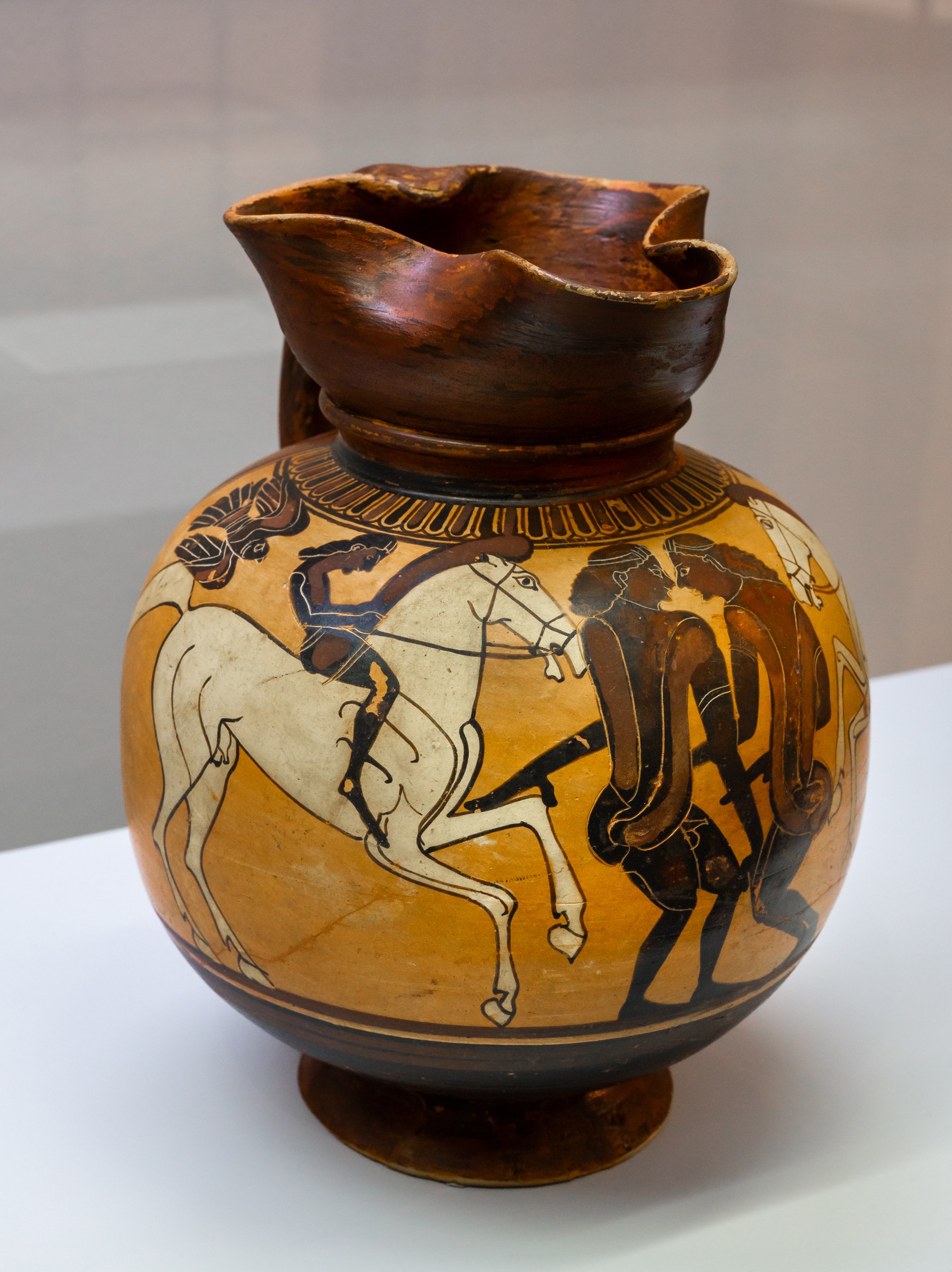
Late corinthian globular oinochoe - CVPAP extra - padded dancers between horsemen - München AS coll Schneider - 01
ArchaiOptix
- Source:
- Wikimedia Commons
- Rights:
- Reusable with conditions: credit the creator; share any adaptation under the same license. Source record ↗
- Recorded as:
- cc by-sa 4.0
Komastic dance is almost invisible in surviving Greek literature and is known chiefly through vase paintings like this one. A historian of ancient dance depends entirely on visual sources—the vase painter's choice of what to show, what to emphasize, what to leave out. This vessel's detailed rendering of the padded costume, the stance, and the social framing of the dancers is primary evidence for how Greeks understood and performed this form of entertainment. For a dancer today, the image raises urgent questions: How did the padding restrict or enable movement? What was the actual choreography? What was the emotional register—purely comic, or something more complex?
What you are looking at
A globular ceramic vessel with a trefoil (three-lobed) pouring mouth, decorated in the black-figure technique against a warm orange-red clay ground. The main frieze wraps around the body of the vase and depicts a procession of four human figures interspersed with two birds. At the center are two padded male dancers facing each other, their bodies rendered in the reserved clay color with black outlines. They wear thick, quilted costumes that create an exaggerated silhouette—particularly prominent around the torso and hips. Between and around them stand two younger men in short chiton-style dresses, rendered in black figure, who appear to be horsemen: each holds the reins of a horse (shown only as heads with bridles, the bodies extending beyond the frame). Two eagles with spread wings fly behind the horses. A decorative band of vertical striations runs around the shoulder of the vase, just below the trefoil mouth. The vessel sits on a low pedestal foot.
The dancing
The two central figures are unmistakably dancers. Their bodies are broad and heavily padded, especially across the belly and buttocks—a costume designed to exaggerate the dancer's mass and create a grotesque or comedic effect. They stand nearly upright but with knees slightly bent and weight distributed across a wide stance, giving an impression of stability and bulk. Their arms are rendered schematically (as thin black lines) and do not indicate a formal hold. The horsemen flanking them are thinner, younger figures in short dress, and while they do not themselves dance, they define the space: the dancers perform between mounted companions. This grouping—dancers framed by or in proximity to horsemen—suggests a staged or processional context rather than an intimate social dance.
The dance depicted
This vase depicts a scene of komastic dancing, a form of entertainment in ancient Greece in which padded male dancers performed at symposia and public celebrations. The heavily padded costumes (komai) are the defining marker of this tradition. The dancer figures shown here are rendered in a style typical of late Corinthian pottery (mid-6th century BCE): stiff posture, schematic anatomy, and thick quilting designed to read as ridiculous or absurd to the viewer. Komasts were often portrayed in comic or transgressive contexts—their padding both comical and phallic in implication. The presence of horsemen suggests either a procession or a scene mixing different social classes or roles. This is a record of a widespread but poorly documented form of popular entertainment.
How it was made
The work is a ceramic vessel in the black-figure technique, in which figures are rendered as silhouettes in black gloss against the natural clay ground. Details are incised through the black layer or left in reserve (reserved clay showing through as the figure color). This technique originated in Corinth in the 7th century and dominated Greek pottery export until the red-figure technique superseded it in the 5th century. The black-figure technique allowed for fine linear detail (visible here in the facial features, reins, and feather patterns of the eagles) while maintaining strong graphic read from a distance. The technique required skill in painting and firing; the black gloss was achieved through a three-phase kiln process. As a functional vessel (an oinochoe was used to pour wine), this decorated object would have circulated through trade networks and symposium contexts, making it both a practical tool and a prestige object that communicated aesthetic refinement and knowledge of fashionable imagery.
About this work
This late Corinthian oinochoe (wine jug) preserves a rare pictorial record of komastic dancing, a form of performance entertainment in ancient Greece that left little literary trace. The vase depicts two padded male dancers in exaggerated costume, flanked by young horsemen and watched over by eagles. The black-figure technique allows the artist to render the dancers' quilted bodysuits with precision, capturing both the visual spectacle and the grotesque humor of the form. The scene is not narrative but iconic: a snapshot of a recognized type of entertainment that would have been instantly legible to a symposium guest holding this vessel. The work belongs to the mid-6th century BCE, a period of intense ceramic production and export from Corinth, and testifies to the role of dance as a valued social practice worthy of commemoration on fine pottery.
How to look at it
Attend first to the silhouettes and the play of reserved (light) figure against black ground—the white clay of the dancers' padded bodies reads as the main visual event. Notice the thickness and distortion of their costumes: the padding extends horizontally from the body in a way that would have limited realistic movement but created a grotesque, phallic visual form. The posture is stiff and frontal; there is no indication of dynamic motion or athleticism. The composition frames the dancers symmetrically, with the horsemen and eagles anchoring them in a larger social scenario. Finally, observe the decorative band above: the vase painter has separated the figured scene from the geometric ornament, a convention of the period. The maker has chosen a moment of stasis (the dancers facing each other, ready or pausing) rather than a moment of rapid movement—a constraint of the medium and a choice about what deserves commemoration.
The artist
The vase is unattributed (the painter's name is lost). It was produced in Corinth, which remained a major pottery center in the 6th century BCE despite losing market dominance to Athenian workshops. The painter worked within a well-established convention for depicting komasts—a type that appears on dozens of surviving vessels from the same period and region. The consistent style, proportions, and iconography suggest a workshop tradition rather than individual innovation, though the quality of execution here (particularly the fine detail of the eagles and the careful rendering of the quilted costume) suggests a competent practitioner, likely trained in a recognized Corinthian pottery workshop.
The period
This vase dates to the late Corinthian I phase (ca. 550–540 BCE), a period of transition in Greek art and politics. Corinth was at this moment a mercantile power but was losing its grip on pottery export markets to Athens. The imagery of komastic dancers may reflect both the currency of this entertainment form and also its association with a slightly older, Archaic aesthetic—by the Classical period (5th century onwards), such imagery becomes rarer in major pottery centers, though the performance form itself persisted. The late 6th century was also a period of intense cultural exchange around the Mediterranean; Corinthian pottery was exported widely, meaning this vessel's imagery would have circulated and influenced how other Greeks understood entertainment forms. Socially, komastic entertainment was a feature of the elite male symposium, a context in which drinking, poetry, music, and dance were intertwined.
Where it lives
The vase is held in the Staatliche Antikensammlungen (State Antiquities Collection) in Munich, in the Eva-Maria & Berthold Schneider collection, a major private assemblage of Greek pottery now held in public trust. The object entered this collection in the modern era; its excavation history and earlier provenance are not recorded in the available catalogue information.
Questions about this work
What is a komast?
A komast was a padded male performer in ancient Greece, typically a slave or hired entertainer who danced at symposia (elite drinking parties) and public festivals. The heavily quilted costume (komai) exaggerated the dancer's belly and buttocks, creating a grotesque or comic effect. Komastic dance scenes appear frequently on 6th- and 5th-century Greek pottery and are thought to have involved crude, sexually explicit, or absurdist humor.
Why are the dancers so heavily padded?
The padding served multiple purposes: it created a visual spectacle and silhouette instantly recognizable to viewers; it made the performer's body appear grotesque or comic, inviting laughter; and it may have had an obscene, phallic dimension. The padding would have restricted natural movement, forcing the performer into an artificial gait that was itself part of the entertainment.
What do the horses and horsemen signify?
The presence of horsemen alongside the dancers suggests either a processional context (a parade or street performance) or a mixing of different social roles or entertainments within a single event. Horsemen often appear in Greek procession imagery as markers of civic or religious occasion, so their presence here may indicate a public festival rather than a private symposium.
How do we know what ancient Greek dance looked like?
Very little is known from written sources; most knowledge comes from vase paintings like this one, from sculpture, and from later Greek and Roman descriptions. The images show posture, costume, groupings, and sometimes instruments, but cannot convey rhythm, speed, or the full range of movement. Vase paintings thus offer an incomplete but precious visual record.
More dance artwork





