49 works in this view — arrow keys or swipe to move between them.
Dance in Art
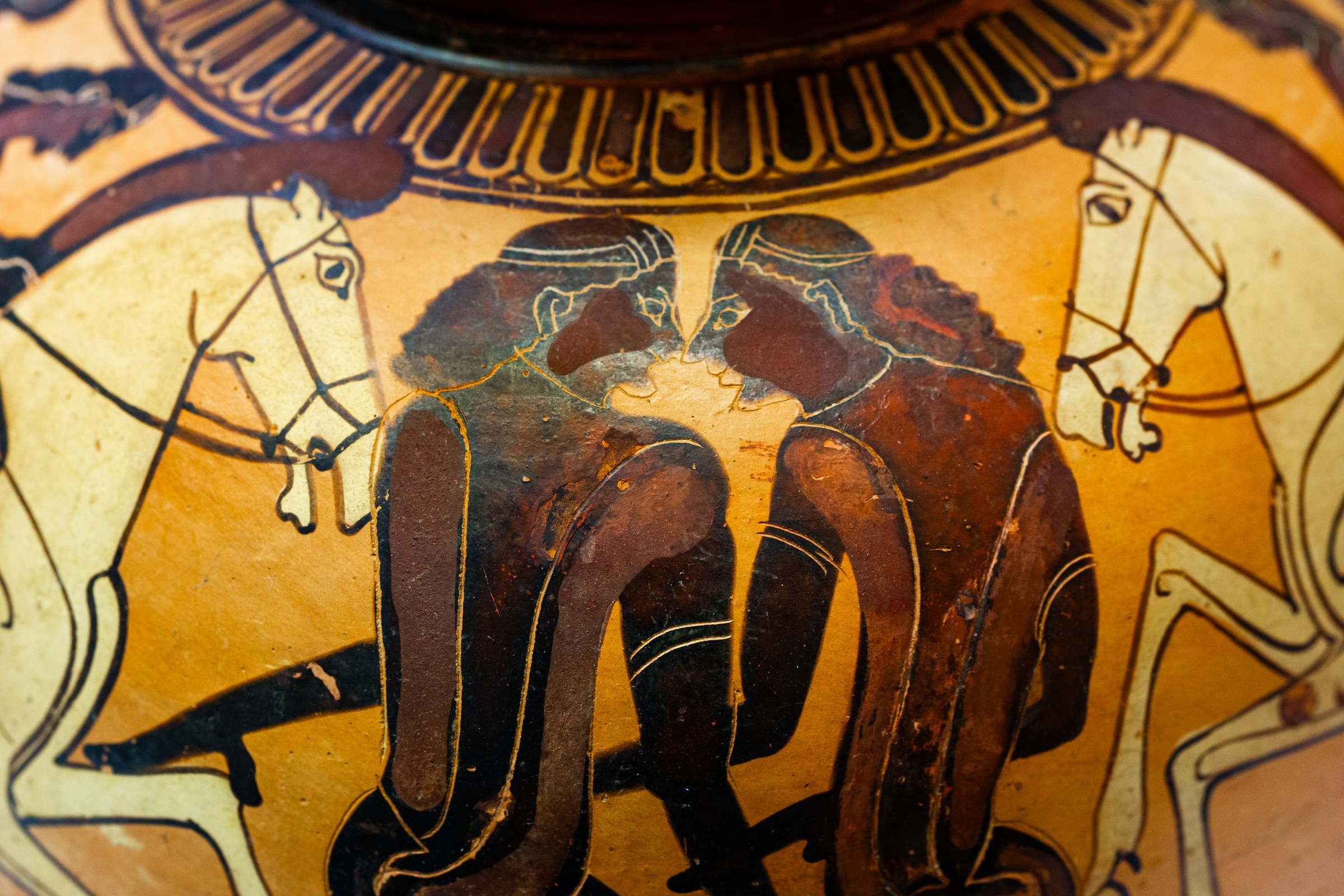
Late corinthian globular oinochoe - CVPAP extra - padded dancers between horsemen - München AS coll Schneider - 04
ArchaiOptix
- Source:
- Wikimedia Commons
- Rights:
- Reusable with conditions: credit the creator; share any adaptation under the same license. Source record ↗
- Recorded as:
- cc by-sa 4.0
This vase is direct visual evidence of Greek performance practice before the Classical period, showing a dance form (komastic entertainment) that is documented primarily through images and literary fragments. It demonstrates that Greek artists understood the komastic body as a distinct physical type, requiring specific costume and posture, and worthy of careful artistic representation. For dance historians, it offers rare visual data about movement quality, costume, and social context of a form that shaped later theatrical tradition.
What you are looking at
A terracotta oinochoe (wine jug) decorated in the black-figure technique shows a procession of revelers against an orange-red slip. At the center are two padded male dancers, their bodies rendered in dark gloss with careful incised detail. Both wear close-fitting caps and are nude except for thick padding around the torso and hips—the characteristic dress of komasts, or revelers in symposium entertainment. Their bodies lean forward in animated posture, suggesting active movement. On either side stand young horsemen in short chitons, holding the horses' reins. The horses themselves are rendered in the cream-colored slip of the ground, with fine black-line detail showing bridles and harnesses. Two eagles with spread wings appear in the upper register behind the horses, a heraldic element framing the scene. The composition is tightly organized around a central axis, with the padded dancers occupying the visual focus. The painting shows the precision typical of late Corinthian work: fine incised lines define musculature on the dancers' padded bodies, and the horses display the anatomical accuracy that Corinthian potters prized.
The dancing
The two central dancers are shown in mirror-image posture, their bodies weight-forward and slightly bent at the waist, arms positioned at their sides or slightly extended. Their padded bulk—the exaggerated stomach and hip protection—dominates the visual field and suggests vigorous, possibly acrobatic movement. The incised detail on their bodies indicates muscle definition beneath the padding. The flanking horsemen stand more formally upright, creating a stable frame for the dancers' kinetic energy. The overall composition emphasizes the contrast between the static, supported posture of the riders and the active forward lean of the performers.
The dance depicted
These are komasts—professional or semi-professional entertainers who performed at symposia (all-male drinking parties) in archaic Greece. The padded costume was iconic to the type, exaggerating the body for comic and acrobatic effect. The presence of horsemen framing the dancers suggests either a procession or a performative pairing of related entertainment forms. The forward-leaning posture and the way the padding bunches suggest energetic, possibly athletic movement—jumping, bending, or tumbling rather than the measured steps of a formal dance. The komastic tradition was popular in Corinth and celebrated in image as entertainment spectacle, not sacred or ritual dance.
How it was made
This is a ceramic vessel formed from clay and decorated using the black-figure technique, in which dark gloss (likely from iron oxide) is painted onto a lighter clay slip and fired in a kiln. The fine incised lines showing muscle and anatomical detail were added after the gloss dried but before firing, allowing the orange ground to show through. The technique required precision and speed—the painter worked on a curved surface with limited time before the slip dried. Black-figure was the dominant ceramic technique in Corinth during this period and allowed for detailed narrative imagery; it was eventually superseded by the red-figure technique that offered greater anatomical freedom.
About this work
This is a Greek vase of the late Archaic period, produced in Corinth around 550–540 BCE and decorated in the black-figure technique. It documents the komastic tradition—a form of theatrical entertainment performed for elite male audiences at symposia. The dancers' padded costumes and forward-leaning posture suggest acrobatic or vigorous movement performed as part of entertainment spectacle alongside other forms like horseback display. The work belongs to a substantial corpus of Corinthian pottery imagery documenting performance culture; such vases were themselves luxury goods used in the symposium context, serving both as functional vessels and as decoration celebrating the pleasures they contained. The quality of the painting and the care given to anatomical detail indicate this was a prestigious commission, likely created for a wealthy patron.
How to look at it
Observe the contrast between the static, upright posture of the horsemen and the forward-leaning, kinetically charged stance of the dancers. The padding is not incidental costume—it is the primary visual and physical marker of the komastic type. Look at the incised lines on the dancers' bodies: the artist has gone to trouble to show musculature beneath the padding, suggesting that athletic capability and bodily strength were valued aspects of the performance. The positioning of the eagles above and behind the horses adds heraldic weight to the scene, suggesting that this is a formal spectacle or procession, not an everyday entertainment. The tight compositional arrangement and the careful distribution of figures suggest the painter understood the komasts as a distinct and valued category of performer.
The artist
The painter is unattributed, but the work belongs to the late Corinthian black-figure tradition of the mid-sixth century BCE. Corinth was a major pottery production center and exporter; its painters were skilled in miniature narrative work and developed the black-figure technique to high sophistication. The precision of the incised detail and the compositional balance suggest a trained workshop hand, possibly working in a major Corinthian pottery atelier. The style is consistent with what scholars call the Corinthian black-figure phase, a period of technical mastery before red-figure dominance.
The period
The komastic tradition was part of archaic Greek symposium culture, a social institution centered on elite male drinking, entertainment, and intellectual exchange. By the mid-sixth century, when this vase was made, komastic performance was well established and celebrated in both pottery imagery and literary references (including Aristophanic comedy, which borrowed komastic elements). The archaic period saw increasing interest in narrative imagery on vases—moving beyond geometric abstraction to depict scenes of daily life, ritual, and entertainment. Corinthian potters were leaders in this shift, and the black-figure technique allowed them to show complex narrative scenes with fine detail. The vase documents a moment when Greek artists were developing visual conventions for representing performance and the performing body.
Where it lives
The vase is held in the Staatliche Antikensammlungen (Bavarian State Collection of Antiquities) in Munich, part of the Eva-Maria and Berthold Schneider collection, a major private holding of Greek ceramics now in public custody. It is documented in the 2025 publication *Schönheit und Funktionalität griechischer Vasen* (Beauty and Functionality of Greek Vases), the scholarly catalogue of the Schneider collection.
Questions about this work
What are komasts and why were they padded?
Komasts were entertainers who performed at Greek symposia (elite drinking parties). The padding exaggerated the body—creating an enlarged stomach and hips—for comic and acrobatic effect. It made the performer visually distinctive and emphasized the body as a site of entertainment spectacle. The costume allowed for a particular kind of movement and visual joke that was part of the appeal.
Is this vase showing a dance or something else?
It is showing performance entertainment that likely involved vigorous, possibly acrobatic movement, but not the formal, measured stepping associated with ritual or court dance. The komastic tradition was closer to modern circus or cabaret entertainment—physical display and comedy for an audience of wealthy men. It combined elements that might be called dance, acrobatics, and comedy.
Why are horsemen shown with the dancers?
The pairing suggests either a procession combining different entertainment forms, or a scene where equestrian display and komastic performance were understood as related spectacles. Both involve trained bodies, visual display, and entertainment for an elite male audience. The composition treats them as complementary rather than competing forms.
What does the black-figure technique tell us about this vase?
Black-figure was the dominant ceramic decoration technique in Corinth in the sixth century; it required precision and skilled hand control. The fine incised lines showing muscle and anatomical detail demonstrate this vase was made by a trained workshop painter, not a casual artisan. The technique was labor-intensive and the vases were luxury goods—this was made for a wealthy patron and was itself part of symposium display culture.
More dance artwork





