49 works in this view — arrow keys or swipe to move between them.
Dance in Art
Ángel María Cortellini Bullfighter's Farewell
Ángel María Cortellini
- Source:
- Wikimedia Commons
- Rights:
- Public domain — free to use, share and adapt.
- Recorded as:
- public_domain
While not a dance painting proper, this work is significant for its documentation of Spanish performance ritual and its place within the visual culture of Romantic Spain—a culture that deeply informed European artistic representation of Spanish dance and movement traditions. The painting exemplifies how bullfighting and other Spanish performance practices were aestheticized and circulated as subjects of fine art, a phenomenon that shaped how European audiences understood Spanish movement and physicality.
What you are looking at
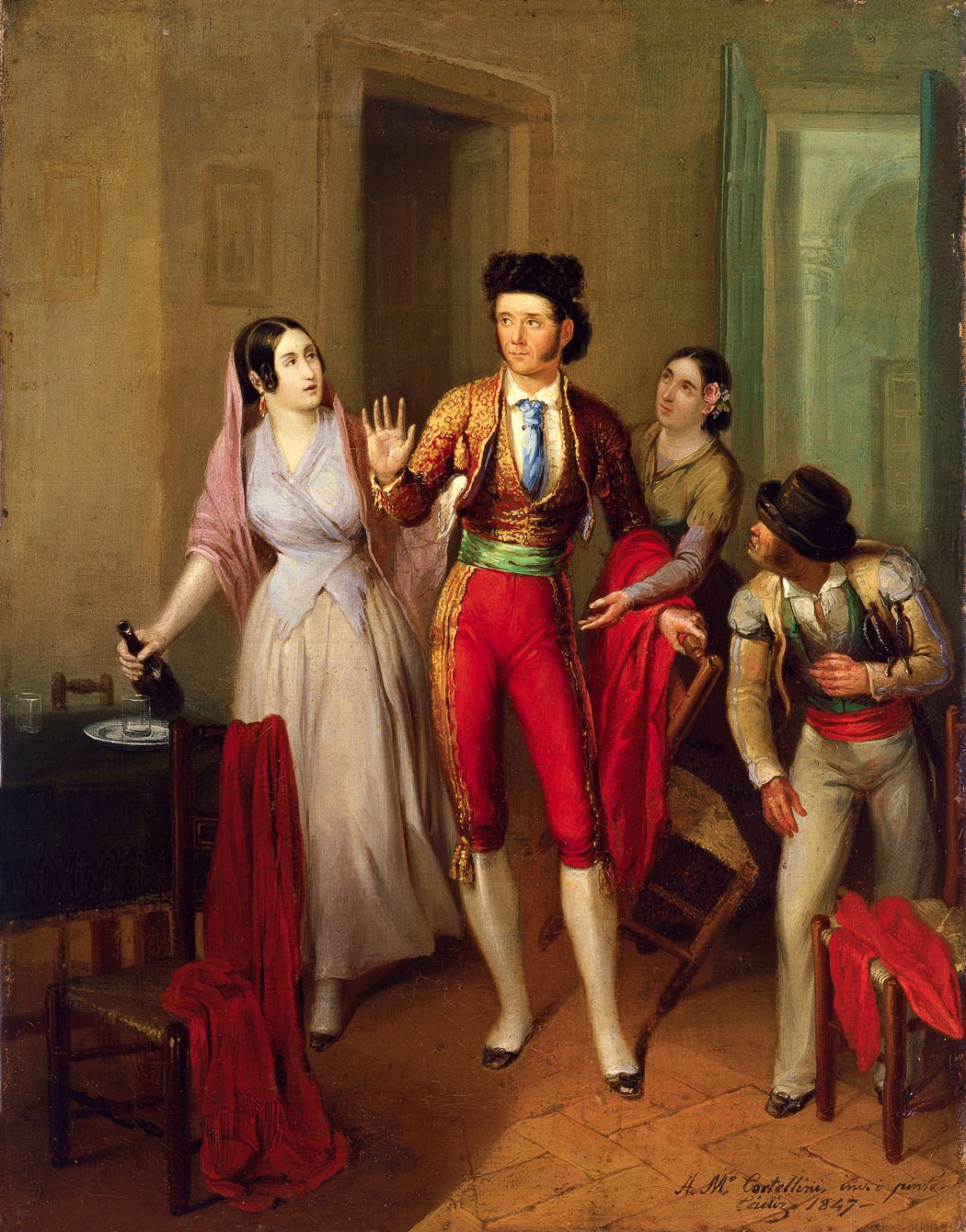
A man in splendid bullfighting dress stands at the center of an interior scene, his body angled in a gesture of farewell or benediction. He wears the traditional traje de luces—a short jacket of gold brocade over a blue shirt, red breeches, and white stockings—with his dark hair swept back dramatically. Around him stand three other figures: a woman in white muslin with a pink shawl to his left, a younger man in ochre to his right, and a small figure in tan breeches on the far right holding what appears to be the bullfighter's cape. Red fabric—likely the cape itself—drapes across chairs in the foreground. The setting is austere, with pale ochre walls, dark doorways, and sparse furnishings; the light is warm and intimate. The moment captures a private farewell before the bullfighter departs for the arena.
The dancing
The bullfighter occupies the visual and emotional center, his weight distributed evenly, his raised right hand open in a gesture of departure or salute. His posture is upright, almost formal. The woman to his left leans slightly toward him, her body angled in response; the other figures form a loosely grouped audience around this central figure. There is no physical contact between any of the figures—this is a moment of emotional proximity performed at a distance. The composition suggests a theatrical or ritualistic farewell rather than an interactive dance.
The dance depicted
This is not a depiction of dance in the conventional sense, but rather a scene of bullfighting ritual and farewell. However, the image carries the visual and gestural language of Spanish theatrical and social performance traditions—the formal posture, the emotional heightening, the draped fabric, and the audience arrangement are all elements that inflect Spanish visual culture including flamenco and other theatrical forms. The bullfighter's raised hand and the woman's responsive lean suggest a moment of theatrical intensity that borders on choreographic formality. This is more accurately a scene of social ritual and preparation than of dance itself.
How it was made
Oil on canvas, executed in the mid-nineteenth century with careful attention to the warm tonality of the interior and the contrast between the bullfighter's brilliant dress and the muted surroundings. The paint is applied with deliberate modeling of light across the figures' faces and fabrics; the interior space is rendered with subtle perspective and atmospheric tone. This technique—soft lighting, interior setting, psychological focus—was characteristic of academic Romantic painting and suggests circulation among educated Spanish collectors and museums rather than popular or commercial distribution.
About this work
This is a Spanish academic painting of ca. 1847 depicting Francisco Montes ('Paquiro'), a renowned matador, in a private moment of farewell before entering the bullring. The work documents not a dance but a highly ritualized Spanish performance culture and the figure of the torero as a subject of Romantic artistic attention. The painting belongs to a broader nineteenth-century tradition of depicting Spanish national life and performance—a tradition that overlapped with artistic interest in flamenco and other Spanish folk and theatrical forms. The work is held in the Carmen Thyssen Museum in Málaga, Spain.
How to look at it
Attend first to the bullfighter's gesture—the raised right hand and the formal posture that suggests both farewell and blessing. Notice how the other figures respond silently to this moment, their gazes and body angles organized around him. The red fabric in the foreground and the bullfighter's brilliant costume dominate the composition against the austere walls; this contrast between the spectacular and the quotidian is central to the painting's meaning. The moment captured is one of stillness and emotional intensity before action—a farewell that is almost ceremonial in its formality.
The artist
Ángel María Cortellini was a Spanish painter active in the mid-nineteenth century, working primarily in the Romantic academic tradition. He specialized in historical and genre scenes, particularly those depicting Spanish national life and notable historical figures. The inscription on this canvas—visible in the lower right—confirms his authorship and the date 1847. His work belongs to the broader movement of Romantic painting that elevated Spanish national subjects to the status of fine art.
The period
This painting was made in 1847, during the Romantic era in European art, when Spanish subjects and Spanish performance culture held particular fascination for educated audiences. Bullfighting had become a subject of serious artistic attention, and the figure of the torero was celebrated as an embodiment of Spanish courage and national character. This was also a period of intense European artistic interest in flamenco and other Spanish folk practices, though the present work focuses on the bullfighting elite rather than folk traditions. The painting's intimate interior setting and psychological focus reflect Romantic priorities in depicting significant moments in the lives of notable figures.
Where it lives
The painting is held in the Carmen Thyssen Museum in Málaga, Spain (accession CTB.1995.136). It entered the collection as part of the Carmen Thyssen-Bornemisza collection, which was founded in the 1990s and opened to the public in Málaga in 2011. The work's presence in a Spanish museum dedicated to art history reflects its importance as a document of Spanish visual culture.
Questions about this work
Is this a dance painting?
Not strictly. It depicts a bullfighting farewell ritual rather than dance, but it belongs to the broader visual culture of Spanish performance and movement traditions that overlapped with flamenco and other theatrical forms. The formal gestures and ritualized arrangement of figures carry choreographic resonance even if the subject is not dance itself.
Who was Francisco Montes 'Paquiro'?
Francisco Montes was a celebrated Spanish matador of the nineteenth century, known for his innovations in bullfighting technique and his status as a cultural figure of national importance. His fame was such that he became a subject for fine artists like Cortellini.
What is the red fabric in the foreground?
It is the bullfighter's cape (likely the muleta, the small cape used in the final stages of the fight), which is about to be carried to the arena. Its presence emphasizes the imminence of the bullfight and grounds the farewell in practical preparation.
Why is this moment significant?
The painting documents a moment of Spanish cultural ritual at a time when European artists and audiences were intensely interested in Spanish performance and national character. It exemplifies how Romantic artists elevated Spanish subjects to high art and how bullfighting was understood as a form of aesthetic and moral performance.
More dance artwork





