49 works in this view — arrow keys or swipe to move between them.
Dance in Art
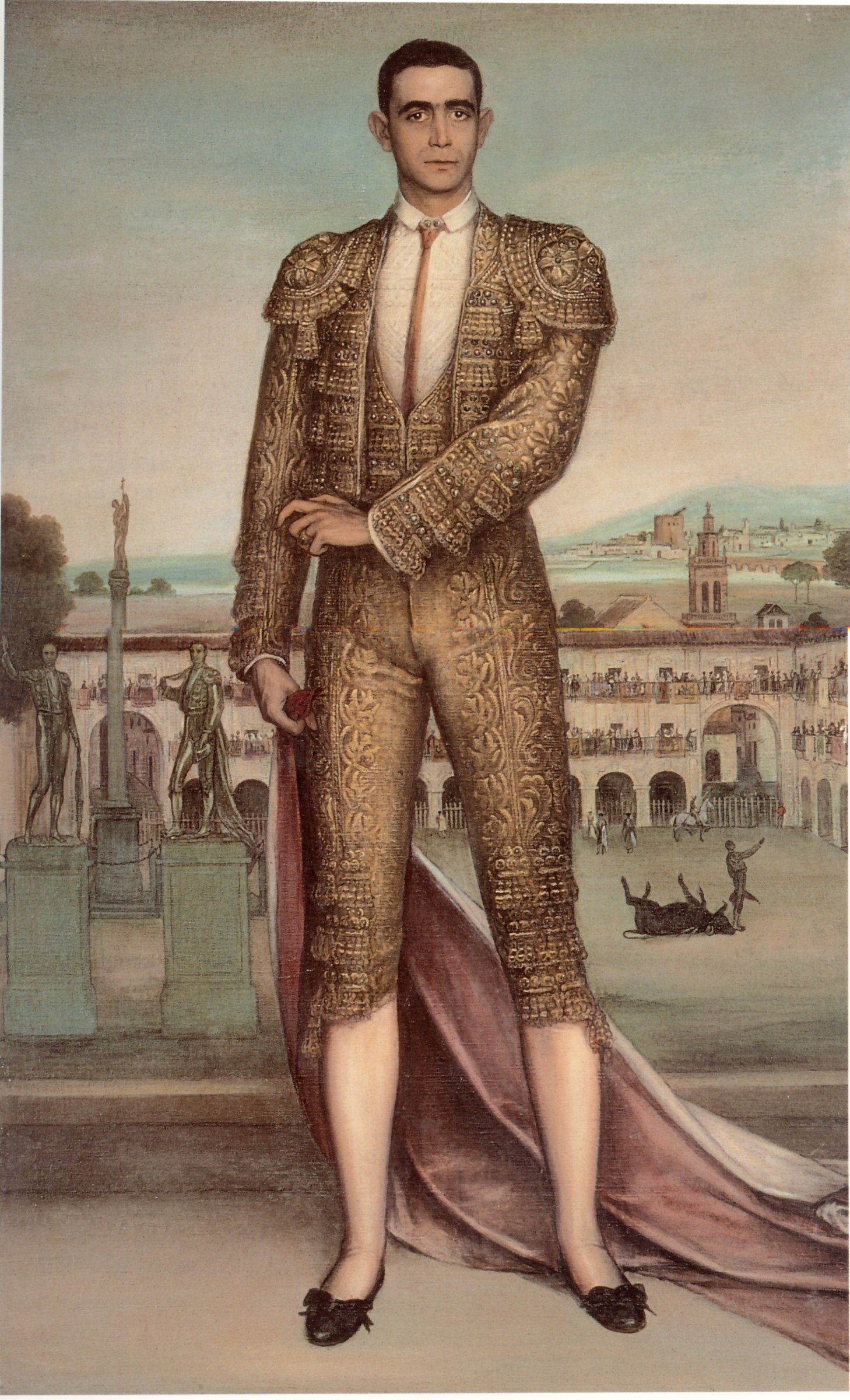
Spanish: «Machaquito» o «Machaquito como apoteosis del toreo Cordobés»Machaquito como apoteosis del toreo cordobéstitle QS:P1476,es:"«Machaquito» o «Machaquito como apoteosis del toreo Cordobés»"label QS:Les,"«Machaquito» o «Machaquito como apoteosis del toreo Cordobés»"
Julio Romero de Torres
- Source:
- Wikimedia Commons
- Rights:
- Public domain — free to use, share and adapt.
- Recorded as:
- public_domain
For those studying how artists of the early 20th century visualized physical performance and masculine heroism, this image is essential—it shows how the vocabulary of classical sculpture and apotheosis was applied to a living performer of the people. The suit of lights, the arena setting, and the monumental pose offer insight into how Spanish performance—whether bullfighting or dance—was constructed and celebrated as spectacle.
What you are looking at
A life-size male figure stands alone in a vast arena or bullring, dominating the composition. He wears an extravagantly embroidered suit of lights (traje de luces) in gold and cream with intricate geometric and floral patterns covering jacket, vest, and tight breeches that end above the knee. A burgundy cape trails behind him, pinned or held at the waist. His posture is frontal and monumental—one arm relaxed at his side, the other across his body—with the bearing of a triumphant performer. The setting is a Spanish plaza de toros rendered in soft atmospheric perspective: a multi-story bullring with arched galleries fills the background, populated with tiny spectators. The foreground shows the sand of the arena floor. Classical statuary and architectural elements frame the figure on the left. The light is diffuse and golden, suggesting late afternoon. This is a portrait of apotheosis—the figure commands the entire scene, diminishing the crowd and space around him into supporting elements of his glory.
The dancing
The torero is shown in a moment of stillness rather than active movement, standing with weight evenly distributed and body fully frontal. His posture conveys authority and rest after exertion, not the dynamic tension of combat. The slight positioning of the legs and the way the weight sits suggest ease and confidence rather than any active dance position. His arms hang naturally, without the tension or precision of a choreographed pose. This is a portrait stance of a celebrated performer in his costume, not a documentation of movement.
The dance depicted
This is not a depiction of dance but of bullfighting (toreo)—specifically, a portrait of Rafael González Madrid, known as Machaquito, a legendary Córdoba torero of the early 20th century. However, bullfighting shares with dance a vocabulary of bodily control, rhythm, positioning, and costuming. The torero's movements in the ring—the precise footwork, the sculptural poses, the relationship between body and cape—are balletic in character, and the suit of lights itself (the embroidered costume visible here) is performance dress of the highest formality. The image commemorates not a particular moment of combat but the fame and status of the performer, rendered as a kind of apotheosis.
How it was made
This is a color lithograph or chromolithograph, a technique that allowed rich, layered color and fine detail in reproduction, making it suited to commemorative portraits and wide circulation. The softness of the image—the atmospheric perspective, the subtle modeling of light and shadow—is characteristic of early 20th-century color lithography. The monumental scale of the figure and the architectural framing suggest this was intended as a popular print, celebrating a public hero in a format accessible to many. The technique's facility with gold tones and intricate patterns is fully exploited in rendering the embroidered suit of lights.
About this work
This is Julio Romero de Torres's portrait of Machaquito, the celebrated Córdoba torero, rendered as a monument to his fame. The painting transforms a performer into a classical statue, isolating him in an arena that belongs to him absolutely. Though bullfighting is not dance, it shares with dance a long history of bodily training, costume, and public performance. Romero de Torres, a prominent Spanish painter of the early 20th century, was fascinated by Spanish culture and performance—he painted bullfighters, flamenco dancers, and Gypsy subjects with equal intensity. This work sits at the intersection of portraiture, history painting, and the celebration of a living legend at the height of Spanish popular culture.
How to look at it
Attend to how the artist has centered and isolated the figure—the torero could be a classical hero or god, placed in an arena but not shown in action. The suit of lights is rendered with extraordinary detail and pattern, drawing the eye to the costume as much as the body. Notice the contrast between the meticulous foreground figure and the soft, almost dissolved background, which places the torero outside ordinary space and time. The cape trailing behind him adds drama and movement to what is otherwise a still, frontal pose. The tiny spectators in the arena galleries reinforce his solitary monumentality—he has transcended the crowd that created his fame.
The artist
Julio Romero de Torres (1874–1930) was one of the most prominent Spanish painters of his era, known for his evocative, sometimes melancholic paintings of Spanish life and character. Born in Córdoba, he was drawn repeatedly to the themes of bullfighting, flamenco, and Gypsy culture. He served as director of the Museo de Bellas Artes in Córdoba and enjoyed considerable official success and patronage. His work bridged academicism and modernism, combining classical composition and careful finish with symbolist and romantic subject matter. He was deeply invested in capturing and elevating Spanish popular culture—performers, types, and moments—as subjects of high art.
The period
This work was made in 1911, at the height of both Machaquito's fame and a broader moment of Spanish cultural nationalism. The early 20th century saw Spanish artists and intellectuals engaged in defining and celebrating what was 'essentially Spanish'—flamenco, bullfighting, the Gypsy, the landscape. Simultaneously, the suit of lights had evolved into its most elaborate form, and bullfighting was being documented, celebrated, and mythologized in visual culture. This was also the period when Orientalist and Hispanicist taste in European art was at its peak, and Spanish subjects held particular appeal to European audiences. In the art world, academic portraiture was being challenged by modernism, yet Romero de Torres found a way to make academic monumentality serve modern celebrity.
Where it lives
The work is recorded as held in Wikimedia Commons and is sourced from that repository. No accession number, collection, or current holding institution is stated in the available record.
Questions about this work
Was Machaquito a real person?
Yes. Rafael González Madrid, known as Machaquito (1880–1955), was one of the most celebrated bullfighters of the early 20th century, known for his technical mastery and style. He was from Córdoba, Spain. He died in poverty after a long retirement, a fate common among performers of his era.
Why is bullfighting relevant to a gallery of dance in art?
Bullfighting and dance share a long cultural history in Spain and Latin America, and both are forms of bodily performance requiring years of training, precise technique, and engagement with tradition and spectacle. Many early 20th-century artists, including Romero de Torres and later Pablo Picasso, treated bullfighting and dance as parallel forms of Spanish cultural expression.
What is a suit of lights?
A traje de luces (suit of lights) is the formal costume worn by a torero, composed of a heavily embroidered jacket, vest, and breeches, usually in gold, silver, or pastel colors with intricate patterns. It is one of the most elaborate and expensive performance costumes in the world, and each suit is custom-made and often personalized to the individual performer.
Why does this portrait look so formal and static?
This is a commemorative or apotheotic portrait—it is not meant to show Machaquito in action but rather to celebrate him as a timeless figure, a hero elevated above the moment. The monumentality, the classical frontal pose, and the arena rendered small around him all contribute to the effect of timelessness and transcendence.
More dance artwork





