49 works in this view — arrow keys or swipe to move between them.
Dance in Art
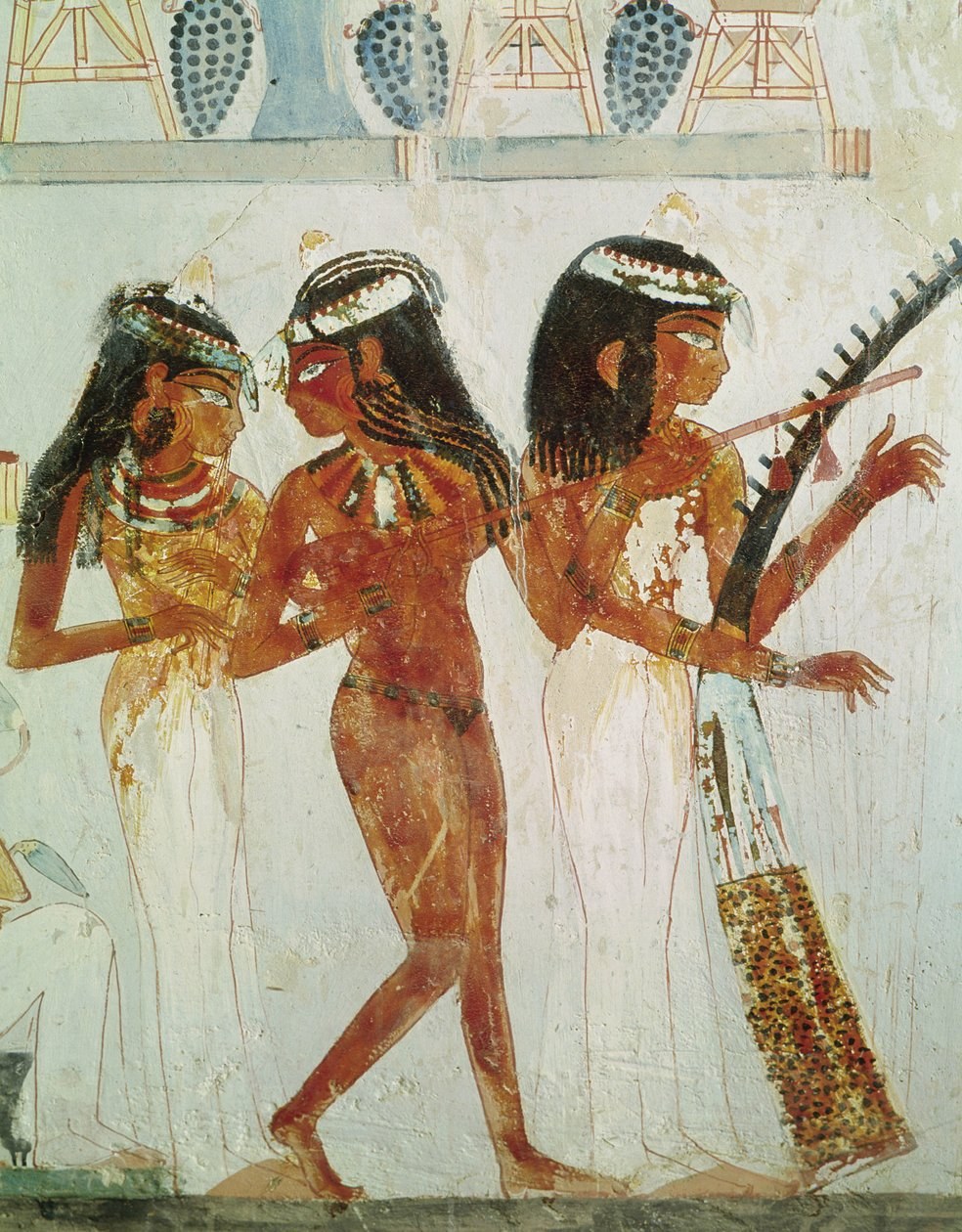
Egyptian 18th Dynasty - Musicians and a Dancer from the Tomb of Nakht New Kingdom
unknown painter, Egypt, 18th Dynasty , c. 1422-1411 BCE
- Source:
- Wikimedia Commons
- Rights:
- Public domain — free to use, share and adapt.
- Recorded as:
- public_domain
The image is one of the earliest and most reliable records of ancient Egyptian musical instruments in use and the courtly context in which performance took place. For dance historians, it documents the material culture and social positioning of performers in a non-Western civilization where movement, music, and ritual were inseparable, and it shows how the Egyptians themselves chose to commemorate these arts in their most permanent medium—the tomb wall.
What you are looking at
Three women stand in profile against a pale background, rendered in the distinctive style of New Kingdom Egyptian wall painting. They wear the elaborate dress of high-status figures: gold-patterned linen sheaths, broad collars of lapis-blue and gold beads, and jeweled pectoral ornaments. Each wears a dark wig styled in tight braids, crowned with a lotus flower or decorative fillet. The leftmost and central figures hold musical instruments—the woman on the left carries what appears to be a double pipe (aulos or zummâra), while the central figure holds a stringed instrument, possibly a lute. The rightmost woman gestures with an open hand, her posture suggesting movement or speech. Above them, a register depicts three large pear-shaped objects rendered in blue and green stippling—likely stylized date palms or vegetables in a garden setting, indicating this scene takes place in or adjoins a domestic or palatial space. The painting uses the Egyptian convention of profile view, hierarchical scale, and register composition; the figures are rendered with ochre and red pigments for skin, black for hair and outlines, and applied pigments for jewelry and ornament.
The dancing
The three figures stand in a line, each with a distinct posture. Their weight appears evenly distributed in a standing position typical of Egyptian representational convention rather than active dance movement. The leftmost figure's body faces left in strict profile, her arm raised to hold the double pipe. The central figure similarly faces left, one arm bent to hold her instrument. The rightmost figure's pose is more animated: she faces left but her right arm extends outward and upward in an open gesture, palm facing outward, while her left arm remains at her side. This rightmost gesture suggests either a moment of address, gesture in accompaniment to music, or the beginning of movement, though the overall stance remains grounded rather than in mid-motion.
The dance depicted
This is not a depiction of dance in the modern sense, but rather a representation of court musicians and an attendant figure, likely a singer or dancer-servant. The identification as dancers is uncertain. The two figures with instruments are clearly musicians (playing pipes and a stringed instrument), while the third may be a vocalist or a figure engaged in decorative or ceremonial movement. The rightmost figure's raised arm and open gesture are consistent with either singing, chanting, or the stylized gesture-language of Egyptian court ritual performance. Whether she is depicted as an active dancer or as performing a complementary role to the musicians cannot be determined from the posture alone. The scene likely documents the musical and performative entertainment of the elite household or funerary context (given the tomb attribution), where music, song, and graceful movement were interdependent arts.
How it was made
This is a fresco or tempera wall painting from an Egyptian tomb, executed on plaster using pigments applied to a prepared surface. The technique is evident from the flat, linear quality of the outlines, the limited color palette of natural pigments (ochres, lapis-lazuli blue, carbon black), and the distinctive Egyptian conventions of proportion and profile representation. The pigments have faded and the surface has suffered losses (visible as areas of white plaster and pigment flaking), consistent with the age of the work and conditions of tomb preservation. The technique allowed for narrative clarity and symbolic communication of status through color and ornament, rather than naturalistic rendering of movement or spatial depth.
About this work
This is a section of a New Kingdom Egyptian tomb wall depicting three high-status figures engaged in courtly performance: two musicians and a singer or attendant. The work documents the visual conventions of elite domestic and funerary entertainment in ancient Egypt, circa 1422–1411 BCE. The painting shows the standard Egyptian representational system—profile view, hierarchical composition, applied color—in service of commemorating the household retinue and the arts that graced the deceased's eternity. It belongs in a gallery of dance in art because it records how ancient Egyptian culture represented the performers, musicians, and attendant figures that constituted the performative life of the elite, even though the notation of movement itself is severely constrained by the conventions of the medium. The work is a primary document of how one civilization chose to preserve the image of its performers for eternity.
How to look at it
Attend to the details of dress and ornament: the specificity of the jewelry, the styling of the wigs, and the fine patterning on the linen garments all communicate high status and the occasion's formality. Note the instruments: the double pipes held by the left figure are a real historical artifact, and their representation here is one of our best records of their appearance and use. Observe the gesture of the rightmost figure—her raised arm and open palm are the Egyptian conventional gesture for singing or ritual utterance, and the artist has frozen a moment in which music and vocalization occur simultaneously, even though the bodies do not show the dynamic movement we associate with dance.
The artist
The artist is unknown, as is standard for Egyptian tomb paintings. The work was executed by a workshop or team of painters working in the established conventions of New Kingdom representational practice. These were professional craftspeople trained in proportion, color symbolism, and narrative hierarchy, working from templates and under the direction of a master painter. Individual artistic innovation within this system was limited, and attribution to a named artist is not possible.
The period
During the 18th Dynasty of the New Kingdom (c. 1550–1295 BCE), Egypt reached a peak of wealth and cultural refinement. Elite tombs were decorated with scenes of daily life, leisure, and courtly ceremony, intended to ensure the deceased's comfort and status in the afterlife. Music and dance were central to elite entertainment and religious ceremony. The period saw the development of sophisticated musical ensembles and the professionalization of court entertainers. In the visual arts, the New Kingdom refined the conventions of Egyptian representation—the profile view, the register system, and the symbolic use of color—that had been in place since the Old Kingdom. These conventions were not attempts at naturalism but rather a symbolic language designed to communicate identity, status, and the eternal nature of the commemorated figures.
Where it lives
The work is identified as coming from the Tomb of Nakht, a New Kingdom structure in the Theban necropolis. The catalogue record does not specify the current holding institution; the source is listed as Wikimedia Commons, suggesting the image is in the public domain or widely reproduced. Tomb paintings such as this were created as permanent decoration of burial chambers and were not intended for removal or trade.
Dance in this work
Questions about this work
What instruments are shown in the painting?
The leftmost figure holds a double-pipe (aulos or zummâra), a wind instrument with two parallel tubes. The central figure holds a stringed instrument, most likely a lute or harp. These are among the primary instruments of ancient Egyptian court music and are depicted here with sufficient detail to aid modern organological study.
Were these performers slaves or members of the household?
The wealthy dress and ornament of these figures—the gold collars, the jeweled pectorals, the finely pleated linen—indicate they were high-status members of the household, not enslaved performers. In ancient Egypt, court musicians and entertainers could occupy positions of respect and material comfort, though they were still subordinate to the tomb owner.
How do we know this is from a tomb?
The catalogue identifies it as from the Tomb of Nakht. Tomb paintings were a standard form of decoration in New Kingdom burials, and the subject matter—scenes of daily life, household entertainment, and service—was characteristic of funerary art intended to sustain the deceased in the afterlife.
Why are all the figures shown in profile?
Profile representation was a convention of Egyptian art, not an attempt at naturalism. It allowed the artist to show the most recognizable aspect of each figure and to maintain clarity in a register composition. The profile view was a symbolic language that communicated identity and status more effectively than perspective would have.
More dance artwork





