49 works in this view — arrow keys or swipe to move between them.
Dance in Art
Tomb Of Nebamun Painting 2
George Lodge
- Source:
- Wikimedia Commons
- Rights:
- Reusable with conditions: credit the creator. Source record ↗
- Recorded as:
- cc by 3.0
This work is instructive precisely because it is not a dance image, yet it represents the visual world from which actual Egyptian dance imagery emerges. For scholars and dancers studying ancient movement, learning to distinguish between the eternal, frontal, profile-view register and the comparatively rare images that do capture rhythm, gesture, and gathering is fundamental. The formal Egyptian figure type seen here—with its characteristic stance, costume, and compositional rules—appears in Egyptian dance scenes too, making this an essential visual reference.
What you are looking at
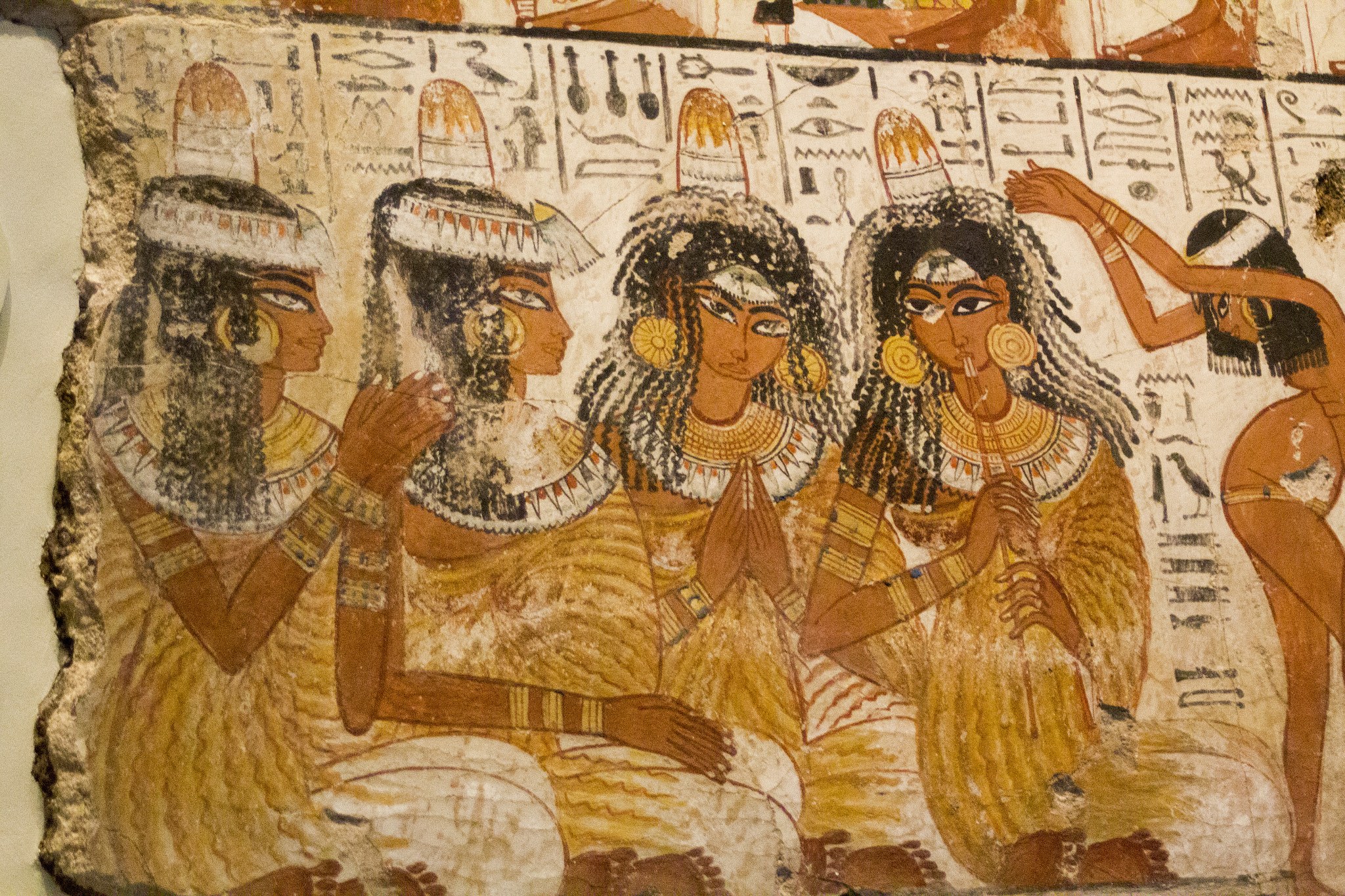
This is a fragment of an ancient Egyptian tomb wall painting, likely from the New Kingdom era (c. 1550–1070 BCE), depicting a formal scene of seated figures arranged in profile view as was the Egyptian convention. Four figures dominate the composition: two men on the left wearing pleated linen kilts and broad collars, followed by two women in pleated linen sheaths with elaborate broad collars and large circular gold earrings. All four figures wear the distinctive black wigs of ancient Egyptian high status, some adorned with gold circlets. The figures are rendered in the characteristic Egyptian palette of ochre-brown flesh tones, black outlines, and gold accents. Behind and above them runs a register of hieroglyphic text and symbolic imagery including cartouches, the Wadjet eye, and various ritual objects. The painting's surface shows age-related damage and loss, particularly on the left edge. The formal seated posture, the careful ordering by gender, the wealth of gold jewelry, and the hieroglyphic accompaniment all suggest a funerary or temple context of high ceremonial importance.
The dancing
All four figures sit upright in profile, their torsos frontal in the Egyptian composite view typical of tomb and temple decoration. Their legs extend parallel beneath them, feet placed flat and forward. The men's arms rest on their laps or at their sides; the women's arms are similarly composed. There is no active gesture or dynamic movement—the scene represents a formal, eternal posture rather than a moment of action. The figures maintain uniform scale and register, with no overlapping or spatial recession; they are presented as equal and simultaneous rather than interactive.
The dance depicted
This image does not depict dance. It is a formal funerary or temple scene showing high-status individuals in the seated, eternally posed manner characteristic of ancient Egyptian non-narrative religious art. The rigid profile view, the formal attire, the hieroglyphic context, and the complete stillness of the figures all indicate this is ceremonial or commemorative representation rather than documentation of movement or dance practice. While ancient Egypt certainly had ritual dances and celebratory movement, this particular image records static, timeless presence rather than any kinetic event.
How it was made
This appears to be a fragment of true fresco—pigment applied to wet plaster—a technique common in Egyptian tomb and temple decoration. The painting technique involved careful underdrawing in black outline, followed by application of pigments (ochres, blacks from carbon or magnetite, and gold leaf) into the plaster ground. The damage visible on the left edge, with loss of pigment and plaster, is characteristic of tomb wall decay over millennia. The precision of the line work, the deliberate color distinctions by social role, and the integration with hieroglyphic text show the work of a trained tomb-painting workshop.
About this work
This is a fragment of ancient Egyptian tomb wall decoration, likely from the New Kingdom period, showing four seated figures of high status in the formal, hieratic style that dominated Egyptian funerary art for over two millennia. The work exemplifies the Egyptian convention of presenting eternal, idealized presence rather than narrative action or transient moment. It is included here because understanding non-dance funerary art is essential context for recognizing actual dance imagery in ancient Egyptian sources—a distinction many viewers conflate. Dance did occur in Egyptian temples and tombs (in the Opet festival, in funerary rites, in celebration), but this particular register represents the timeless, formal realm of the deceased and the gods, not the embodied movement of the living.
How to look at it
Approach this as a statement about eternal status rather than as a narrative moment. The artist has arranged these four figures not as they were ever positioned in life, but in a formal, frontal, synchronized alignment that communicates social hierarchy and funerary permanence. Attend to the precision of the profile view, the uniformity of scale, and the careful use of gold to signal wealth and divine association. Notice how the hieroglyphic text above and around the figures makes them 'readable' to the ancient Egyptian viewer—name, title, relationship—in a way no body language alone could achieve. This is text-and-image unified in service of eternity.
The artist
This work comes from the anonymous tradition of Egyptian tomb painting, a practice spanning two millennia with standardized training, workshop organization, and stylistic conventions. Painters worked within strict hieratic rules governing proportion, color, and composition, applied across temples and tombs of the New Kingdom. No individual artist signature is recorded; the work represents the collective practice of a tomb-painting atelier, likely working under the supervision of a master draftsman. The precision and finish visible here suggest a high-status commission.
The period
Ancient Egypt's New Kingdom (c. 1550–1070 BCE) was the age of empire and elaborate funerary art. Tomb painting was not intended as visual record but as magical provision for the afterlife: the painted figures and objects were believed to become functionally real in the afterlife realm. The formal seated pose, the careful identification through hieroglyphic captions, and the eternal present tense of the image all reflect this theological purpose. While Egyptian wall painting ranged widely—including scenes of agriculture, hunting, feasting, and yes, music and dance—formal funerary portraits like this one maintained strict compositional rules across centuries.
Where it lives
The record attributes this work to George Lodge and dates it to 2017, identifying it as sourced from Wikimedia Commons. This suggests it is a modern photograph or facsimile of an ancient tomb fragment, not an ancient artwork. The original tomb or temple source is not specified in the available record.
Questions about this work
Is this a photograph of an actual ancient Egyptian tomb painting?
Almost certainly. The deterioration, the authentic Egyptian technique, the hieroglyphic text, and the New Kingdom style all indicate this is a photograph or documented image of a real tomb wall, not a modern recreation. The record lists George Lodge (2017) as the source, likely meaning the photographer or digitizer, not the original artist. The actual tomb location is not specified in the available data.
Were there dancers in ancient Egyptian tombs?
Yes. Ancient Egyptians performed ritual dances in temples (especially during festivals like the Opet celebration), in funerary rites, and in celebration. However, most tomb paintings preserved formal, static scenes like this one. Actual dance imagery appears less frequently in the surviving record, often in scenes of musicians and entertainment. The formal seated pose here—timeless and eternal—represents a different artistic register than movement imagery.
What do the hieroglyphs say?
The visible text is not fully legible in this image, but it typically identifies the seated figures by name and title, stating their eternal status and relationship to the deceased or deity. The cartouches visible in the upper register likely contain royal or divine names. A specialist in Middle Egyptian would need the full tomb record or better image resolution to translate the specific inscriptions.
Why are all the figures shown in profile?
The profile view was the standard Egyptian convention for depicting the human form in wall painting and relief, especially in funerary and temple contexts. It allowed the most complete and recognizable rendering of the body's features. The Egyptian artist combined profile body with a frontal eye and torso (the composite view), creating a timeless, iconic image rather than a naturalistic one. This convention persisted for over 2,000 years with remarkable consistency.
More dance artwork





