49 works in this view — arrow keys or swipe to move between them.
Dance in Art
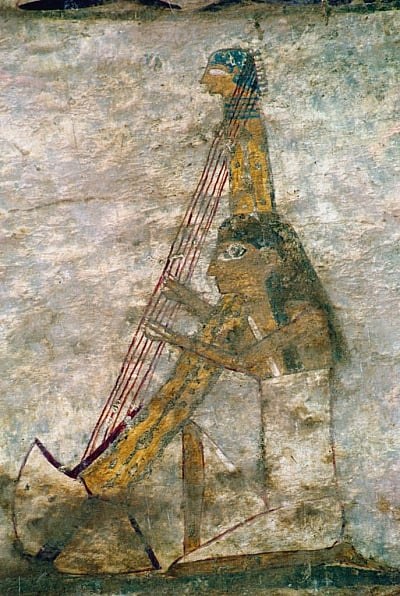
Woman playing an arched harp, detail from a tomb wall painting at Beni Hasan
Ancient Egyptian artist
- Source:
- Wikimedia Commons
- Rights:
- Public domain — free to use, share and adapt.
- Recorded as:
- public_domain
The Beni Hasan tomb paintings are the richest visual record we have of Middle Kingdom Egypt, including scenes of dance, acrobatics, wrestling, and music. This image of a harp player is evidence that women held recognized professional status as musicians in elite households, and it documents an instrument and playing technique that shaped the soundscape of ancient Egyptian performance.
What you are looking at
A figure seated or kneeling in profile faces left, playing a large arched harp with both hands. The harp is positioned vertically, its curved frame dominating the composition; the strings run from a resonance box at the base upward in a graceful arc. The player wears a long linen garment that appears translucent or pleated, characteristic of Middle Kingdom Egyptian dress, with a dark cap or wig. The background is a weathered limestone surface with traces of pigment—ochre, blue, and black—typical of tomb wall painting. The figure is depicted with the formal frontality and profile conventions of Egyptian art: the torso faces forward while the head, legs, and arms are shown in profile. The work is fragmentary, with significant losses to the surface that reveal the underlying plaster.
The dancing
The musician is stationary, seated or kneeling, with both arms raised and extended toward the harp strings. The right arm reaches upward to the upper strings while the left arm is positioned lower, suggesting active plucking or strumming of different registers of the instrument. The posture is formal and contained, typical of Egyptian representational conventions, with no suggestion of swaying or full-body movement. The precise hand position on individual strings cannot be discerned from the damage and age of the surface.
The dance depicted
This is not a depiction of dance but of musical performance—specifically harp-playing. However, in ancient Egyptian court and ceremonial contexts, music and dance were inseparable, and professional musicians often accompanied dancers. The arched harp was a high-status instrument played primarily by women in the Middle Kingdom; its presence in a tomb wall signals the deceased's participation in elite artistic and ceremonial life. The formal, static pose is typical of Egyptian funerary art, which privileged the clear identification of the deceased's profession and status over the capture of movement.
How it was made
This is a fresco or paint-on-limestone wall painting from an intact tomb at Beni Hasan, a necropolis in Middle Egypt. The pigments—earth ochres, Egyptian blue, and carbon black—were applied to prepared plaster and have survived millennia in the dry climate. The technique allowed for bold outlines in dark pigment and areas of flat color, creating a graphic clarity suited to tomb art's function as eternal representation rather than documentary realism. The fading and surface loss visible in the photograph are consistent with exposure and stone deterioration over 4,000 years.
About this work
This is a detail from a Middle Kingdom tomb painting at Beni Hasan, one of Egypt's most significant sites for the study of daily life and professional roles in the second millennium BCE. The image preserves a record of the arched harp, an instrument central to Egyptian elite culture, and shows a female musician in the formal, hieratic style mandated by funerary convention. While the pose is static and ceremonial rather than a snapshot of movement, the work documents the sophisticated musical culture that accompanied dance and ritual in ancient Egypt. It belongs in a dance history archive because music and dance were never separate in Egyptian practice, and because the tomb paintings of Beni Hasan are among our most detailed sources for understanding the performative arts of the ancient world.
How to look at it
Notice the formal conventions at work: the profile of the head and the legs, the frontal torso, and the careful symmetry of the pose, which communicate status and permanence rather than momentary action. The arched harp is rendered with anatomical precision—the player and instrument occupy complementary spaces in the composition, the curve of the harp echoing the curve of the player's extended arms. The damage to the surface is part of the work's history; what remains visible shows the artist's skill in suggesting the texture of linen and the weight of the instrument with minimal means.
The artist
Unknown. This is the work of a professional tomb-painting workshop active during the Middle Kingdom, probably the 12th Dynasty (c. 1985–1795 BCE). Egyptian tomb painters worked within strict iconographic and stylistic conventions and did not sign individual works; their identities are rarely recoverable. The quality of draftsmanship and the prestigious context (a tomb at a major necropolis) suggest a workshop of high skill.
The period
The Middle Kingdom (c. 2055–1650 BCE) was a period of cultural refinement and the flourishing of the arts in Egypt. Tomb painting reached a sophisticated level, with scenes documenting not only the deceased's journey to the afterlife but also the material and social world they inhabited. Music and dance were integral to court life, religious ceremony, and entertainment; depictions of musicians and dancers appear frequently in private tombs of officials and elite families. The arched harp itself was a relatively recent innovation in the Middle Kingdom, having been introduced during the 12th Dynasty, and became a marker of luxury and courtly sophistication.
Where it lives
This is a detail from a tomb wall at Beni Hasan, a necropolis in the Minya governorate of Middle Egypt, located about 250 km south of Cairo on the east bank of the Nile. The tomb paintings at Beni Hasan have been known to scholars since the 19th century and are among the most accessible and best-documented examples of Middle Kingdom art in situ.
Questions about this work
Was music and dance connected in ancient Egypt?
Yes, inseparably. Professional musicians performed at court celebrations, religious ceremonies, and funerary rites, and were almost always accompanied by dancers and acrobats. The tomb paintings at Beni Hasan include numerous scenes where musicians and dancers appear together, showing that they were part of the same performative tradition.
What was the arched harp and who played it?
The arched harp was a large, high-status stringed instrument that emerged in the Middle Kingdom. It was typically played by women in elite households and at court, and required significant skill. The instrument is recognizable in art by its distinctive curved frame and vertical string arrangement, which allowed players to pluck multiple octaves.
Why do Egyptian figures look stiff and formal?
Egyptian tomb art followed strict conventions designed to ensure the deceased's eternal survival and recognition in the afterlife. The frontality and profile views, the formal posture, and the hierarchical scale were not attempts at realism but at clarity and permanence. The style conveyed status, profession, and identity in a language understood across centuries.
More dance artwork





