49 works in this view — arrow keys or swipe to move between them.
Dance in Art
Dance outside a country innlabel QS:Lde,"Tanz vor einem Landgasthof"label QS:Len,"Dance outside a country inn"
Joaquín Domínguez Bécquer
- Source:
- Wikimedia Commons
- Rights:
- Public domain — free to use, share and adapt.
- Recorded as:
- public_domain
The painting is valuable for what it shows about 19th-century Spanish provincial life and the occasions on which community dance took place, even though it does not depict active dancing. For historians of Spanish folkways and costume, it documents the dress and ritual framing of a regional celebration. For scholars of how dance was represented in 19th-century art, it demonstrates the realist tradition's interest in social setting and context rather than in the performance moment itself.
What you are looking at
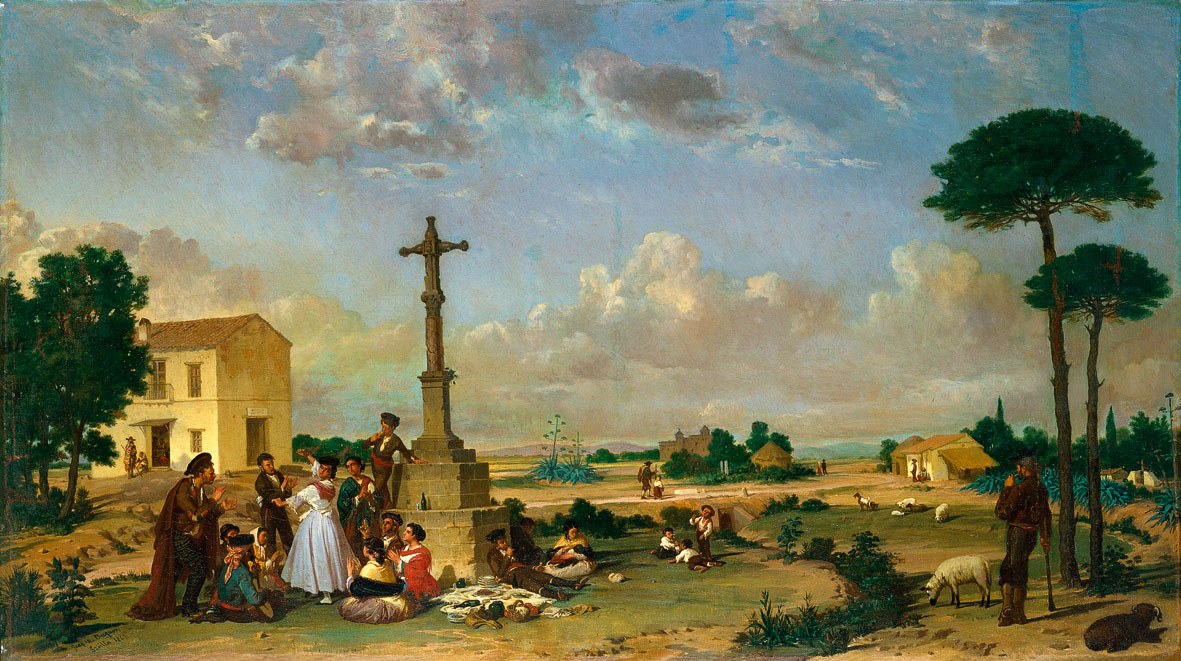
A large-scale narrative painting depicts a festive gathering in a rural Spanish landscape, centered on a stone wayside cross. A group of people in 19th-century dress clusters around the cross, with women in white dresses prominent among figures in darker clothing. To the left stands a substantial stone house with shuttered windows; to the right, tall pine trees frame the composition. The middle distance opens to an expansive plain with scattered buildings and a church spire, rendered in warm ochres and greens under a sky of billowing clouds. The foreground shows scattered figures—some seated, others standing—suggesting a fiesta or religious gathering. The light is warm and diffuse, typical of Iberian midday, and the whole scene carries the character of a documentary moment: people have stopped in this place, dressed in their best, for some significant occasion.
The dancing
The figures display a mix of standing and seated positions, with no unified dance formation visible. Those nearest the cross appear to be in conversation or observation rather than in coordinated movement. Women in long white or light-colored dresses stand among darker-clothed men and children. The overall posture is relaxed and social rather than choreographed; bodies are upright and dispersed, suggesting a gathering or procession pause rather than active dancing. No couple holds are evident, and there is no visible footwork pattern or synchronized movement among the assembled people.
The dance depicted
The title promises a dance scene, but the image depicts preparation for, or pause within, a religious or festive ceremony rather than active dancing. The figures are arranged as if waiting, socializing, or observing rather than performing. The stone cross and the gathering suggest a wayside shrine or outdoor religious observance—possibly a fiesta, pilgrimage stop, or local celebration in rural Spain—where dancing may be about to begin or has just concluded. The composition reads more as social documentation than dance representation, capturing the social fabric around the event rather than the dance itself.
How it was made
The painting is executed in oil on canvas with a naturalistic technique of moderate detail. The artist employs warm earth tones and a diffuse, realistic light treatment consistent with 19th-century academic landscape painting. The large scale and documentary character suggest this was intended for exhibition and public circulation. The technique allows for subtle gradations of dress, architecture, and atmosphere, supporting the work's function as a record of provincial Spanish life and custom. The finished, polished surface indicates professional salon practice rather than sketch or study.
About this work
This 1867 painting by Joaquín Domínguez Bécquer documents a moment in rural Spanish social life, centered on a wayside cross and a gathering of local people. Although titled as a dance scene, it functions primarily as ethnographic or folkloric observation—recording the dress, setting, and social arrangement of a provincial Spanish fiesta or religious gathering. The work sits at the intersection of Romantic interest in regional custom, mid-19th-century realist documentation, and the European academic tradition of historical genre scenes. It belongs in a gallery about dance because it captures the social and ceremonial context from which Spanish regional dance emerges, even though the dancing itself is implied rather than depicted.
How to look at it
The viewer should attend to the composition's framing of the social occasion: the prominent placement of the cross and the gathering around it, the attention to costume and individual figures, and the spacious landscape setting that situates this moment in a specific place. The artist has chosen a moment of pause or assembly rather than action, emphasizing the ceremonial and social context of the gathering over the dance itself. The painting's documentary tone—the careful rendering of architecture, dress, and weather—suggests the artist's interest in recording a specific kind of Spanish provincial custom and in making it legible to viewers unfamiliar with it. The sky and landscape are given as much weight as the figures, placing the human gathering within a natural and geographic context.
The artist
Joaquín Domínguez Bécquer (1817–1879) was a Spanish painter best known for his regionalist subjects and his attention to Spanish provincial life and landscape. He worked in the tradition of academic realism and genre painting, documenting Spanish customs, architecture, and social scenes with ethnographic interest. His work was exhibited in Madrid salons and reflects the 19th-century European taste for picturesque representations of regional and rural life, particularly in Spain. He was part of a generation of Spanish painters who treated folk custom and landscape as worthy subjects for large-scale exhibition painting.
The period
In the 1860s, Spanish painters were increasingly turning to regional subjects and folk life as material for serious historical and genre painting. This coincided with broader European Romantic and Realist currents that valorized peasant life, regional costume, and provincial custom as expressions of national character. At the same time, photography was beginning to challenge painting's documentary function, but large-scale painted records of social custom remained prestigious. Spanish regional dances—particularly flamenco and folk forms—were becoming objects of artistic interest and collection, though often as backdrop or setting rather than as formally analyzed movement. The painting reflects this moment when Spain's folk traditions were being framed for urban, educated audiences.
Where it lives
The work is known through Wikimedia Commons, where it is listed in the public domain. No museum accession, exhibition history, or current holding is recorded in the available catalogue data.
Questions about this work
Why is this called a dance painting if people aren't actively dancing?
The title may refer to the fiesta or celebration—the social occasion for which dancing is customary—rather than to a depiction of the dance itself. Spanish regional fiestas centered on crosses or shrines often included dancing as part of the celebration. The painting documents the setting and social assembly, capturing the context in which dance would occur, even if the moment shown is one of preparation or gathering rather than performance.
What is the stone cross and why is it the focus?
Wayside crosses were common in Spanish rural landscape and often marked shrines, pilgrimage sites, or village gathering places. The cross here anchors a religious or ceremonial gathering, suggesting this is not merely a secular fiesta but a religiously sanctioned community occasion. Its prominence in the composition emphasizes the role of Catholic practice in structuring Spanish provincial social life and celebration.
What does the painting tell us about 19th-century Spanish regional dress?
The women wear long white or light cotton dresses—modest, practical, and formal enough for a public gathering. The men are in dark coats and hats. Children accompany adults. The overall impression is one of modest prosperity and respectability: these are not wealthy urban figures, but nor are they impoverished. The dress suggests a community that has prepared itself for a significant occasion and considers the gathering important enough to warrant formal presentation.
Is this a specific place or a composite scene?
The painting is titled as a scene of a country inn (Gastgof), and the substantial stone building on the left may be meant to represent this. However, the prominent cross and religious character suggest a shrine or pilgrimage site as much as an inn. The artist may have combined elements—a real location, a typical Spanish provincial gathering, and a genre scene—to create a representative image of Spanish country life rather than a portrait of a specific moment or place.
More dance artwork





