49 works in this view — arrow keys or swipe to move between them.
Dance in Art
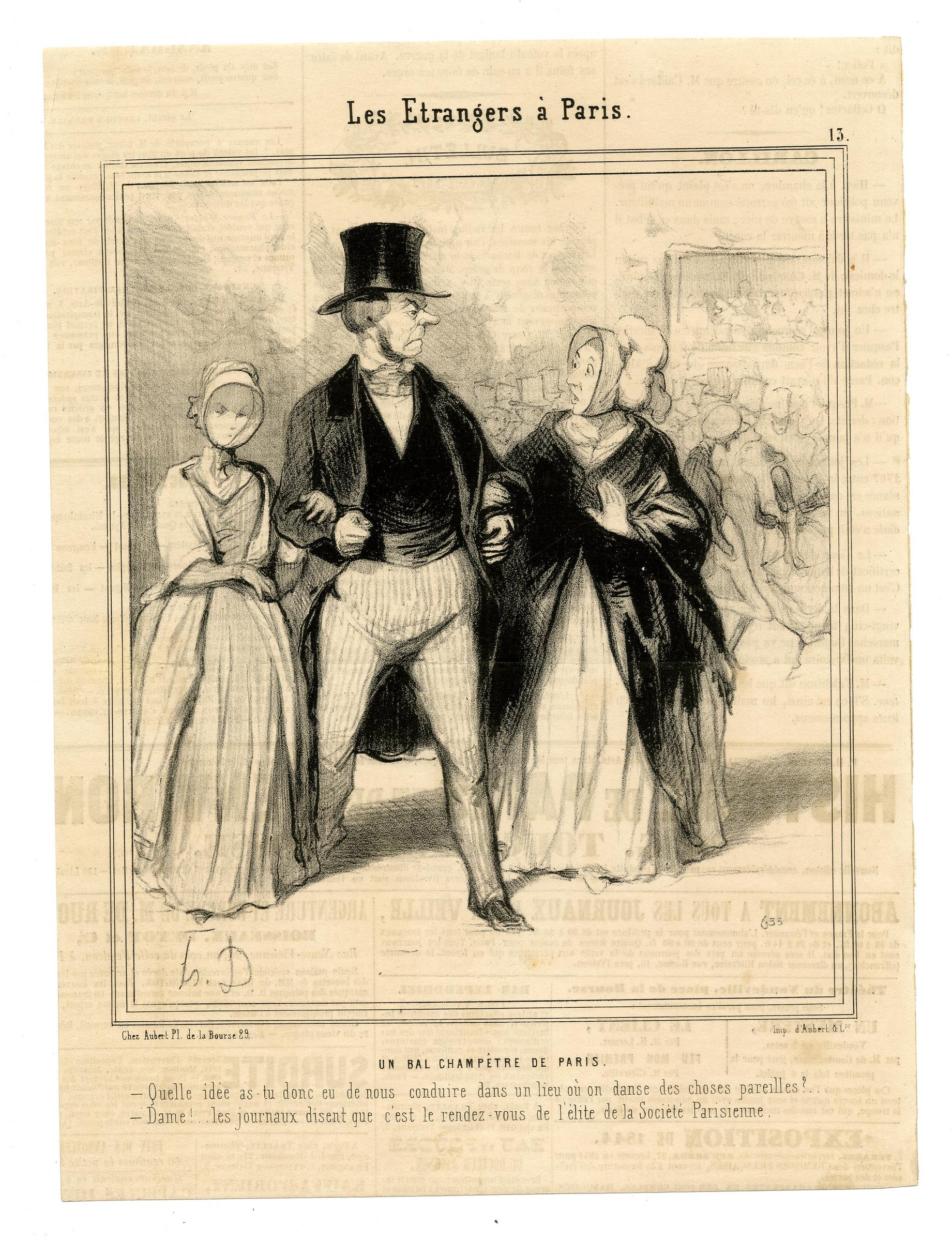
Un bal champêtre de Paris (Country dance in Paris)
Print made by: Honoré Daumier Printed by: Aubert & Cie Published by: Aubert
- Source:
- Wikimedia Commons
- Rights:
- Public domain — free to use, share and adapt.
- Recorded as:
- public_domain
This work reveals how dance functioned in 19th-century social discourse: not as spectacle to celebrate but as a boundary marker between classes and moral positions. The refusal to look at the dancers, the stiffness of the withdrawing figures, and the satirist's eye all tell us that popular dance was controversial—threatening to bourgeois order. For dance historians, this image is evidence of how the body was read as a text of respectability or transgression, and how urban leisure was contested terrain.
What you are looking at
A well-dressed middle-class man in a black coat and top hat stands center-stage, his arms linked with two women on either side—one younger on the left, one older on the right—both wearing long pale dresses and bonnets. All three figures are shown in profile or three-quarter view, walking away from a country dance visible in the background. Behind them, a crowd of dancers and musicians fills the right side of the composition in lighter, sketchier detail. The foreground figures are rendered with sharp clarity and satirical precision, their postures tense and purposeful, while the background celebration dissolves into busy, barely-articulated forms. The whole is executed in lithographic crayon with bold blacks contrasting pale paper, the architectural frame and the care lavished on the central trio emphasizing their disapproval and withdrawal from the rustic entertainment.
The dancing
The man's body is stiff and upright, his chin elevated, his stride decisive—an exaggerated stance of moral withdrawal. The two women mirror his bearing; the younger woman's head turns slightly toward the viewer as though in shared indignation or embarrassment, while the older woman gazes downward. None of the three is dancing or even looking back at the festivities. Their linked arms form a rigid chain, a show of family unity and respectability against the disorder behind them. The silhouette of the man dominates: legs in profile with visible tension, his bulk assertive against the lighter figures beyond.
The dance depicted
The work depicts a country dance—a bal champêtre—but does not depict the dancers themselves performing it. Instead it satirizes the audience's attitude toward rural or popular dance. The actual dance is relegated to background and outline; what the image captures is the moment of withdrawal and judgment. This is a social satire on class anxiety and propriety, not a document of dance technique. The country dance itself (likely a galop, polka, or other popular figure dance of the 1840s) is rendered formulaically and without detail, serving only as the catalyst for the central figures' moral theater.
How it was made
This is a lithograph, a print medium that allows bold, gestural mark-making and rapid distribution. Daumier's hand is evident in the crayon work: heavy blacks in the man's coat and the bold hatching of form, with softer grayscale for the women's dress and the atmospheric background. The technique allowed Daumier to achieve sharp social caricature—exaggerating the man's nose, jaw, and posture for satirical effect—while maintaining legibility for a newspaper public. Published in Le Charivari on 19 July 1844, this was ephemeral political and social commentary meant to be seen, laughed at, and discarded, yet lithography's relative durability has preserved it as a historical record.
About this work
This is a satirical lithograph from the 1840s, one of a series called 'Foreigners in Paris,' mocking the anxieties of respectable Parisian society. The image captures a moment of social theater: a bourgeois family withdrawing in moral disapproval from a popular entertainment, their rigid, self-conscious postures contrasting sharply with the unseen revelry behind them. The print is both a document of urban class tension and a study in bodily gesture—the comedy lies in the performers' own performance of propriety. Daumier is not showing us the dance; he is showing us the dance of social pretension and judgment that surrounds it.
How to look at it
Focus on the contrast between the three foreground figures and the blurred, energetic background. Notice how Daumier uses line and posture to convey judgment: the rigid spine, the averted eye, the elevated chin. The younger woman's face is turned toward us as if to say, 'Can you believe this?'—a shared conspiracy with the viewer against the dancers we are not shown. The man's nose and jaw are caricatured for comic effect, but the real satire is in the body: respectability, it turns out, has a shape, and Daumier has drawn it with a steady hand. The background dancers are present but almost invisible, their liveliness subordinate to the foreground theater of disapproval.
The artist
Honoré Daumier (1808–1879) was a lithographic caricaturist and painter whose work for Le Charivari and other publications made him one of the defining visual commentators on French urban and political life. He excelled at social satire delivered through exaggerated bodily gesture and facial expression. His prints were widely circulated and influential; he worked prolifically across several decades, often returning to themes of class, hypocrisy, and the gap between pretense and reality. This print sits squarely within his practice of mordant social observation.
The period
In the 1840s, Paris was experiencing rapid urbanization and the emergence of distinct leisure zones and social classes. Public balls and country dances were popular among working people and the provincial petite bourgeoisie, while respectable Parisian society maintained a complex relationship with such entertainments—fascinated and horrified in equal measure. Quadrilles, polkas, and galops were the dances of the moment, and their association with working-class venues and immigrants (the series title references 'foreigners') made them objects of satire and anxiety for conservative critics. Daumier's print captures this moment of social tension with surgical precision.
Where it lives
The image comes from Wikimedia Commons and is identified as Plate 13 from a series published in Le Charivari on 19 July 1844. No current holding institution is recorded in the available catalogue data.
Dance in this work
Questions about this work
Is this actually showing a dance?
The print depicts a country dance in the background, but its focus is on the family withdrawing from it, not on the dance itself. This is intentional: Daumier is satirizing bourgeois attitudes toward popular dance, not documenting dance practice. The actual dancers are secondary to the social commentary.
What kind of dance is shown in the background?
The print provides no specific detail. It is labeled a 'country dance' (bal champêtre), which in 1840s Paris would typically refer to a quadrille, galop, polka, or other popular figure dance. Daumier renders it generically to emphasize the social divide rather than dance technique.
Who are these people?
The series is called 'Foreigners in Paris,' but this particular print shows a respectable Parisian family—a father and two female relatives—using their withdrawal as a statement of class position. The caption indicates they are tourists or observers scandalized by local entertainments.
Why is this in a dance gallery?
Because it is a primary source for how dance was socially perceived and contested in 19th-century urban culture. The refusal to dance, the judgment of dancers, and the bodily language of disapproval are all part of dance history. This image tells us how dance was feared, moralized, and used to mark social boundaries.
More dance artwork





