49 works in this view — arrow keys or swipe to move between them.
Dance in Art
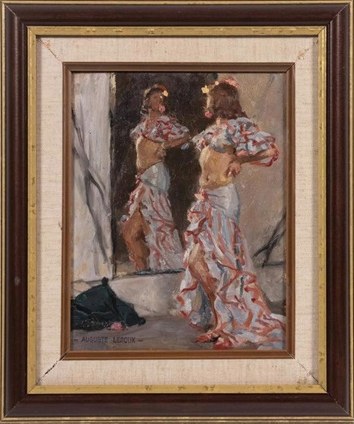
Auguste Leroux - La danseuse de flamenco au miroir
Auguste Leroux
- Source:
- Wikimedia Commons
- Rights:
- Public domain — free to use, share and adapt.
- Recorded as:
- public_domain
The work documents a specific moment in European modernism's encounter with Spanish dance—not the spectacle of flamenco performance itself, but the body and consciousness of the performer offstage. It reveals how dance imagery in fine art moved beyond action to psychology, and how the dancer's body was increasingly framed as a subject of introspection and self-awareness rather than pure virtuosity.
What you are looking at
A woman in a patterned dressing gown stands before a mirror, caught between the real and reflected image. She wears a loosely draped garment of coral or rust-toned fabric with a bold geometric or floral pattern, worn off one shoulder in a deliberately theatrical way. Her pose is contemplative and intimate—one hand raised to her body, weight shifted as if mid-turn. The mirror dominates the composition, creating a doubling effect; her reflection meets her gaze. The background is muted, rendered in greys and browns, with a dark draped fabric (possibly a shawl or curtain) hanging to the left. The lighting is warm and diffuse, falling across her form. The entire scene has the quality of a private moment—a dancer, or a woman performing the role of one, studying herself.
The dancing
A single female figure in a contrapposto stance, her weight on one leg, the other knee slightly relaxed. Her upper body twists toward the mirror; one arm is raised and bent, the other lower across her body. The pose suggests both languor and awareness—she is looking at herself, a moment of narcissistic or self-scrutinous pause. There is no rigid frame or balletic alignment; instead, the body has the ease and introspection of rehearsal or private ablution. The gesture reads as moment-to-moment rather than locked in a formal step.
The dance depicted
The catalogue identifies this as a flamenco dancer, but the pose and setting suggest something more ambiguous. The woman's dress and demeanour—the off-shoulder drape, the intimate mirror study—evoke the private preparation or dressing room of a theatrical performer rather than the upright, taut carriage of active flamenco dance. She is not dancing; she is paused, observing, rehearsing her image. If this is a flamenco dancer, the work captures not the performance itself but the performer's relationship to her own body and appearance—a theme central to early-to-mid 20th-century modernist painting.
How it was made
The catalogue record states oil on wood panel, 35.6 × 30.5 cm (14 × 12 in.), though this should be verified from the work itself. The technique appears consistent with post-Impressionist or early modernist painting: loose brushwork in the background, warmer palette concentrated on the figure, and a flattened, almost Art Deco simplification of form. The small panel size and intimate subject suggest a studio work, possibly a study. The inscription visible in the lower left ("Auguste Leroux") confirms authorship on the work itself.
About this work
This is a small oil painting of a woman in a patterned gown studying her reflection in a mirror. The work is catalogued as depicting a flamenco dancer, and the title invokes that tradition, but the painting itself shows not a moment of dance but of preparation, introspection, and self-regard. The artist is Auguste Leroux, identified by inscription. The work sits at the intersection of the theatrical, the domestic, and the modern: it captures the professional female performer as a subject of visual and psychological interest, not merely as a body in motion. The mirror-doubling device was a favoured motif of 20th-century modernism, allowing the painter to explore surface, reflection, and the performance of identity.
How to look at it
Attend to the doubling created by the mirror: the painting is not primarily interested in dancing movement, but in the relationship between the body and its image, between the performer and her own gaze. Notice the warmth and softness of the handling in the figure, contrasted with the cool, sketchy background; this tells you the artist's focus is on the woman's consciousness and physicality, not on setting or action. Look at the hand positions—neither balletic nor actively gestural, but exploratory and self-conscious. The pose captures a moment of private theatricality, not public performance.
The artist
Auguste Leroux was a French painter active in the early-to-mid 20th century, working in a post-Impressionist idiom with modernist affinities. He is known for figure studies and theatrical subjects, often featuring women in contemporary or exotic dress. His work sits between academic training and modernist reduction, favouring warm palettes and intimate scale. Little is widely documented about his practice, but his choice of subject—the theatrical female performer in private study—aligns with broader early modernist interests in psychology, femininity, and the performer's interiority.
The period
This work was completed in 1954, a moment when European modernism had consolidated itself and the exoticism of Spanish and flamenco culture held a particular appeal for avant-garde and post-Impressionist painters. The mid-20th century saw a turn toward psychological and introspective approaches to the figure; the dancer was no longer merely a subject of motion studies (as in Degas) but of subjectivity and self-regard. The mirror as a device for exploring identity and doubling was a favoured modernist strategy, influenced by Symbolism and by psychoanalytic ideas circulating in European intellectual culture. Flamenco itself, by this date, had been absorbed into European high-cultural representation as a marker of passion, authenticity, and the female body.
Where it lives
The work is held in Wikimedia Commons. It is identified as oil on wood panel, 35.6 × 30.5 cm, catalogued under the title "La danseuse de flamenco au miroir" (The Flamenco Dancer at a Mirror). The collection and current location are not recorded in the source data.
Questions about this work
Is this woman actually dancing?
No. The painting captures a moment of pause and self-regard, not active dance. She is studying her reflection, possibly in preparation for performance or in a moment of private contemplation. The work is about the performer's consciousness and body awareness rather than the execution of steps.
Why is she called a flamenco dancer if she's not dancing?
The title and catalogue identify her as a flamenco dancer, likely because her dress, the period, and the artist's interests point toward that tradition. However, the painting itself prioritizes the woman's interiority and her relationship to her own image, rather than the documentation of flamenco movement or style.
What is the mirror doing in the composition?
The mirror is central to the painting's meaning. It creates a doubling effect—we see both the body and its reflection—and invites us to think about self-image, performance, and identity. The mirror was a favourite device in modernist art for exploring psychology and the gap between being and appearing.
When was this painted, and does that matter?
1954. By this date, European modernism had moved well beyond Impressionism, and artists were deeply interested in psychology, introspection, and the subjectivity of their subjects. The post-war period also saw a particular interest in female performers and their inner lives, partly influenced by psychoanalytic thought.
More dance artwork





