49 works in this view — arrow keys or swipe to move between them.
Dance in Art
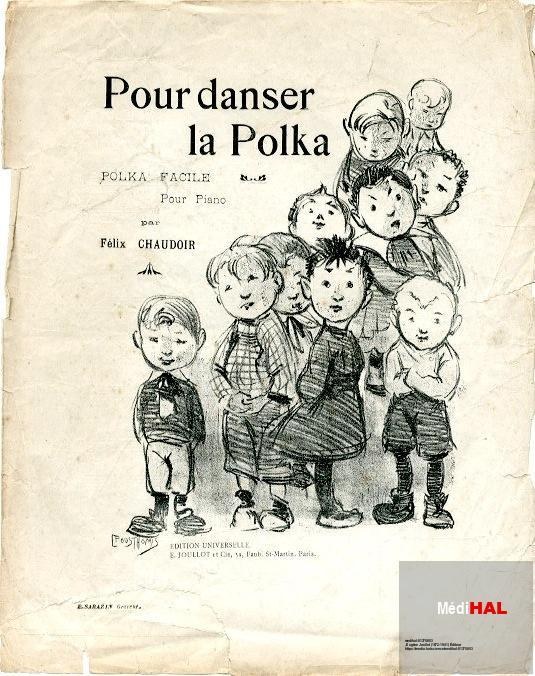
Pour danser la polka - polka facile pour piano par Félix Chaudoir -couverture partition pour piano grand format - -illustration Léon Pousthomis- (MédiHAL 1375853)
Éliane Daphy / Institut Interdisciplinaire d'Anthropologie du Contemporain / National Center for Scientific Research
- Source:
- Wikimedia Commons
- Rights:
- Public domain — free to use, share and adapt.
- Recorded as:
- public_domain
This cover reveals how polkas entered household practice through affordable published arrangements and how dance pedagogy relied on printed music. The deployment of children as symbols of accessibility and joy shows how the polka's democratic appeal — its positioning as a dance for ordinary people, not just aristocrats — was marketed and reinforced in visual culture. For historians of social dance and 19th-century music publishing, it documents the economic and social infrastructure that made the polka a truly popular rather than elite form.
What you are looking at
This is the cover of a piano score for a polka, illustrated with a charming group composition of eight children arranged in a loose pyramid formation. The children, rendered in black ink with cross-hatching for tonal depth, are dressed in late 19th-century children's clothing — girls in simple dresses, boys in suits and knickerbockers. Their faces are round and cheerful, characteristic of the sentimental children's illustration style of the period. The composition stacks the figures vertically, with taller children at the back and smaller ones toward the front, creating a playful sense of collective joy. The artist has captured the informality of childhood movement rather than posed formality; the children's bodies lean and angle toward each other, suggesting togetherness and gaiety. The illustration fills most of the upper half of the page, leaving space below for the text identifying the work as "Pour danser la Polka" and crediting composer Félix Chaudoir and illustrator Léon Pousthomis.
The dancing
The eight figures are not in a dance hold or formation but rather grouped pyramidally as if posing together for a picture. Their postures are relaxed and natural, with slight forward leans and turned heads that suggest informal sociability rather than choreographed movement. No footwork is visible, and the illustration technique does not permit precise study of weight distribution or frame. The mixed-gender grouping and the apparent ages (roughly 4–10 years old) suggest this was marketed to families and children as an easy, social dance rather than a performance piece.
The dance depicted
The polka was a popular social dance of the 19th century, originating in Bohemia and spreading rapidly across Europe and America. It was danced by couples or groups in social settings, marked by a lively 2/4 time signature and characteristic hopping, three-step movement. This score is labeled "polka facile" (easy polka) and appears to be based on a famous popular song by Chaudoir, reissued by the publisher E. Joullot. The presence of children on the cover and the "facile" designation suggest this was pedagogical material aimed at making the dance accessible to young learners and amateur pianists. The image does not depict the dance in action but rather uses children as symbolic figures of innocence, accessibility, and social harmony — the polka's appeal as a dance for everyone.
How it was made
This is a lithographic or engraved cover for a published piano score, a common commercial format in the late 19th century. The technique permits fine linear detail in the children's faces and clothing while maintaining bold enough contrast for reproductive printing. The use of children and informal composition distinguishes this from more formal sheet music covers that might feature romantic couples or idealized figures. The commercial distribution model — a printed score available to amateur musicians and teachers — shaped both the illustrative approach and the simplified musical arrangement, targeting a broad domestic market rather than concert performers.
About this work
This is a commercial sheet music cover from the late 19th century advertising an easy piano arrangement of a popular polka by Félix Chaudoir. The polka was one of the most widely danced social dances of the era, enjoyed across all social classes in Europe and the Americas. Rather than depicting the dance itself, the illustration uses a charming group of children to signal that this version is accessible to young players and learners. The work documents both the material culture of domestic music-making and the pedagogy of dance instruction in the period — how dances were disseminated through printed music and taught to the next generation. It belongs in a dance collection as evidence of how the polka was marketed, taught, and imagined as a fundamentally social, family-friendly practice.
How to look at it
The viewer should attend to the informal, non-choreographic arrangement of the children — they are not shown dancing but grouped as if for a family portrait. The artist's choice to depict joy and togetherness rather than the technical execution of the polka reflects the marketing strategy: this is not a dance for experts or performers, but for ordinary families and amateur musicians. Notice how the pyramid composition and the children's gentle leaning toward each other conveys sociability and collective pleasure, values central to the polka's appeal. The style of the children's dress (late 19th-century) and the printing technique itself are evidence of when and how the work circulated.
The artist
Léon Pousthomis was a French illustrator active in the late 19th century, known for his work in popular publications and sheet music covers. His style favored charming figural compositions rendered in line and cross-hatching, well suited to reproductive printing. He appears to have worked frequently in the context of music publishing and children's illustration. Félix Chaudoir was a French composer and songwriter whose works enjoyed popularity in the mid-to-late 1800s; the "famous song" referenced in the score's subtitle suggests at least one of his compositions achieved wide currency.
The period
The polka emerged in Bohemia in the 1830s and became one of the dominant social dances of the Victorian era and beyond. By the 1890s and early 1900s, when this cover was likely printed, the polka had long been established as a standard ballroom and social dance, taught to children and performed at all levels of society. The rise of lithographic and engraved sheet music covers in the second half of the 19th century made music publishing a major visual industry; covers competed for attention and sales through attractive illustration. The pedagogical emphasis on "facile" or simplified versions reflects broader 19th-century movements toward music education for amateurs and children. Illustration in this period increasingly used children and domestic scenes to signal modernity, accessibility, and progress.
Where it lives
The work is identified in the record as held by MédiHAL (Multimedia Documents in Health and Life Sciences), a French digital repository. It is catalogued as a reprint or later edition by publisher E. Joullot (who purchased rights from the original publisher Julien Hardy in 1897); the rating number EJ380 suggests it was part of Joullot's numbered catalogue. The source for this entry is Wikimedia Commons, where it is available for online viewing.
Dance in this work
Questions about this work
Was this music actually meant for children to dance?
The label "polka facile" indicates it was a simplified arrangement for amateur pianists, likely including young people and household players. The cover image signals the work's accessibility and family-friendly character, but it is ambiguous whether children actually danced to this particular arrangement or whether the cover is using children symbolically to convey ease and universal appeal. The polka itself was danced by children and adults alike in 19th-century social settings.
What is the difference between this polka and the 'famous song' mentioned inside?
The score is based on musical motifs from a well-known song by Chaudoir, but a polka arrangement transforms the song into a dance piece with the characteristic 2/4 rhythm and structure. The publisher's note indicates that the piano arrangement adapts pre-existing melodies rather than offering wholly original material — a common practice in commercial music publishing of the era.
How do we know when this was printed if the date is uncertain?
The record notes that the catalogue number (EJ380) permits a dating window of 1899–1902, with a hypothesis of 1902 pending confirmation. This relies on the publisher Joullot's records and the numbering sequence of their catalogue. The visual style of the illustration and printing technique are consistent with late 19th-century French commercial printing but do not permit independent precision.
Why use a pyramid of children instead of showing the dance?
Cover illustrations in 19th-century music publishing often used symbolic rather than literal imagery. Children connoted innocence, modernity, accessibility, and universal appeal — all values the publisher wanted to associate with an affordable, easy-to-learn version of a popular dance. Showing the polka being danced might have suggested it required skill or belonged to a specific social class, whereas the charming group of children welcomes all players and dancers.
More dance artwork





