49 works in this view — arrow keys or swipe to move between them.
Dance in Art
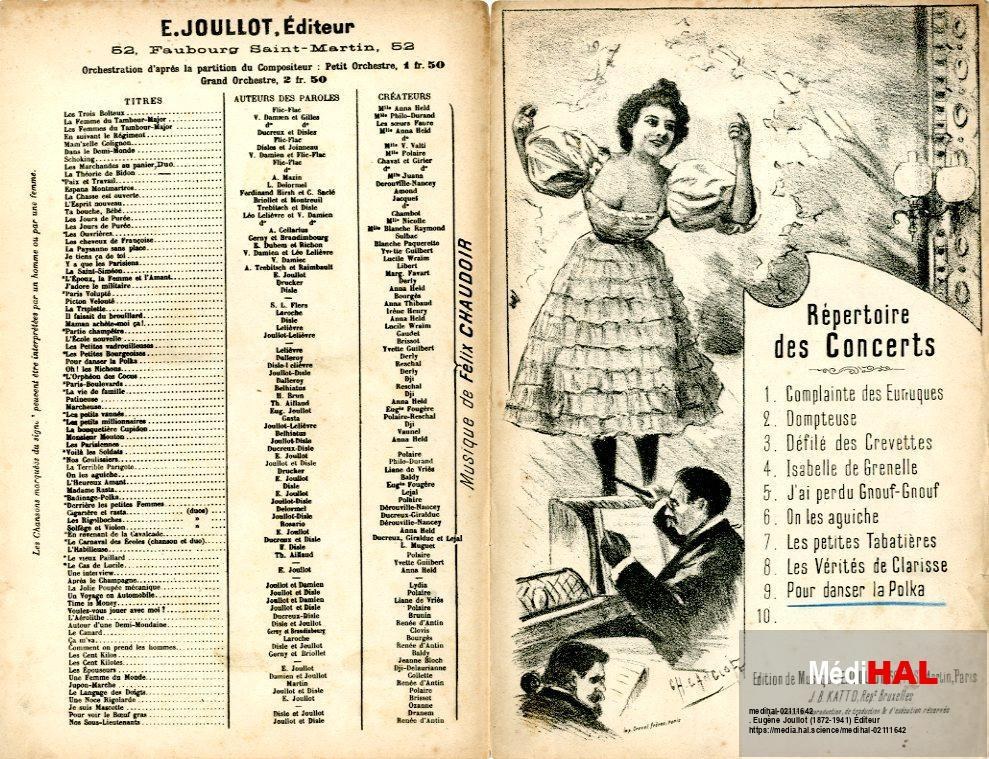
Répertoire des concerts - Pour danser la polka -illustration Ch Gangloff (Charles Gangloff 1870-1941)- -1895- (MédiHAL 2111642)
Éliane Daphy / Institut Interdisciplinaire d'Anthropologie du Contemporain / National Center for Scientific Research
- Source:
- Wikimedia Commons
- Rights:
- Public domain — free to use, share and adapt.
- Recorded as:
- public_domain
This image is crucial evidence for understanding the polka's place in 1890s ballroom culture and the visual conventions used to document social dancing in printed media. It shows a professional engraver's understanding of ballroom technique, including the closed position and upright frame that defined the period's formal partnered dances, and it demonstrates how dance was marketed and circulated through music catalogs aimed at amateur musicians and dancers.
What you are looking at
A crowded ballroom scene rendered in black ink engraving, crowded with couples dancing in the foreground and background. Two women in elaborate tiered skirts occupy the center: one facing left in three-quarter view, the other seen from behind. Both wear fashionable 1890s dress with voluminous skirts, fitted bodices, and puffed sleeves. A man in dark formal coat dances with the woman on the right, his posture upright and attentive. The composition is dense with overlapping figures—musicians, dancers, and onlookers—creating a sense of movement and social gaiety. The engraving technique renders fine detail in the women's skirts through parallel hatching and cross-hatching, emphasizing the textile structure. The setting is indoors, suggested by architectural elements and the compressed, interior spatial arrangement. A decorative border frames the right edge of the composition. The overall effect captures the energy and formality of a fin-de-siècle social dance event.
The dancing
The primary couple displays a closed ballroom hold: the man's right hand at the woman's waist, her left hand resting on his shoulder, their free hands clasped at approximately shoulder height. Both bodies are upright and well-separated at the hips, the posture of trained ballroom dancers. The woman's weight appears forward onto her right leg, her body slightly rotated; the man stands square. The surrounding dancers are rendered in varying degrees of detail, some mere silhouettes suggesting depth, others fully articulated in similar closed positions. The engraver has captured the formality of the period's social dance through rigid spinal alignment and the geometric clarity of the hold.
The dance depicted
This is a polka, as confirmed by the title and the dance repertoire listing. The polka was a central social dance in the 1890s, danced in closed ballroom position in public and private ballrooms across Europe and America. The posture and frame shown here—upright, formal, with a clear closed position—reflect the ballroom polka as a performed social dance rather than the more vigorous folk variant. The image documents how the polka appeared in fashionable French society of the 1890s: a respectable, partnered dance for mixed-gender couples in formal dress. The surrounding figures and the crowded composition emphasize the polka's role as a social spectacle, a moment of courtship and display within the structured rituals of the ballroom.
How it was made
This is a wood or steel engraving, identifiable by the fine parallel lines (hatching) used to model form and suggest texture, especially visible in the rendering of the women's skirts and the men's coats. The engraving technique allowed for sharp detail and high-contrast blacks and whites without intermediate tones. Such engravings were economical to reproduce and circulate widely in music publications and illustrated periodicals, making them a primary form of visual documentation of dance and fashion in the 1890s. The technical precision of the engraving—the clean lines, the careful articulation of hands and faces—indicates a professional engraver of skill, likely working from a drawn design. This was a commercial product, part of a printed music catalog, designed for affordable mass distribution.
About this work
This engraving depicts a polka in a fashionable Parisian ballroom of the 1890s, part of a printed music catalog issued by publisher E. Joullot. The work documents both the dance itself—its posture, hold, and social context—and the moment in which it was made: the fin-de-siècle obsession with ballroom dancing as a marker of social refinement and courtship. The image appears as a cover or interior illustration in a catalog of dances available for orchestra, reflecting the commercialization of dance music and the standardization of ballroom technique in the late nineteenth century. Charles Gangloff's engraving captures the formal, mannered quality of the period's social dancing and the elaborate dress that framed it, offering a precise visual record of how the polka looked when executed in elite social contexts.
How to look at it
Attend first to the couple's hold and frame: the closed ballroom position shown here was not 'natural' but learned and performed, and it signals the polka's status as a formal social dance requiring instruction and practice. Observe the woman's elaborate skirts and how the engraver rendered their structure and movement through fine hatching; her skirt appears to be in motion, caught at a moment of rotation or forward travel. Note the density of the surrounding dancers and musicians, which emphasizes the polka's role as a public spectacle within the ballroom, not a private or intimate moment. Finally, look at the engraver's choice to enlarge the central couple: they occupy the visual center and are rendered in sharper detail than the surrounding figures, a compositional hierarchy that elevates the dance itself as the subject worthy of attention.
The artist
Charles Gangloff (1870–1941) was a commercial engraver working in Paris during the Belle Époque. He specialized in fashion illustration and dance imagery for music publishers and periodicals, producing precisely detailed engravings of contemporary social scenes. His work reflects the technical skill required of professional engravers of the period and his particular interest in documenting fashionable society. The catalog attribution and the consistency of his style across multiple engravings suggest he was a sought-after illustrator for music publishers seeking to visually market dance to middle-class and upper-middle-class consumers.
The period
The 1890s were the height of the ballroom dancing craze in Europe, particularly in France. The polka, though originating earlier in the century, remained a cornerstone of ballroom repertoire, danced alongside the waltz, quadrille, and cotillion. The publication of dance catalogs with orchestral arrangements reflected the professionalization and commercialization of amateur music-making and dancing; middle-class households purchased sheet music for home performance or hired orchestras for private balls. Simultaneously, the elaborate fashion visible in the engraving—the voluminous skirts, puffed sleeves, and fitted bodices—was at its peak, and the visual documentation of fashionable dress became inseparable from the documentation of social dancing. Engraving remained the primary method for reproducing images in commercial publications until photographic reproduction became standard in the early twentieth century.
Where it lives
This engraving appears in a printed music catalog issued by E. Joullot, a Paris music publisher located at 52 Faubourg Saint-Martin. The work was created as a commercial illustration for the catalog, likely designed to attract customers by showing the dances available in orchestral arrangement. The catalog is held in the BNF collections and is accessible through MédiHAL, a digital repository for academic and heritage materials.
Dance in this work
Questions about this work
What is the polka, and why was it danced in ballrooms?
The polka is a spirited couple dance in 2/4 time, originating in Bohemia in the 1830s and spreading rapidly across Europe. By the 1890s, it was a standard ballroom dance, danced in closed position in formal settings. It was neither the fastest nor the slowest of the ballroom dances, making it accessible to amateur dancers while remaining showy enough to display skill and fashion.
How do we know this is a polka and not some other ballroom dance?
The catalog title explicitly identifies it as 'Pour danser la polka' (For Dancing the Polka), and the engraving was published as an illustration for that piece. The upright closed-position frame shown is consistent with 1890s ballroom polka technique, though the same frame was used for waltzes and other ballroom dances, so the visual evidence alone would not be definitive.
Why are the women's skirts so full and elaborate?
The voluminous, tiered skirts visible here were the height of 1890s fashion, made possible by internal structures of boning and petticoats. For dancers, such skirts were both an aesthetic ideal and a practical challenge: they moved dramatically during dancing and required skill to manage while maintaining the upright ballroom posture. The engraver's careful rendering of the skirts emphasizes their importance as markers of social status and fashion consciousness.
What does this engraving tell us about how dance was learned and taught?
The precision of the hold and frame shown here suggests that ballroom dancing was formalized and taught through instruction. The publication of orchestral arrangements in catalogs implies that amateur musicians and dancers purchased these materials to learn dances in domestic or semi-public settings. The visual documentation of 'correct' technique in engravings like this one likely served as an instructional reference for dancers and musicians.
More dance artwork





