49 works in this view — arrow keys or swipe to move between them.
Dance in Art
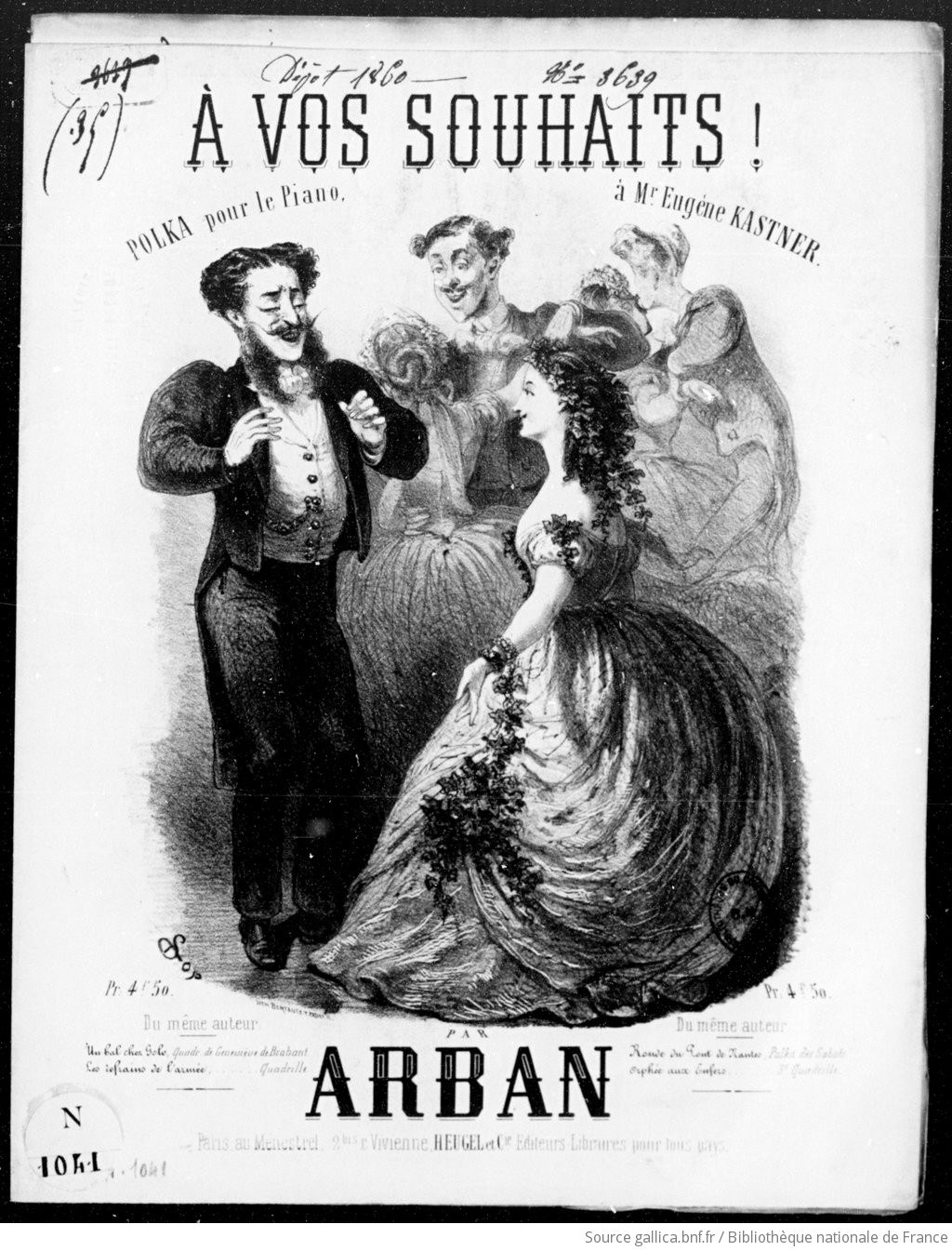
illustration de l'œuvre musicale "A vos souhaits Polka pour piano"
Louis Pierre Gabriel Bernard Morel-Retz
- Source:
- Wikimedia Commons
- Rights:
- Public domain — free to use, share and adapt.
- Recorded as:
- public_domain
This work documents the polka at the height of its social dominance, showing how the dance appeared in real time to artists and audiences, and how commercial illustration shaped popular understanding of contemporary dance. For historians of ballroom dance and 19th-century social life, it is evidence of what the polka looked like in motion and how it was marketed and consumed.
What you are looking at
This is a lively ballroom or salon scene capturing a polka in progress. In the foreground, a couple dances in close embrace: the man, bearded and formally dressed in a dark jacket and vest, inclines toward his partner, whose attention is directed back toward him. She wears an elaborate ball gown with a full skirt, off-shoulder neckline, and fitted bodice, her dark hair arranged in the fashionable ringlets of the 1860s. Her skirt is caught mid-swirl, billowing around her legs in a arc that dominates the lower half of the composition. Behind this principal couple, two further couples can be seen dancing in the same energetic style, creating a sense of movement and social pleasure. The background figures are less detailed but equally engaged, their clothing and positioning suggesting the same period and dance. The setting appears to be an indoor ballroom or drawing room, rendered with the soft modeling and careful attention to fabric that characterizes mid-19th-century commercial illustration. The overall mood is one of gaiety and social ease—the polka was a dance of democratic sociability, and the artist has captured that quality of uninhibited pleasure.
The dancing
All visible dancers adopt the closed ballroom frame characteristic of the polka: partners face one another at close quarters, with the man's right hand on his partner's back and their other hands joined. The man's posture is upright but animated, leaning slightly forward; the woman's weight appears to shift into the turn, her upper body responsive to his lead. The principal woman's skirt swings outward from rapid rotational movement—polka involves quick traveling steps with pronounced hip action, and the fabric's extension captures this momentum convincingly. The dancers' feet are not clearly rendered, but their upper bodies and the swirl of fabric around them convey the quick, energetic stepping characteristic of the polka. No pointe work, no formal ballet frame—this is popular ballroom dancing of the period.
The dance depicted
This is explicitly a polka, as stated in the title. The polka emerged in Bohemia in the 1830s and became the dominant social dance of the mid-19th century across Europe and America, displacing the waltz in popularity among middle-class dancers. It is a couple dance in 2/4 time with a quick, bouncy step pattern that produces the characteristic hip motion visible in the woman's skirt here. The dress, the setting, the intimacy of the frame, and the moment of energetic rotation all confirm this is a social polka as danced in urban ballrooms around 1860. The illustration is titled as a polka pour piano—sheet music cover art—which places it in the context of popular music publishing and the proliferation of polka arrangements for home performance.
How it was made
This is a wood engraving or steel engraving, rendered in fine black lines on white stock with the characteristic precision and tonal modeling of commercial music-cover printing from the mid-19th century. The technique allows for fine detail in the figures' faces and clothing while maintaining the bold clarity necessary for reproduction at small scale. The shading is achieved through careful cross-hatching and parallel lines rather than wash or tone, giving the image a crisp, linear quality. This was the standard method for illustrated music covers in the 1860s, allowing hundreds of copies to be printed from a single engraved plate, making the dance visible and desirable to middle-class households who might purchase the sheet music.
About this work
This is the title-page illustration for a polka pour piano, a popular social dance arranged for amateur performance at home. The work captures the aesthetic and social meaning of the polka at its height of fashion in the 1860s: it is a dance of couples, of rapid rotation, of apparent spontaneity within formal dress, and of democratic pleasure rather than courtly ceremony. The engraving is a commercial object—sheet-music cover art—designed to appeal to the amateur pianist and to promote the sale of arrangements. It belongs in a dance gallery because it shows what the polka looked like to its own moment, how it was understood visually, and how dance moved through commercial culture into domestic space.
How to look at it
The artist has frozen the moment of rapid rotation, capturing the woman's skirt at full extension—this is not a posed moment but a snapshot of movement in progress. Notice the lean and incline of the bodies, which conveys the drive and momentum of the step; notice how the man's face and gesture suggest concentration on leading, while the woman's expression shows pleasure and responsiveness. The engraving technique, with its fine parallel lines, creates a sense of energy and motion even in a static image. The composition is crowded and slightly chaotic in the background, which adds to the sense of a real ballroom rather than a formal arrangement.
The artist
Louis Pierre Gabriel Bernard Morel-Retz was a 19th-century French illustrator and engraver specializing in commercial and theatrical subjects. He worked extensively for music publishers, producing title-page illustrations and cover art for popular dances and compositions of the period. His style was characteristic of mid-century commercial engraving: competent in anatomy, attentive to period costume and social detail, and designed for clarity and appeal to a broad middle-class audience. Little detailed biographical information survives, but his work is representative of the professional illustrators who gave visual form to popular culture in the era of mechanical reproduction.
The period
The polka dominated European and American ballrooms from the 1840s through the 1870s, representing a shift in social dancing toward faster tempos, more energetic hip motion, and greater informality than the waltz it displaced. For the piano industry and music publishers, the polka was enormously profitable: millions of arrangements were published, from simple reductions to virtuosic concert versions. The 1860s, when this work was made, was the peak of polka fashion; by the 1880s it had begun to recede from elite ballrooms, though it remained part of vernacular dance culture. Simultaneously, commercial engraving and lithography were at their technical height before photographic reproduction began to displace hand-drawn illustration. Sheet-music covers were a major arena for dance illustration in this period, often more lively and socially engaged than academic art.
Where it lives
This work is held by the Bibliothèque Nationale de France and is available through Wikimedia Commons. It is a music-cover engraving, a commercial printed object produced for distribution with sheet music, and represents a category of 19th-century popular cultural material that was created in large quantities for ephemeral use.
Dance in this work
Questions about this work
What is a polka and why was it so popular?
The polka is a couples dance in 2/4 time that originated in Bohemia in the 1830s. It features quick, bouncy stepping with hip rotation and was danced in close couples frame. It became the dominant social dance of the mid-19th century because it was energetic, fun, and less formally codified than the waltz—anyone could learn it, which made it enormously popular across social classes in Europe and America.
Why is this a wood or steel engraving and not a drawing or painting?
This is an engraving because it was made for mass reproduction on a printing press. A single engraved plate could be inked and printed hundreds of times, making it the economical choice for commercial music publishing. Drawing or painting could not be reproduced at this scale and cost, so engraving was the standard method for sheet-music covers and popular illustration in the 1860s.
What does the woman's skirt tell us about how the polka was danced?
The full extension and swirl of her skirt shows the rapid rotation and hip motion that characterized the polka. The fabric catches the moment of turning, which was central to the dance. The silhouette and weight distribution of the fabric also confirm she is a real dancer rather than a posed model—the artist understood the mechanics of movement.
Who would have bought this sheet music?
Primarily middle-class amateurs—pianists, families, music students—who wanted to play the latest fashionable dances at home or in salons. The polka was widely taught and danced in domestic and semi-public settings, and sheet music was affordable and abundant. This cover illustration was designed to appeal to that market and to make the dance desirable and visible.
More dance artwork





