49 works in this view — arrow keys or swipe to move between them.
Dance in Art
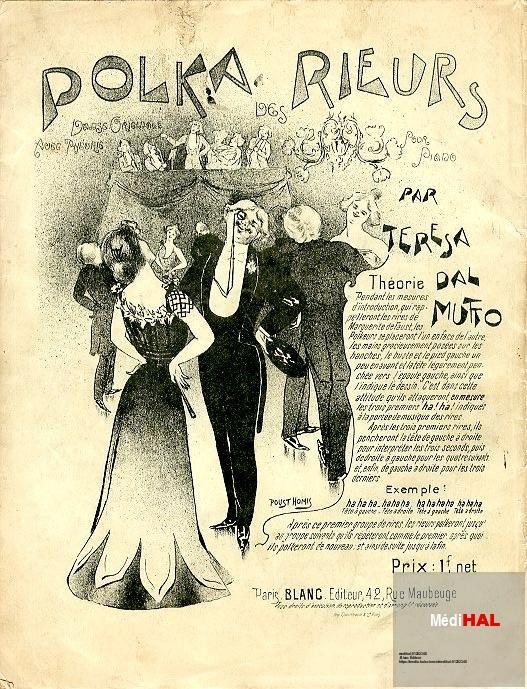
Polka des rieurs pour piano par Teresa Dal Muto -illustration Léon Pousthomis- (MédiHAL 1202348)
Éliane Daphy / Institut Interdisciplinaire d'Anthropologie du Contemporain / National Center for Scientific Research
- Source:
- Wikimedia Commons
- Rights:
- Public domain — free to use, share and adapt.
- Recorded as:
- public_domain
This is one of the earliest documented works by the illustrator Léon Pousthomis, placing it in the early history of professional dance illustration in commercial media. It documents the polka at the moment when it was no longer a novelty but an established feature of respectable ballroom culture, and it shows how artists of the period visualized the gap between formal technique and the playful, social reality of amateur dancing.
What you are looking at
This is a music cover illustration for a piano score, rendered as a pen-and-ink drawing in the Art Nouveau style. The composition centers on three elegantly dressed figures in late 19th-century formal attire. On the left stands a woman in a white ball gown with a dramatically trained skirt, her posture animated and playful. In the center, a man in black tails and white shirt front faces toward her, his body tilted with apparent amusement or engagement. On the right, another figure (gender unclear from the sketch) in dark formal dress leans inward toward the central pair. The three figures are surrounded by sketched profiles and partial faces of onlookers crowding in from the background—a theatre or ballroom audience rendered loosely to suggest laughter and social excitement. The title 'POLKA DES RIEURS' (Polka of the Laughers) is emblazoned across the top in decorative lettering. Below the main image, the illustration credits "LEON POUSTHOMIS" and publication details for Blanc éditeur appear. Sections of text labeled "Théorie" and "Exemple" with musical or dance notation are visible in the lower margin.
The dancing
The central male figure is drawn in profile or three-quarter view with his body angled toward the woman on his left, suggesting active engagement rather than formal ballroom positioning. The woman's posture is notably animated—her torso appears to sway or pivot, and her elaborate trained skirt is caught mid-movement, billowing outward as if caught by a turn or twist. Her arms are raised and mobile rather than held in a closed ballroom frame. The surrounding onlookers are rendered as sketchy half-faces and silhouettes, their mouths open in apparent laughter, which emphasizes the social and humorous character of the dance rather than its technical precision. None of the figures display the rigid, lifted frame typical of formal ballroom technique.
The dance depicted
This is sheet music for a Polka, one of the most popular social dances of the 19th century, and the subtitle 'des rieurs' (of the laughers) suggests it was a playful, humorous variant emphasizing entertainment and social merriment over technical display. The polka was a couple dance in 2/4 time, danced in closed position, originating in Bohemia in the 1830s and reaching peak popularity across Europe and America from the 1840s onward. The illustration captures the social exuberance and comedic spirit that made the polka a fixture of ballrooms and public dance halls, distinguished from the more formal waltz by its lighter, quicker stepping and its embrace of humor and improvisation. The presence of the music score and the attribution to 'Teresa Dal Muto' as composer, along with Pousthomis as illustrator, indicates this was a commercial publication aimed at amateur musicians and dancers of the middle and upper classes.
How it was made
This is a pen-and-ink drawing, likely reproduced via wood engraving or lithography for commercial publication. The loose, gestural linework—particularly in the sketched background faces and the flowing lines of the woman's skirt—is characteristic of fin-de-siècle illustration and Art Nouveau design. The technique allowed the artist to convey movement and emotion through suggestive rather than detailed rendering: the surrounding onlookers are indicated by a few expressive lines rather than fully realized figures, which enhances the sense of spontaneous social animation. As a music cover from a commercial publisher (Blanc, 42 rue de Maubeuge, Paris), this object was produced for mass circulation among piano-owning households, making it a window into how middle-class people understood and visualized social dance in the 1900s.
About this work
This is a commercial music-cover illustration for a polka published in Paris around 1900. It depicts three elegantly dressed figures in a moment of animated social dancing, surrounded by sketched faces of laughing onlookers, designed to convey the playful, convivial spirit of the polka as a social entertainment. The pen-and-ink technique and Art Nouveau styling are typical of Parisian commercial publishing of the period, and the work exemplifies how the visual culture of dance—not only the dance itself, but how it was marketed, illustrated, and understood—was disseminated to the urban middle classes who purchased sheet music for home performance.
How to look at it
Note the contrast between the central couple and their context: the man and woman are rendered with clear anatomical form and suggestive movement, while the surrounding crowd dissolves into expressive linework and open mouths. This compositional choice—clarity at the center, expressiveness at the periphery—draws the eye to the dancers themselves while emphasizing the social reaction they provoke. Observe the woman's skirt: the artist has caught it mid-flare, suggesting the outward kick and pivot characteristic of polka steps, and the looseness of the line conveys motion rather than static form. The informal posture and open arms of both central figures, together with the laughing faces in the background, indicate that this is social dancing as play, not performance.
The artist
Léon Pousthomis (1869–1952) was a French illustrator and painter who became well known for his depictions of dance, theatre, and social life. This work is noted as one of his earliest documented illustrations. His career spanned the Belle Époque and early 20th century, a period when commercial illustration and poster art were flourishing in Paris. Pousthomis contributed regularly to periodicals and produced numerous theatrical and commercial illustrations. His work is characterized by fluent line, attention to costume and social setting, and an ability to capture movement and expression economically.
The period
The polka was at the height of its popularity in European ballrooms in the 1880s–1900s, though it had begun to decline relative to the waltz and emerging modern dances. In France, the polka remained a fixture of public dancing and was particularly associated with humor and informality, in contrast to the more stately waltz. This publication date of circa 1900 places the work at a moment of transition: the polka was becoming retrospectively charming rather than fashionably novel, and commercial publishers were capitalizing on its enduring appeal to amateur musicians. In the visual arts, Art Nouveau was at its peak, and commercial illustration was becoming a respected and highly visible art form. The combination of dance subject, commercial publishing, and Art Nouveau styling reflects the period's fascination with modern social life and leisure.
Where it lives
This work is held in the MédiHAL digital repository (identifier 1202348), which archives French cultural materials including music, visual art, and related ephemera. It is catalogued as part of the collection maintained by the Institut Interdisciplinaire d'Anthropologie du Contemporain and the National Center for Scientific Research (CNRS). The object is a commercial music-cover illustration published by Blanc éditeur, one of Paris's active music publishers in the period.
Dance in this work
Questions about this work
Who was Teresa Dal Muto?
Teresa Dal Muto is credited as the composer of this polka. Beyond the attribution on this score, little is documented about her in standard musical reference works. She appears to have been a working composer or arranger producing music for commercial publication in early 1900s Paris, likely composing in popular genres for the amateur market. Many such composers are now obscure, but their work circulated widely during their time.
What is the difference between this polka and a waltz?
The polka is danced in 2/4 time with a characteristic hop-step pattern, while the waltz is in 3/4 time and danced as a continuous turning motion. The polka is quicker and bouncier, with a springing quality that suits humor and informality. Visually, polka dancers hold a closed ballroom frame but move with less gliding smoothness and more vertical energy than in a waltz. The 'polka des rieurs' emphasizes this playfulness through its title.
What does Pousthomis's style tell us about how dance was illustrated at the time?
The loose, gestural line and the attention to movement and social context rather than anatomical precision show that commercial illustrators of this period prioritized capturing the mood and dynamism of dance over technical accuracy. This reflects both the artistic conventions of Art Nouveau and the commercial goal of marketing sheet music to amateurs who wanted to feel the spirit of the dance, not study its mechanics.
More dance artwork





