49 works in this view — arrow keys or swipe to move between them.
Dance in Art
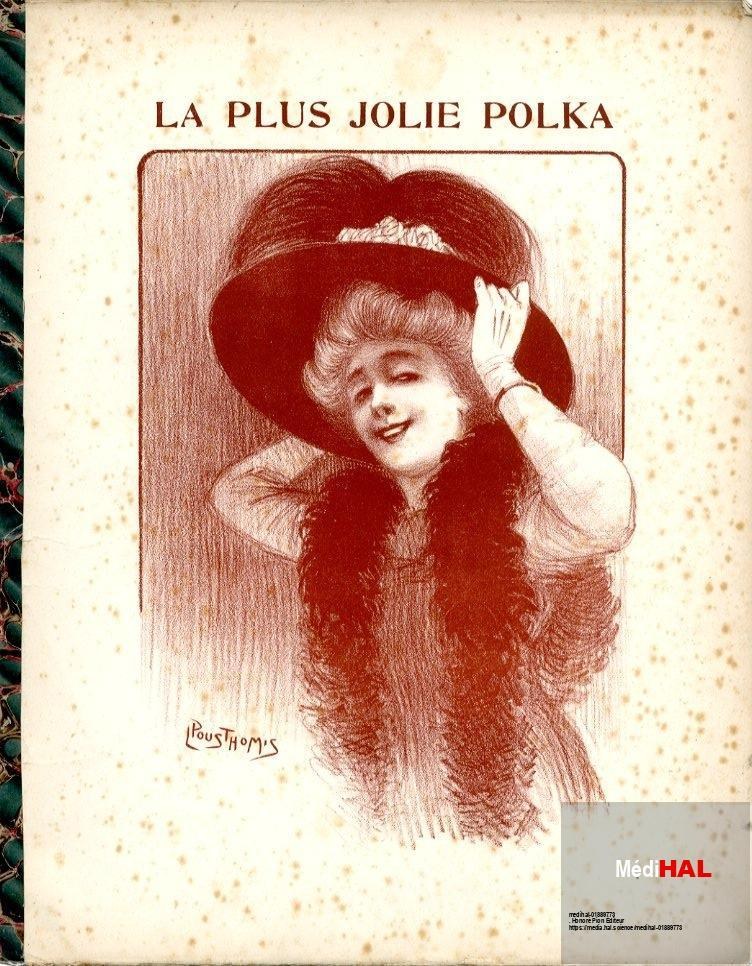
La plus jolie - polka pour piano -couverture partition grand format- -illustration L Pousthomis (Léon Pousthomis 1881-1916)- (MédiHAL 1889773)
Éliane Daphy / Institut Interdisciplinaire d'Anthropologie du Contemporain / National Center for Scientific Research
- Source:
- Wikimedia Commons
- Rights:
- Public domain — free to use, share and adapt.
- Recorded as:
- public_domain
Score covers like this are vital historical documents of how dance was packaged, sold, and imagined in the social imagination. For dancers and historians, they reveal which dances remained popular at specific moments, who was expected to dance them, and how the dance world intersected with fashion, printing technology, and consumer culture. The absence of any actual dancing in the image is as significant as its presence would be—it shows that the polka by 1909 was so well-established that the music could be sold on style alone.
What you are looking at
This is the cover of a large-format piano score for "La plus jolie polka" (The Prettiest Polka), illustrated by Léon Pousthomis. The composition presents a three-quarter-length portrait of a fashionable young woman, rendered in warm reddish-brown tones against a cream background. She wears an elaborate wide-brimmed feathered hat tilted at a jaunty angle, a form-fitting jacket or dress with a large fur stole draped across her shoulders and chest, and white gloves. Her pose is casual and engaging—one hand is raised to adjust or hold her hat, while her gaze meets the viewer with a knowing smile. The illustration captures a moment of feminine elegance and sociability, as if the woman has paused mid-stride at a fashionable gathering. The sketchy, fluid linework and soft shading typical of early-20th-century commercial illustration create an intimate, almost whimsical quality.
The dancing
A single standing figure, shown from approximately the waist up in a three-quarter view. The pose is relaxed and upright, with the weight evenly distributed. One arm is raised with the hand near the hat brim, in a gesture of adjustment or display; the other arm lies naturally at the side. There is no depiction of dancing posture—no turned-out legs, no balletic frame, no active footwork visible. The figure's bearing is social and stationary, suited to a woman at rest during or between social occasions.
The dance depicted
This is a score cover for a polka, a fast duple-meter couple dance that was immensely popular in European ballrooms and salons throughout the 19th and early 20th centuries. The image does not depict the act of dancing itself; instead, it advertises the piece through the portrait of a fashionable woman of the era in whom polka dancers would have recognised themselves—someone of style and elegance, dressed for the ballroom. The polka was danced by pairs in a closed or semi-closed position with a distinctive hopping step and energetic traveling motion, but none of those elements appear here. The cover functions as a social marker: it sells the music by selling an image of its presumed audience.
How it was made
This is a lithographic or engraved score cover, printed in a single reddish-brown colour (monochrome) on cream stock. The technique is typical of commercial music publishing in the Belle Époque: fluid, economical linework combined with tonal shading created by hatching or crayon work, allowing rapid reproduction while maintaining a handcrafted aesthetic. This method was cost-effective for publishers and achieved wide circulation; such covers were intended as both functional wrappers and advertisements, displayed in music shops and carried home by purchasers. The signature "Pousthomis" in the lower left confirms the attribution to the illustrator.
About this work
This is a commercial music-publishing score cover from Paris circa 1909, illustrating a polka composed by A. Delattre and B. Devaux. Rather than depicting the dance itself, the cover sells the music through the aspirational figure of a fashionable woman—a visual synecdoche for the social world of the ballroom. The image tells us that by 1909, the polka, though nearly 60 years old, remained a marker of style and urban sophistication for Parisian society, and that the illustration of feminine elegance was a proven sales strategy for dance music. The work belongs to a vast archive of Belle Époque graphics that shaped popular taste and social identity.
How to look at it
Observe how the illustrator has chosen to present the polka not through movement but through stillness—a pause that paradoxically sells the idea of lively social dancing. Notice the careful attention to fabric texture (the fur stole, the feathers, the gloves) and the woman's direct eye contact, which creates an invitation to join her world. The slightly tilted hat and raised hand convey movement through gesture rather than through actual footwork or partner connection. This is how dance was often sold to consumers: through the promise of elegance and social belonging, not through the technical or kinetic reality of the dance itself.
The artist
Léon Pousthomis (1881–1916) was an illustrator and graphic artist working during the Belle Époque, the period of optimistic cultural and commercial flourishing in Paris before World War I. He specialised in commercial illustration for music publishers and was part of the wider ecosystem of graphic designers who defined the visual language of popular culture in early-20th-century France. His fluid, economical style was well-suited to lithographic reproduction and mass circulation.
The period
The polka was born in Bohemia in the 1840s and by the 1860s had become a fixture of European ballroom dancing, from Vienna to London to Paris. By 1909, when this cover was published, the polka was no longer fashionable as cutting-edge dance—the newer tango and one-step were beginning to dominate—but it remained a staple of ballroom repertoires and social dancing. In art and graphics, the Belle Époque was marked by the rise of commercial colour lithography and art nouveau and art deco styles; this cover is a modest but characteristic example of how dance music was made visible and desirable through sophisticated commercial design. The prominence of the woman's fashionable dress reflects the era's intense focus on female bodies as sites of style and consumer desire.
Where it lives
The work is held in the collections of the Médiathèque de l'Institut Interdisciplinaire d'Anthropologie du Contemporain (MédiHAL), the digital repository of the French National Center for Scientific Research. It is a commercial music-publishing object—a large-format score cover designed for distribution and sale through Parisian music retailers at the address given on the cover (42 boulevard Bonne Nouvelle). The collection record reflects its description as both a musical and a graphic artefact.
Dance in this work
Questions about this work
Did this cover actually sell the polka, or is it just decorative?
Both. In early-20th-century publishing, score covers were essential marketing tools: they were displayed in music-shop windows, carried home by purchasers, and often the first thing potential buyers saw. The cover was part of the product's appeal and likely significantly influenced sales. The choice of Pousthomis and the investment in high-quality illustration suggest the publisher expected the cover to drive interest.
Why does the cover show a woman standing still instead of dancing?
The polka was so well-known by 1909 that the music did not need to be explained visually. Instead, the cover sells the social identity associated with the dance—sophistication, femininity, fashion, and modernity. The woman embodies the aspirational world polka dancers wanted to inhabit, which was a more effective sales strategy than depicting the actual footwork.
Is this engraving or lithography?
The record does not specify, but the fluid linework and monochrome reproduction are consistent with either lithography or fine-line engraving. Both were common for music-publishing covers of this period. The technique allowed rapid, affordable reproduction without sacrificing visual sophistication—key to commercial success.
More dance artwork





