49 works in this view — arrow keys or swipe to move between them.
Dance in Art
Hippopotamus-polka-early1850s
Napoleon Sarony
- Source:
- Wikimedia Commons
- Rights:
- Public domain — free to use, share and adapt.
- Recorded as:
- public_domain
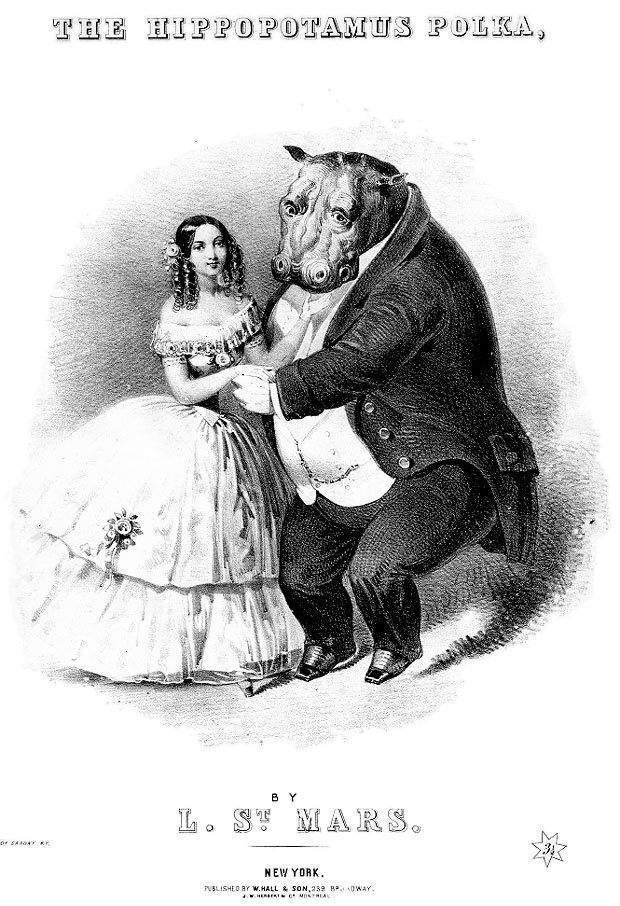
This cover documents the polka at the moment of its greatest vogue in America and Britain, showing how the dance was packaged for popular consumption and what it meant in cultural imagination. The specific choice of an animal partner renders explicit the social transgression always implicit in the polka—the close partnership, the speed, the relative informality compared to older European court dances—and thus reveals how novelty and slight scandal were part of the dance's appeal to Victorian audiences.
What you are looking at
A lithographed cover for sheet music presents an anthropomorphic hippopotamus in formal evening dress—dark coat, white shirt front, and waistcoat—dancing with a young woman in a white ball gown trimmed with pale blue or grey fabric. The woman wears her dark hair in ringlets fashionable of the 1850s and holds a small bouquet. The hippo, rendered with exaggerated but recognizable features, bends slightly toward his partner in a posture of courtly attention. The pair occupy the center of the composition against a plain background, positioned as though mid-movement in a social dance. The woman's skirt has volume and definition typical of the crinoline era, while the hippo's substantial frame creates a comic contrast with her delicate proportions. The overall tone is one of playful satire: a grotesque animal partner treated with the formal courtesies of ballroom protocol.
The dancing
The two figures stand in what appears to be a ballroom closed or near-closed position, with the hippo's right arm extended toward the woman's waist and his left arm raised. The woman's posture is upright and composed, her body angled slightly toward her partner. Both figures are depicted in a moment of forward motion or turn rather than a static pose. The hippo's weight appears to rest on his hind legs in an anthropomorphic stance; the woman stands with the lightness and elongated bearing typical of 1850s ballroom deportment. The scale difference between the two dancers—the hippo's broad shoulders and thick torso against the woman's corseted frame—is central to the composition's humor.
The dance depicted
This is a polka, as indicated by the title and the date (early 1850s, when the polka was at the height of its European and American popularity). The polka was a lively, spirited couple dance in 2/4 time that required close partnership and relatively vigorous movement—exactly the kind of social dance that would be rendered absurd by an enormous hippopotamus as partner. The image captures the essential format of polka instruction and music marketing in this period: sheet music covers routinely featured glamorous or comic scenes of the dance being performed. This particular cover plays on the novelty and exotic appeal of the hippo Obaysch, who arrived at the London Zoo in 1850 and became a sensation. The dance itself is not technically demanding as depicted here—the figures are shown in a formal, almost stately posture rather than in the quick, bouncing action the polka required—but the very incongruity of the animal partner performing a civilized social dance is the point.
How it was made
This is a hand-colored or printed lithograph, a medium well-suited to popular sheet music illustration in the 1850s. The artist John H. Sherwin's design was produced in Napoleon Sarony's lithography studio in New York, making this a commercial print created for mass distribution. Lithography allowed for the combination of fine detail (visible in the woman's facial features and the rendering of fabric) with bold graphic areas and the possibility of hand-coloring for additional appeal. The technique was economical enough to make this an affordable popular object, circulated as the cover of sheet music published by W. Hall & Son on Broadway. This is not a fine art object but a functional commercial illustration, one of thousands of polka covers produced in the 1850s, though distinguished by the celebrity status of Obaysch.
About this work
This is a humorous lithographed cover for 'The Hippopotamus Polka,' a piece of sheet music published in New York in the early 1850s. The cover depicts the famous hippopotamus Obaysch dancing in formal ballroom dress with a young woman in a white gown, in a moment of polka partnership. The image sits at the intersection of several popular obsessions of its moment: the vogue for the polka as a new, modern, slightly transgressive dance; the Victorian appetite for zoological curiosities and their comic anthropomorphization; and the mass production of illustrated sheet music as affordable popular entertainment. It is a work of commercial popular culture rather than fine art, but it is a rich historical document of how the polka was understood, marketed, and made amusing to audiences of the era.
How to look at it
The viewer should attend to the formal courtesies being extended to the hippo—he is treated as a gentleman, with his partner responding to him with the decorum of a ballroom partner. The artist has rendered him not as a monster or a creature but as a somewhat ungainly but earnest dancer, which is what makes the image comic. Look at the positioning of the bodies: despite the grotesqueness of the partner, the dance frame and posture are correct for a formal polka position of the era. The woman's composure—her unruffled expression and proper carriage—is essential to the humor. The image is not mocking the hippo so much as mocking the conventions of ballroom etiquette by applying them without alteration to an impossible situation.
The artist
John H. Sherwin provided the illustration for this cover while working in the lithography studios of Napoleon Sarony, a prominent New York lithographer and printer active from the 1840s into the early 20th century. Sarony's studio was known for producing commercial prints, theatrical illustrations, and sheet music covers—the workhorse of mid-century popular visual culture. Sarony himself later became a celebrated photographer, but at this period his firm was primarily a lithography house producing hundreds of images for popular distribution. Sheet music cover illustration was a significant part of this commercial output.
The period
The polka arrived in Western Europe from Bohemia in the 1830s and became a sensation in Paris, London, and New York by the 1840s and 1850s. It was new, modern, and slightly scandalous—faster and more intimate than the waltz, with couples in close contact dancing at speed. The polka craze generated enormous amounts of popular material: sheet music, dance instruction manuals, satirical prints, and references in literature and visual culture. In the same years, zoological collections and the exhibition of exotic animals became a major source of public entertainment and wonder. Obaysch the hippo, imported to the London Zoo in 1850, became a celebrity, and his name and image were rapidly commercialized across media. This cover represents the intersection of these two enthusiasms: the novelty dance and the novelty animal, brought together for comic effect and commercial appeal.
Where it lives
This image is drawn from Wikimedia Commons and is identified as a cover for sheet music published by W. Hall & Son at 259 Broadway in New York in the early 1850s. The music was composed by Louis St. Mars.
Dance in this work
Questions about this work
Is this a real dance called the Hippopotamus Polka?
Yes, this is the cover of an actual piece of sheet music from the early 1850s. The 'Hippopotamus Polka' was written by Louis St. Mars and published by W. Hall & Son in New York. Like many pieces of popular music of the era, the polka was the standard form, and the title played on whatever novelty or celebrity was current—in this case, the famous hippo Obaysch at the London Zoo.
Who was Obaysch?
Obaysch was a hippopotamus brought to the London Zoo from Egypt in 1850, and he became an instant celebrity. He was the first live hippo seen in Western Europe in modern times, and his arrival generated enormous public interest. His image and name were rapidly commercialized across popular culture—songs, prints, souvenirs, and performances were produced to capitalize on hippo mania.
What is a polka?
The polka is a lively couple dance in 2/4 time that originated in Bohemia in the early 19th century. It became a craze in Western Europe and America in the 1840s and 1850s, prized for its speed, energy, and the close partnership it required between dancers. It was considered modern and slightly scandalous compared to older, more formal dances.
Is this a lithograph?
Yes. The image is a lithograph produced in the studios of Napoleon Sarony in New York. Lithography was the standard printing technique for sheet music covers and popular prints in the 1850s, allowing for relatively fast and affordable production of images for mass circulation.
More dance artwork





