49 works in this view — arrow keys or swipe to move between them.
Dance in Art
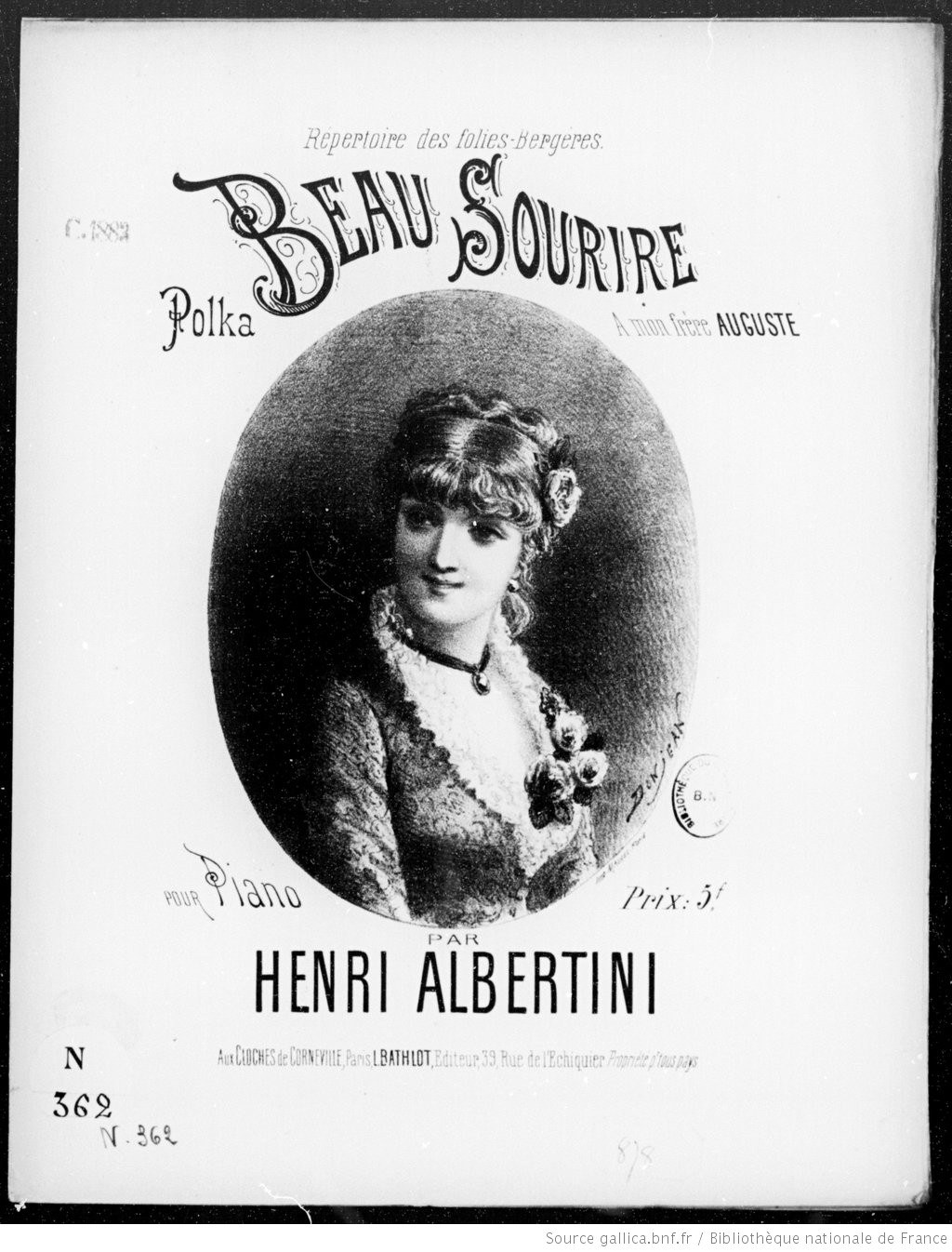
Beau sourire - polka - (...)Albertini Henri btv1b9068941g
Gustave Donjean (1800-1899) Domaine public
- Source:
- Wikimedia Commons
- Rights:
- Reusable with conditions: credit the creator; share any adaptation under the same license. Source record ↗
- Recorded as:
- cc by-sa 4.0
This piece illustrates the commercial circulation of dance music and the role of performer portraiture in music-hall marketing during the Belle Époque. It shows how polka—a popular ballroom and music-hall dance—was mediated through sheet music, performer image, and published collection, reaching middle-class homes and concert venues across Europe.
What you are looking at
This is the cover to a published piano piece, a lithographed illustration framed by ornamental typography. A woman sits or reclines in three-quarter view within an oval vignette, gazing toward the viewer with a composed, theatrical expression. She wears an elaborate dress of the 1870s–80s with lace detailing at the bodice and what appears to be a corsage or floral ornament pinned to her breast. Her hair is styled in the period fashion, swept up and curled, with a small dark ornament or jewel at the crown. The background is a soft tonal wash, creating depth behind the figure. The composition is formal and intimate at once—a portrait-style presentation of a performer, not a dance scene. The title *Beau Sourire* (Beautiful Smile) appears in elaborate display type above the figure, with credits and publication details below.
The dancing
No dance is depicted. The figure is stationary, posed for the camera or for a portraitist's study. Her posture is relaxed and elegant, the body angled, the gaze direct and composed. The gesture is one of social presence rather than movement—the slight turn of the head, the slight play of fabric, the deliberate placement of ornament all suggest a woman aware of being observed and comfortable in that observation. This is a portrait of a performer, not a representation of performance.
The dance depicted
This is not a dance image. It is a cover illustration for a polka composed by Henri Albertini. The title *Beau Sourire* and the credit line indicate that this is part of the *Répertoire des folies-bergères*—a collection of pieces associated with the Folies Bergère, the famous Parisian music hall. The figure may be an actress, dancer, or performer associated with that venue, but no dancing is shown. The polka itself would have been performed by musicians and possibly danced by audience members or performers in the halls, but this image documents neither.
How it was made
This is a lithographic print, recognisable by the characteristic grain and tonal qualities of the stone-printed image. The work shows the technical refinement typical of high-end music-hall publication of the period: the portrait is delicately rendered in greyscale, while the typography is crisp and ornamental. Lithography allowed for relatively affordable mass production of sheet-music covers, making these objects widely distributed among piano-playing households and performance venues. The combination of a named performer's image with the title and composer's name on a single sheet served both as advertisement and as a souvenir.
About this work
This is a sheet-music cover for a polka composed by Henri Albertini, illustrated with a portrait attributed to Gustave Donjean. It documents the commercial world of Parisian popular entertainment in the late 19th century, when sheet music for piano was a major medium of entertainment and performers' images were used to market compositions. The work is not primarily a dance image but a cultural artifact of the music-hall economy. It belongs in a gallery of dance in art because it reveals how dance music was packaged, promoted, and consumed; because the figure may represent a performer associated with the Folies Bergère; and because the polka was a social and theatrical dance form central to the period.
How to look at it
Attend to the formal conventions of the portrait: the oval frame (a device borrowed from painting and photography), the direct but composed gaze, the careful costume, and the soft, flattering rendering. This is not a candid or action image but a carefully staged presentation of a public figure. The ornamental typography frames and aestheticizes the portrait, integrating it into a commercial design. The viewer should note the absence of any hint of dance or movement—the image is about presence and personality, not action.
The artist
Gustave Donjean (1800–1899) was a French illustrator and graphic artist with a long career spanning the 19th century. He was active in the production of commercial and theatrical imagery, including sheet-music covers and music-hall publicity. His work is representative of the professional illustrators who supplied the growing music-publishing industry with portraits, vignettes, and decorative designs.
The period
The polka was enormously popular in the mid-to-late 19th century as both a ballroom dance and a music-hall entertainment. The Folies Bergère, founded in 1869, became one of Paris's most celebrated venues for revue and popular entertainment. Sheet music for piano was a central domestic entertainment medium, and the cover illustrations of such publications were often used to promote both compositions and performers. The lithographic print allowed for rapid, economical production of these marketing objects, making them ubiquitous in middle-class homes and music shops.
Where it lives
This work is held in the Bibliothèque Nationale de France (BnF), as indicated by the catalogue number and the source (Wikimedia Commons, Gallica). It is part of the BnF's extensive collection of music-hall ephemera, sheet-music covers, and theatrical publicity materials.
Questions about this work
Is this a dance image?
No. This is a sheet-music cover featuring a portrait of a performer. While it advertises a polka—a popular dance form—no dancing is depicted. The image is promotional rather than documentary of dance practice.
Who is the figure in the portrait?
The catalogue record does not identify the subject by name. The image may represent a performer associated with the Folies Bergère, but without additional archival documentation, her identity cannot be confirmed from the image alone.
What is a polka in this context?
A polka was a popular ballroom dance of the 19th century, typically performed in pairs to lively music in duple time. It was also a staple of music-hall entertainment and popular theatre. Sheet-music editions of polka compositions were produced in large numbers for home piano performance.
What is the Folies Bergère?
The Folies Bergère was a famous Parisian music hall founded in 1869, known for revue, popular entertainment, and performances by well-known singers and dancers. It became an iconic venue of Belle Époque entertainment and remains in operation today.
More dance artwork





