49 works in this view — arrow keys or swipe to move between them.
Dance in Art
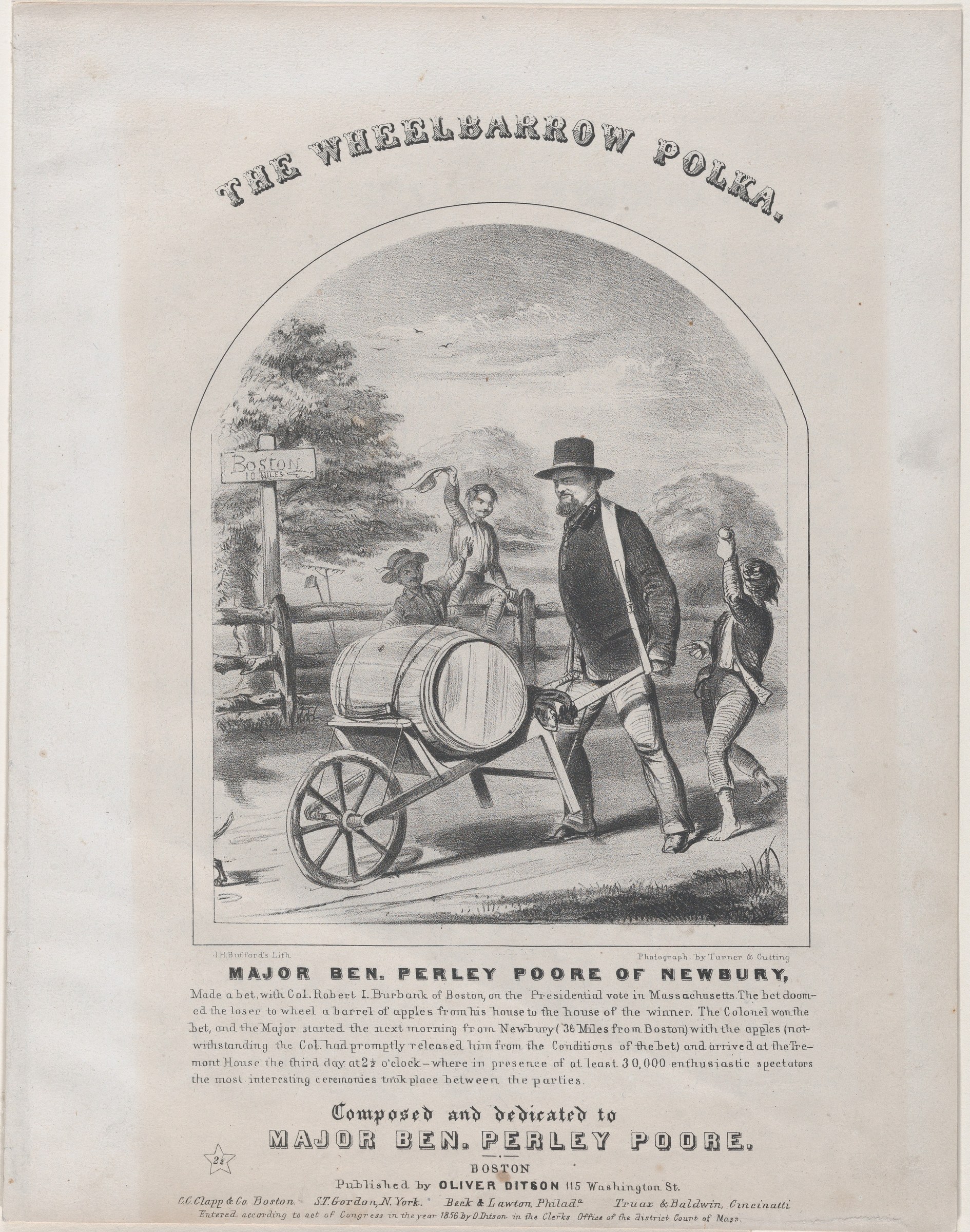
The Wheelbarrow Polka (Sheet music cover)
Winslow Homer / Oliver Ditson Company
- Source:
- Wikimedia Commons
- Rights:
- Public domain — free to use, share and adapt.
- Recorded as:
- cc0
The image reveals how nineteenth-century sheet music covers functioned as popular imagery and social documentation, capturing moments of local celebrity and vernacular humor rather than idealized dance scenes. It demonstrates the polka's penetration into American popular culture by the 1850s, and shows how music publishers leveraged topical humor and recognizable local figures to drive sales of instrumental dance music to amateur performers.
What you are looking at
A sheet music cover depicts a rural outdoor scene with a wooden signpost marked "Boston" visible at left. In the foreground, a gentleman in a top hat and dark coat stands beside a wooden barrel mounted on a two-wheeled hand truck or barrow. The barrel appears to be the subject of a wager or competition. Behind him, a young woman in a light dress with a bonnet sits atop or near the barrel, while another woman in similar dress stands nearby. A third figure—possibly another woman or child—is visible at right. The landscape suggests a country road with trees and vegetation; the scene has the character of a rural Massachusetts setting, as indicated by the Boston sign and the caption's reference to distances from Boston.
The dancing
The gentleman stands in a formal posture beside the wheelbarrow, suggesting oversight or participation in some kind of wager or game. The woman seated on or near the barrel adopts a casual, almost playful pose. The other figures stand nearby in relaxed attitudes, suggesting they are witnesses or participants in a social amusement rather than a formal dance. No closed holds or ballroom frames are evident; the bodies are positioned around the wheelbarrow prop rather than in relation to one another as dancing partners.
The dance depicted
The title identifies this as a polka—a Czech dance that became wildly popular across Europe and America in the 1850s. However, the image does not depict the polka being danced. Instead, it illustrates the humorous narrative described in the caption: a bet involving Colonel Robert L. Burbank of Boston and Major Ben Perley Poore of Newbury, Massachusetts, in which the loser had to wheel a barrel of apples from the loser's house to the winner's house. The imagery commemorates this comic wager rather than showing the actual dance; the music was likely published to capitalize on the story's popularity and the novelty of the situation.
How it was made
This is a wood engraving, a relief printing technique that allowed for fine detail and high-quality reproduction on a printing press. The credit line reads 'J.W. Barrows, Lith.' and 'Photograph by Turner & Cutting,' indicating the work was likely based on a photograph and translated into a lithographic or engraved image for mass production. The print was published by Oliver Ditson, a major music publisher in Boston, suggesting wide circulation as a cover for sheet music sold to amateur musicians and performers across America. The technique permitted the image to reach thousands of copies at modest cost.
About this work
This 1856 sheet music cover for 'The Wheelbarrow Polka' documents a humorous incident between two Massachusetts gentlemen—Colonel Robert L. Burbank and Major Ben Perley Poore—rather than depicting an actual polka performance. The composition transforms a local wager (involving the ceremonial transport of a barrel of apples) into a mass-produced image, printed and distributed by the Oliver Ditson Company, one of America's leading music publishers. The work sits at the intersection of folk humor, commercial music publishing, and mid-nineteenth-century American social life, where dance music served as a vehicle not only for actual dancing but for commemorating local celebrity and comic incidents that captured public imagination.
How to look at it
The viewer should first recognize that this image is not a dance scene at all, despite being a music cover: the figures are posed around a prop and a narrative moment, not in the postures or holds of a couple executing a polka. The composition uses the wheelbarrow as a central focal point, drawing the eye to the object of the wager rather than to the dancers' bodies. Observe the formality of the gentleman's dress (top hat, coat) contrasted with the rural setting and homely prop—the contrast itself is the joke. The fine detail of the wood engraving (visible in the trees, the barrel's construction, the textures of cloth) was a technique that allowed publishers to create visually rich images suitable for reproduction on a large scale, making such topical images affordable and accessible to middle-class households.
The artist
Winslow Homer (1836–1910) was an American painter and printmaker who rose to prominence during the Civil War as a war correspondent and later became known for his paintings of rural American life, the sea, and the outdoors. While Homer is celebrated today chiefly for his mature oils and watercolors, he was also a prolific commercial illustrator and wood engraver in the 1850s and early 1860s, creating works for popular magazines, newspapers, and music publishers. His commercial work often captured scenes of everyday American life with keen observation and gentle humor.
The period
The polka became a sensation in America during the 1840s and 1850s, arriving from Central Europe and spreading rapidly through urban and rural communities alike. Sheet music was the primary means by which dance music circulated, and cover images served as advertisements, genre markers, and often sources of humor or topical interest. The 1850s were the heyday of illustrated sheet music covers in America; publishers like Ditson commissioned artists to create eye-catching images that would appeal to amateur musicians—particularly women—who purchased and played dance music at home. The mid-nineteenth century also saw a lively tradition of local sporting wagers, practical jokes, and community news finding their way into commercial popular culture through music, prints, and newspapers.
Where it lives
Published by Oliver Ditson, 115 Washington Street, Boston, as a sheet music cover in 1856. The work is a commercial print intended for mass distribution to amateur musicians and music lovers. It is now held at Wikimedia Commons.
Questions about this work
Is this an actual dance scene?
No. Although it is the cover of a polka sheet music publication, the image illustrates a humorous local incident—a wager between two Massachusetts gentlemen—rather than depicting the polka being danced. The wheelbarrow, the barrel of apples, and the rural setting are all elements of the story, not the dance itself. The image shows the moment of the bet's execution or celebration.
Who were Major Ben Perley Poore and Colonel Robert L. Burbank?
According to the caption, they were contemporary figures from Massachusetts—Burbank from Boston and Poore from Newbury (36 miles from Boston). The printed narrative indicates they made a wager on the 1856 Presidential election in Massachusetts, with the loser required to wheel a barrel of apples from his house to the winner's. This local incident was apparently notable enough to be memorialized in commercial sheet music, suggesting both men were locally prominent or the incident captured public imagination.
Why would a music publisher create a cover about a wheelbarrow?
Sheet music covers in the 1850s often featured topical humor, local celebrities, and amusing incidents to capture buyers' attention and capitalize on current events or local interest. By naming recognizable figures and illustrating a humorous wager, the publisher made the cover a conversation piece as well as a functional cover for dance music. This marketing strategy helped the sheet music sell to amateur musicians who enjoyed both the music and the story behind it.
What is a wood engraving?
A wood engraving is a relief printing technique in which an image is carved into the end grain of a wooden block, with the raised portions inked and printed. Unlike woodcuts, which use the plank grain, engravings use the harder end grain, allowing for finer detail and sharper lines. This technique was ideal for book and sheet music illustration in the nineteenth century because it produced durable plates capable of printing thousands of copies.
More dance artwork





