49 works in this view — arrow keys or swipe to move between them.
Dance in Art
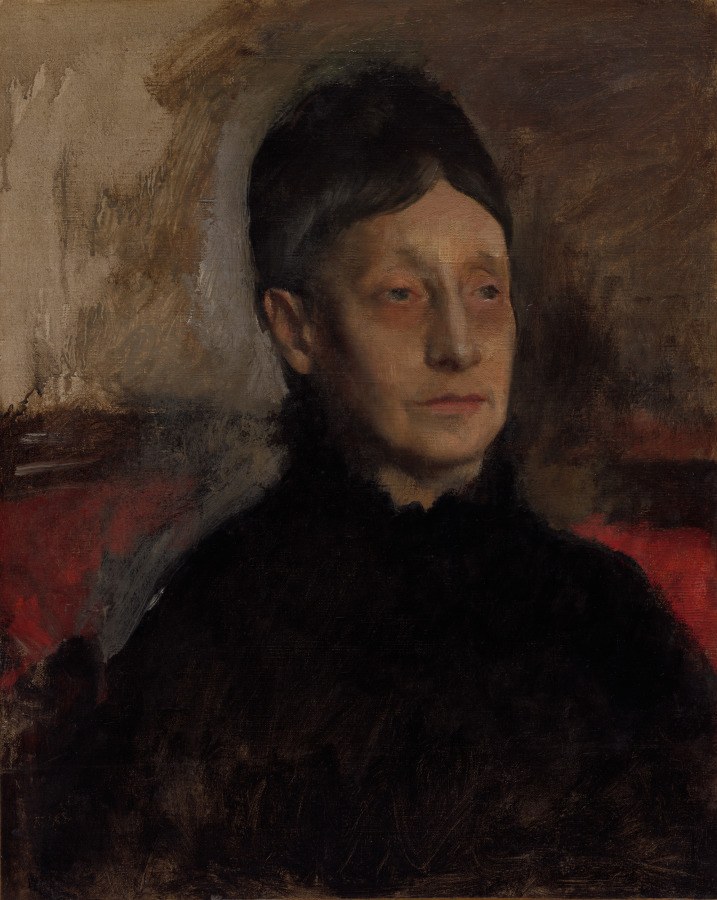
Stefanina Primicile Carafa, Marchioness of Cicerale and Duchess of Montejasi
Edgar Degas (French, 1834–1917)
- Medium:
- oil on fabric
- Collection:
- Modern European Painting and Sculpture
- Source:
- Cleveland Museum of Art
- Rights:
- Public domain — free to use, share and adapt.
- Recorded as:
- CC0
While this work does not depict dance, it matters for understanding Degas as a complete artist and for recognizing that even a gallery focused on dance in art must acknowledge the non-dance work of major dance painters. It also illuminates the social world from which Degas's dancers emerged—the world of aristocratic families, mourning, and formal social ritual. The painting reminds us that Degas's interest in human movement and character was not confined to the stage.
What you are looking at
A three-quarter-length portrait of a woman in dark mourning dress, posed against a muted interior. She sits or stands with her body angled slightly leftward, her gaze directed away from the viewer with an expression of quiet melancholy. The painting employs a restrained palette of browns, grays, and muted ochres; her black dress absorbs light, creating a strong tonal contrast with her pale face and the lighter wall behind her. A hint of red fabric—possibly upholstery or drapery—appears in the lower right. The composition is intimate and psychologically charged, with minimal props or setting details. The woman's posture suggests resignation rather than animation; her hands rest quietly, her shoulders slightly drawn. The brushwork is deliberate but not heavily worked, allowing the underlying structure of the form to show through in places.
The dancing
A single stationary female figure, shown from the waist or knees up. Her pose is contemplative and formally composed rather than active or gestural. The body weight appears distributed evenly; there is no suggestion of movement, dance, or the dynamic engagement of muscles. Her arms hang naturally at her sides or rest in her lap. The face, rendered with careful attention to bone structure and psychological depth, conveys emotional restraint. There is nothing in the posture, hold, or positioning of the body that suggests dance training or the preparation for movement.
The dance depicted
This is not a depiction of dance. The sitter is posed in a conventional portrait attitude of the 1860s–70s. While Degas is celebrated for his ballet paintings, this work belongs to his substantial practice as a portraitist, particularly of family members during his visits to Italy. The quiet, almost austere presentation—especially the mourning dress noted in the catalogue—situates this firmly in the tradition of memorial or formal family portraiture rather than the observation of movement or performance.
How it was made
Oil on canvas, painted with a loose, economical touch. Degas builds form through tonal modulation rather than linear precision, allowing warm and cool grays and browns to create volume and depth in the face. The dark dress is handled with broad, almost summary brushstrokes, while the face receives more detailed rendering. This technique—efficient and psychologically alert—was characteristic of Degas's portraiture and reflects his training in the academic tradition combined with his interest in modern observational immediacy.
About this work
This is a formal portrait of Degas's aunt, Stefania Carafa, duchess of Montejasi, painted during one of his working visits to Naples in 1870. It demonstrates Degas's mastery of the portrait form and his ability to capture psychological presence through restrained means. Although the work belongs to a gallery dedicated to dance in art, it serves as a counterpoint to Degas's more celebrated ballet imagery—a reminder that his acute powers of observation and formal invention extended well beyond the stage into the domestic and social world of his family and patrons.
The painting is also an historical document: the mourning dress suggests the recent death of a family member (the catalogue notes her brother Achille), and the image preserves a moment of private grief made public through portraiture. It represents the kind of intimate, unflinching family record that Degas produced throughout his career, often with more psychological penetration than sentiment.
How to look at it
Attend to the direction of the sitter's gaze—she looks away from the viewer, which is unusual and creates a sense of privacy and interiority. Notice how Degas uses darkness and light: the black dress becomes almost abstract in its intensity, while the face emerges with remarkable subtlety from the surrounding tones. The minimal setting—just a wall and a hint of furniture—keeps the focus entirely on the figure's psychological presence. The painting rewards close looking at the face, where you can see how little linear detail Degas uses to convey intelligence, weariness, and composure.
The artist
Edgar Degas (1834–1917) was trained in the academic tradition and began his career as a history painter and portraitist. He came from a wealthy Creole banking family with extensive connections in Italy; several of his relatives lived in Naples and other southern cities. Throughout his career, Degas maintained a substantial practice as a portraitist, particularly of family members, even as he became famous for his ballet paintings. His approach to portraiture was psychologically acute and formally inventive, often employing unusual cropping and viewpoints derived from photography and Japanese prints. He visited Naples and other Italian cities multiple times, producing portraits and studies during these sojourns. The portrait tradition remained central to his practice even after he had achieved recognition for his avant-garde work.
The period
In the 1870s, Degas was at the height of his early maturity, deeply engaged with ballet and the theater while also maintaining his role as a society portraitist. The decade saw the consolidation of Impressionism and the emergence of new attitudes toward color and form in European art. In Italy, particularly Naples, the social world remained more hierarchical and formal than in Paris, and portraiture continued to hold high cultural value. The practice of mourning dress and portraiture was still a significant social convention, and the representation of grief or melancholy was treated with gravity and psychological depth rather than sentimentality.
Where it lives
The work is in the collection of the Cleveland Museum of Art, catalogued as Modern European Painting and Sculpture. It is part of the museum's holdings of nineteenth-century European portraiture and represents the breadth of Degas's practice beyond his more widely known ballet subjects.
Questions about this work
Why is a non-dance portrait in a dance gallery?
Degas is celebrated as the painter of ballet, but he was also a major portraitist. This painting shows the full scope of his artistic practice and reminds us that even in galleries devoted to a specific subject, the greatest artists often worked across multiple genres. It also documents the social world—aristocratic, formal, marked by ritual—from which Degas's dancers emerged.
What does the black dress tell us?
The mourning dress signals grief: the catalogue notes that Degas probably painted this during a visit to Naples, possibly to mark the recent death of his aunt's brother, Achille. Mourning dress was a formal social convention in the nineteenth century, and its presence here transforms the portrait into a historical document of family loss.
How does this differ from Degas's ballet paintings?
In his ballet works, Degas captures bodies in motion—dancers mid-arabesque or in rehearsal. Here, the body is entirely still and inward. The portrait is about psychological presence and formal composition rather than the observation of movement. It shows that Degas's acute eye for human character and form worked across both dynamic and static modes.
More dance artwork





