49 works in this view — arrow keys or swipe to move between them.
Dance in Art
Avant Le Ballet
Charles Paul Renouard (French, 1845–1924)
- Medium:
- Color lithograph
- Collection:
- Prints
- Source:
- Cleveland Museum of Art
- Rights:
- Public domain — free to use, share and adapt.
- Recorded as:
- CC0
The work demonstrates that by the 1890s, balletic movement had become a recognizable visual language in popular culture—so familiar that an artist could invoke it playfully in a sketch of dogs at play. For dance historians, it shows how the aesthetic of theatrical movement inflected the way illustrators saw and rendered bodily action in ordinary life. For art historians, it exemplifies Renouard's role as a chronicler of Parisian society, capturing social moments with economical, assured line.
What you are looking at
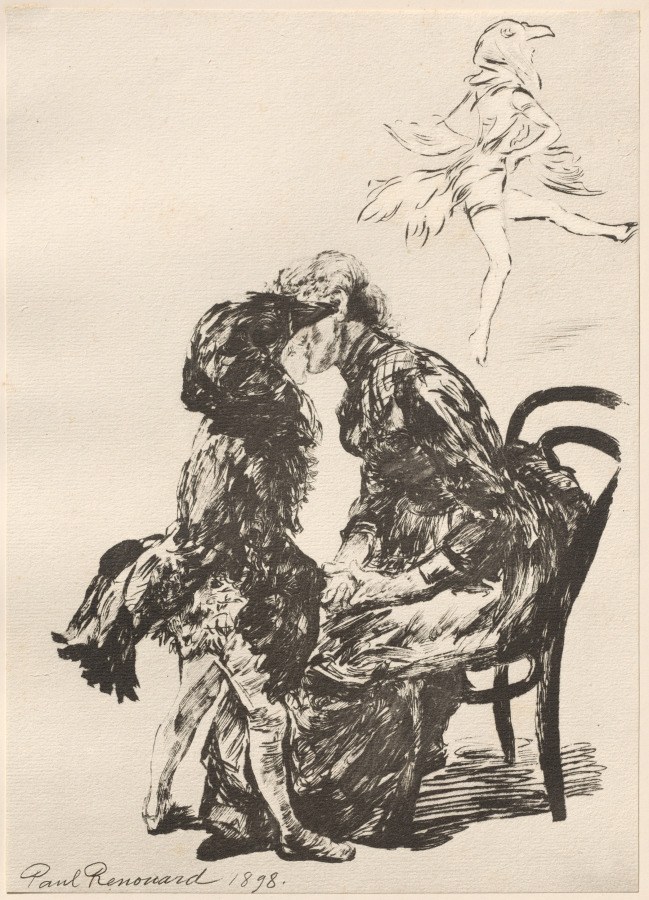
A woman in elaborate late-nineteenth-century dress sits on a wooden chair, leaning forward with animated gesture as she watches two dogs engaged in playful interaction before her. The woman wears a dark, richly patterned dress with full sleeves and what appears to be a feathered hat or headdress. The two dogs—one darker and one lighter in tone—rear up on their hind legs facing each other in a lively pose, their bodies twisted in a way that suggests movement and mutual engagement. A faint sketch of a small figure, possibly a dancer or acrobat, appears in the upper right corner of the composition. The drawing is executed in bold black ink with dynamic, gestural line work that conveys movement and personality, typical of Renouard's observational sketch style.
The dancing
The human figure is rendered with confidence in the seated posture, her forward lean and hand gesture suggesting active engagement with the scene. The dogs dominate the composition through their upright, confrontational stance—bodies twisted, legs extended, creating a sense of kinetic energy. The faint upper sketch shows a figure in an inverted or acrobatic position. The artist has chosen poses that emphasize dynamic tension and playful interaction rather than rest.
The dance depicted
This work does not depict human dance. While the title 'Avant Le Ballet' (Before the Ballet) invites an interpretation of preparation or anticipation, the composition shows dogs at play rather than dancers. The small inverted figure sketched in the upper right may represent a performer or acrobat, but it is too faint and incomplete to establish as a dance image. The work appears to be a witty visual pun: the dogs' animated, contorted postures suggest balletic movement—the leaping, twisting forms one might find in theatrical dance—but applied to animals. This is observational comedy about movement rather than documentation of actual dance practice.
How it was made
A color lithograph in the catalogue record, though the work as reproduced appears to be rendered primarily in black ink with pen or lithographic crayon on cream paper. The technique allows Renouard to capture spontaneous gesture and rapid notation—the line work is loose and confident, with heavy blacks in the dogs' forms and lighter, almost invisible line in the upper sketch. This suggests a drawing that was likely intended for print publication, giving it wide circulation among newspaper and magazine readers rather than fine-art collectors.
About this work
Charles Paul Renouard was one of the most prolific illustrators of Parisian life in the late nineteenth century, and this 1898 drawing exemplifies his wit and observational skill. The work plays visually on the title's promise: instead of depicting dancers before a performance, it shows two dogs whose acrobatic play mimics balletic posture and movement. The composition sits at the intersection of animal studies and dance representation—using the language of theatrical movement to animate creatures engaged in pure, unselfconscious play. For a gallery of dance in art, it matters as an example of how dance movement could be recognized and invoked even outside the theater, and how the formal vocabulary of ballet had become familiar enough to audiences that it could be applied, ironically, to everyday scenes.
How to look at it
Attend to the posture and energy of the dogs: the artist has rendered them with the same attention to line, balance, and dramatic gesture that he applied to theatrical subjects. Note how the woman's seated position and forward lean create a triangular composition that frames the action. The faint sketch in the upper right invites the viewer to complete the joke—to recognize that human performers practicing balletic movement would adopt similarly extreme, contorted poses. The title operates as a key: it teaches the viewer to see the dogs' play as a visual echo of dance training or performance.
The artist
Charles Paul Renouard (1845–1924) was a French illustrator and painter celebrated for his depictions of Parisian theatrical and social life. He was a prolific contributor to periodicals including Le Figaro and Le Gaulois, and worked in lithography, etching, and pen and ink. His practice combined careful observation with rapid notation, allowing him to capture spontaneous moments. He was known for works depicting theater scenes, rehearsals, and backstage life, as well as society portraiture and genre scenes. His style—economical line, dramatic use of black, psychological insight—made him influential in modern illustration.
The period
The 1890s saw the height of fin-de-siècle Parisian culture, with the theater and music hall at the center of artistic and social attention. Renouard was documenting this world as a professional illustrator at the moment when ballet was undergoing significant change—the Russian Imperial Ballet's influence was beginning to reach Paris, though Diaghilev's Ballets Russes would not arrive until 1909. The title 'Avant Le Ballet' (Before the Ballet) likely refers to preparation or anticipation, a theme common in theatrical illustration of the period. Lithography was the dominant medium for illustrated journalism and fine-art prints, allowing artists like Renouard to reach wide audiences.
Where it lives
The work is held in the Prints collection at the Cleveland Museum of Art. Renouard's prolific output of illustrated works—many in lithography—meant that his prints circulated widely in periodical publications; this piece may have been created for print journalism before becoming part of a fine-art collection.
Questions about this work
Is this actually about dance?
Not directly. The title 'Avant Le Ballet' is a playful reference: the dogs' acrobatic, twisted postures mimic the extreme physical positions of ballet dancers, but the subject is animal play. The work works as visual humor, inviting viewers familiar with balletic movement to recognize it in the dogs' forms. It demonstrates how recognizable and transferable the aesthetic of dance had become by the 1890s.
Who was Charles Paul Renouard?
A French illustrator and painter (1845–1924) known for documenting Parisian theatrical and social life. He was a prolific contributor to illustrated periodicals and a skilled lithographer and draftsman. His work combined careful observation with rapid, confident line work, making him influential in modern illustration practice.
What is the small figure in the upper right?
A faint sketch, rendered almost as quickly as a note. It appears to show a figure in an inverted or acrobatic pose, possibly a performer or dancer. It is too sketchy and incomplete to identify with certainty, but it reinforces the theme of physical performance and contortion that the dogs' postures also suggest.
More dance artwork





