49 works in this view — arrow keys or swipe to move between them.
Dance in Art
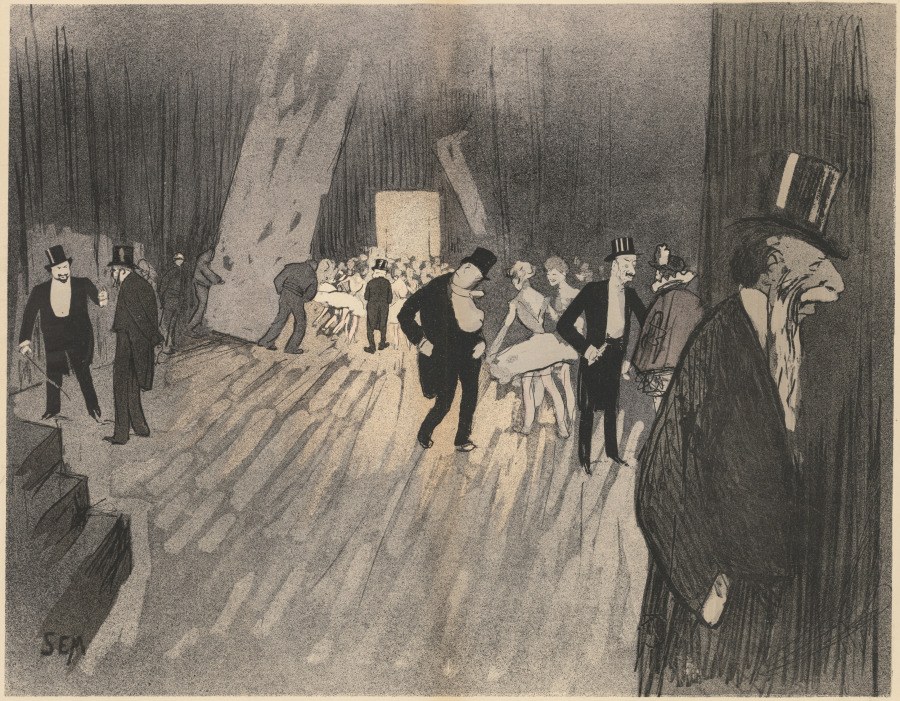
Backstage of the Ballet
Sem (Georges Gourçat) (French, 1863–1934)
- Medium:
- lithograph hand-colored with watercolor
- Collection:
- Prints
- Source:
- Cleveland Museum of Art
- Rights:
- Public domain — free to use, share and adapt.
- Recorded as:
- CC0
This work preserves the social archaeology of professional ballet at a formative moment in its history. It shows us the dancers, stage hands, musicians, and patrons in their everyday dress and informal bearing—the human reality of the theatre that was Sem's subject. For understanding how ballet was made, experienced, and socially positioned in late 19th-century Paris, this kind of observant, unsentimental documentation is invaluable.
What you are looking at
A crowded theatrical backstage viewed from an elevated vantage point, rendered in tonal lithography with selective hand-coloring in watercolor. The deep stage space recedes toward a brightly lit backdrop, framed by heavy vertical curtains that close the sides of the composition. The floor is marked by strong diagonal planking in perspective. Two dozen or more figures populate the space: dancers and theatre personnel in evening dress (tailcoats, top hats, and formal attire) mingle and move through the backstage area. Some figures stand in conversation; others appear to be preparing or waiting. The lighting creates a strong contrast between the warm, bright central area where dancers gather and the deeper shadow of the wings. The crowd is distributed unevenly, with denser clustering in the middle distance and more isolated figures in the foreground and sides. The overall mood is one of theatrical bustle and social mingling during a performance or rehearsal.
The dancing
The figures stand and move in small conversational groups with relaxed posture and informal placement—no formal hold or partnered frame is evident. Bodies are oriented variously, some facing into the crowd, others turning away. Several men gesture with hands raised or akimbo. The dress is consistently formal evening wear for both men and women, with women in what appear to be performance or social gowns with fitted bodices. The bodies suggest movement through space and social interaction rather than choreographed dancing—this is a scene of preparation and socializing, not a formal dance.
The dance depicted
This is not a depiction of dance in progress, but of the world of ballet—the backstage social and professional space where dancers and theatre personnel assembled. The image captures the informal moment before or after a performance, or during a rehearsal break. The formal evening dress of the male figures and what appear to be stage costumes on some women suggest a professional theatrical context. The scene documents the social culture of late 19th-century Parisian ballet, where the stage door and backstage were sites of interaction between performers, stage managers, musicians, and patrons.
How it was made
This is a hand-colored lithograph, a reproductive technique that allowed for circulation in multiples while retaining the artist's direct mark-making. The selective hand-coloring in watercolor over printed tonal lithography creates atmospheric depth: the print's grey and black tones establish the composition and shadow, while watercolor touches (pale flesh tones, hints of fabric color, bright whites in the lit background) guide the eye and enliven the scene. Lithography's capacity for tonal gradation was ideal for capturing the chiaroscuro of stage lighting and the complex spatial recession of the theatrical interior. The technique was common for theatrical and satirical subjects in fin-de-siècle Paris, and suited to the kind of social observation this image embodies.
About this work
This is a behind-the-scenes view of the Paris Opéra or a major ballet theatre in the 1890s, capturing the social and professional milieu of late 19th-century dance. Sem (1863–1934), a celebrated theatrical and social satirist, recorded the world of entertainment and high society in observant, affectionate works. The image sits at the intersection of dance history and social history: it documents not the dance itself but the culture, hierarchy, and informal moments that surrounded professional ballet performance in the Belle Époque. For dance historians, it offers rare visual evidence of backstage practice and the composition of the ballet world beyond what appears on stage.
How to look at it
Attend to the scattered, conversational arrangement of the figures and the absence of any formal choreography or dance position. Note the strong role of architectural framing—the curtains and planking—in organizing the composition and creating depth. The lighting is deliberately theatrical: the viewer's eye is drawn to the bright central area where figures cluster, while the wings fall into shadow. The artist has chosen a moment of pause or mingling rather than action, emphasizing the social rather than the balletic dimension. This choice—to depict the theatre's hidden social life rather than its visible spectacle—is the work's fundamental innovation.
The artist
Sem (the pseudonym of Georges Gourçat, 1863–1934) was a French caricaturist, lithographer, and social chronicler who built his reputation on witty, observant images of Parisian high society, theatre, and entertainment. He worked primarily in lithography and contributed regularly to newspapers and satirical journals. His subjects ranged from the demimonde to aristocracy to the world of the stage, and he captured social types and situations with economy and a light hand. He was as much documentarian as satirist: his work records the actual appearance, dress, and milieu of Parisian society at the turn of the century.
The period
The 1890s were a period of expansion and transformation in European ballet. The Romantic era's dominance was fading, but classical ballet training and spectacle remained central to the Paris Opéra's prestige. This was the era of the rise of the prima ballerina as celebrity and of growing interest in the behind-the-scenes world of theatre as a subject for visual art. In the same decades, photography was beginning to document theatrical interiors and rehearsals, but lithographic satire and social observation remained the primary medium for capturing theatrical society and the informal life of performers. Sem's work coincides with a broader cultural interest in the theatricality and social complexity of Parisian performance.
Where it lives
The print is held in the Prints collection at the Cleveland Museum of Art. It is catalogued as a hand-colored lithograph from 1895, consistent with Sem's productive period in the medium and his focus on Parisian theatrical subjects.
Questions about this work
Is this a depiction of an actual ballet performance?
No. This is a backstage scene, a view of the social world surrounding ballet performance rather than the performance itself. The figures are not dancing, but gathering, conversing, and preparing in the theatrical space behind the curtain.
Why would Sem choose to paint backstage rather than the stage itself?
Sem was a social satirist and observer primarily interested in the human comedy of Parisian society. The backstage offered a richer, more complex subject: the mixing of dancers, musicians, stagehands, and social visitors; the informality and hierarchy of professional theatre; the human reality behind the spectacle. This was more interesting to him than reproducing the stage show itself.
What does the formal dress of the male figures tell us?
It indicates that these are professional musicians, stage managers, and patrons—not stagehands or crew. The top hats and tailcoats show a distinction in social status and role within the theatre. The evening dress suggests this backstage scene is one of formal professional interaction, not working-class labour.
How does the hand-coloring change the meaning of the lithograph?
The selective watercolor touches (pale skin tones, fabric hints, bright background) animate the printed lithographic tones and draw the eye into the theatrical space. They emphasize the contrast between shadow and light, reinforcing the sense of a theatrical interior with staged lighting. Without the coloring, the image would be more purely tonal and less atmospheric.
More dance artwork





