49 works in this view — arrow keys or swipe to move between them.
Dance in Art
Nude Female Dancers from a Tunic
Unknown artist
- Medium:
- Silk; complementary weft-faced twill weave with inner warps (samite)
- Collection:
- Textiles
- Source:
- Cleveland Museum of Art
- Rights:
- Public domain — free to use, share and adapt.
- Recorded as:
- CC0
This fragment is one of the few surviving visual records of professional female dancers in the early Islamic and Byzantine world, offering direct evidence of their costume, pose, and the context in which they performed. The technical mastery of the weaving demonstrates that dance imagery was valued highly enough to justify extraordinary expense and skill in its reproduction.
What you are looking at
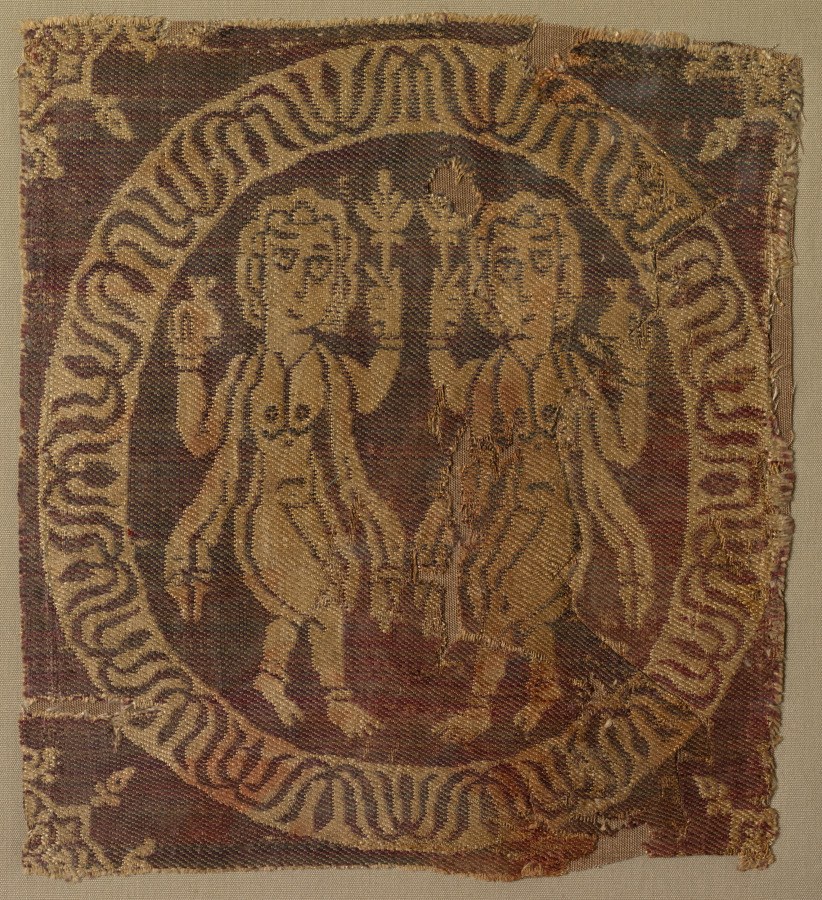
Two female figures face each other in a symmetrical composition within an ornamental border of interlocking geometric patterns. Both wear sheer, pale garments with definition created by fine linear shading. Each figure wears a long scarf or shawl draped loosely around the shoulders and across the body, and both wear anklets rendered as thin bands around the lower leg. The figure on the left holds what appears to be a branch or palm frond; the figure on the right holds a round fruit, likely a pomegranate as noted in the record. The background is rendered in darker woven tones that create depth through contrast. The entire composition is framed by a decorative border of repeated wavy or undulating lines, suggesting a silk textile square meant to be appliquéd to linen.
The dancing
Both dancers stand with weight evenly distributed, their bodies upright and formal. Their arms are positioned to display the objects they hold—one extended to present the branch, the other to present the fruit—in a gesture of offering or display. The figures face each other directly across a vertical axis of symmetry, suggesting a mirrored or complementary pose rather than movement through space. Neither figure leans, twists, or shows weight transfer; the stance is posed and hieratic rather than captured mid-motion.
The dance depicted
This appears to depict courtly or ceremonial female dancers from the early Islamic or Byzantine tradition, likely performing a formal entertainment dance rather than a social or athletic form. The symmetrical presentation, the formal stance, and the props (branches and fruit) suggest a ritual or court performance with symbolic significance. The sheer garments and emphasis on the female form indicate these are professional entertainers rather than amateur participants. Without inscriptions or additional context, the specific dance form cannot be identified, but the style and setting suggest Sassanian Persian or early Islamic court culture, where such performers were documented in visual sources.
How it was made
This is a woven textile fragment created in silk using complementary weft-faced twill weave with inner warps (samite), a luxurious and technically demanding technique. The image is created entirely through the manipulation of weft threads in contrasting tones—the pale dancer figures stand out against darker background weft, while fine linear details in the garments and faces are achieved through precise thread placement. This technique required exceptional skill and was expensive to produce, indicating the fragment was made for a wealthy patron. The geometric border pattern is integral to the weaving and suggests the square was designed to be cut and applied as a decorative element to larger linen tunics, as the catalogue record states.
About this work
This is a small woven silk square from around 700 CE, depicting two symmetrical female dancers in formal pose with symbols of abundance or offering. It belongs to a widespread tradition of producing luxury textiles with figural imagery for the Byzantine and early Islamic courts, where such pieces were sewn onto tunics as status markers and expressions of courtly refinement. The work exemplifies the high technical achievement of early medieval textile production and documents a now-vanished tradition of court entertainment that combined dance, costume, and symbolic gesture. The dancers' formal bearing, props, and sheer garments tell us that professional female performers held an established place in elite court culture of this period, and that their image was considered appropriate for incorporation into the dress of the elite.
How to look at it
Examine the interlocking geometric border first to understand the intended function—this is a square meant to be cut and sewn onto a larger garment. Then study the dancers themselves: note how perfectly symmetrical and posed they are, with no sense of motion or weight shift. The artist has chosen a moment of stillness and formal presentation rather than the dynamic movement of actual dance. Observe how the sheer garments are defined: the body beneath is suggested through fine parallel lines and tonal variation rather than bold outline. This linear technique was the primary tool available to the weaver and shows how the medium shapes what can be depicted.
The period
In the 7th and 8th centuries, the eastern Mediterranean and Persian worlds were experiencing significant cultural and political transformation. The rise of Islam and the solidification of Byzantine power created two competing court systems, both of which maintained traditions of elite entertainment including professional dancers. Textile production was a major art form and a vehicle for communicating status and artistic sophistication. Such silk textiles were traded along long-distance routes and were among the most valuable commodities in the medieval world. The depiction of the female form in luxury textiles suggests these pieces were worn by members of the imperial or aristocratic class who had access to such imports and the means to employ them.
Where it lives
This fragment is held in the Textiles collection of the Cleveland Museum of Art. It is a small square of woven silk textile, one of thousands of such fragments that survive from the early medieval Mediterranean and Near East, many of them still attached to linen tunics or preserved in burials.
Dance in this work
Questions about this work
Who were these dancers?
They were professional entertainers in a court or elite urban setting, likely performing for an audience of the wealthy and powerful. Their status as performers is indicated by their costume, their public depiction on luxury textiles, and the formal, ritualized quality of their pose. Such dancers are documented in historical sources from the Byzantine and early Islamic courts, though most records have been lost.
What do the branch and pomegranate mean?
The objects likely carry symbolic significance related to abundance, fertility, or spring. In early Islamic and Byzantine art, such tokens often appear in the hands of figures performing entertainment or serving functions at court. The specific meaning may relate to a particular season or occasion, but without more context it cannot be determined precisely.
How was this made?
A weaver created this image by carefully selecting and manipulating silk threads of different colors in a samite weave, a technique that requires exceptional skill. The square would then be cut from the larger bolt of cloth and sewn onto a linen tunic as a decorative and status-conveying element. The expense of the materials and skill involved means only the wealthiest people owned garments decorated with such pieces.
How do we know when this was made?
The dating is based on style, costume, and the archaeological context of similar textiles found throughout the Mediterranean and Near East. Textiles like this were produced in large numbers during the 6th–8th centuries and have survived in burials and collections. The specific date of 700 CE in the record reflects the period's conventional dating for this style of figural textile.
More dance artwork





