49 works in this view — arrow keys or swipe to move between them.
Dance in Art
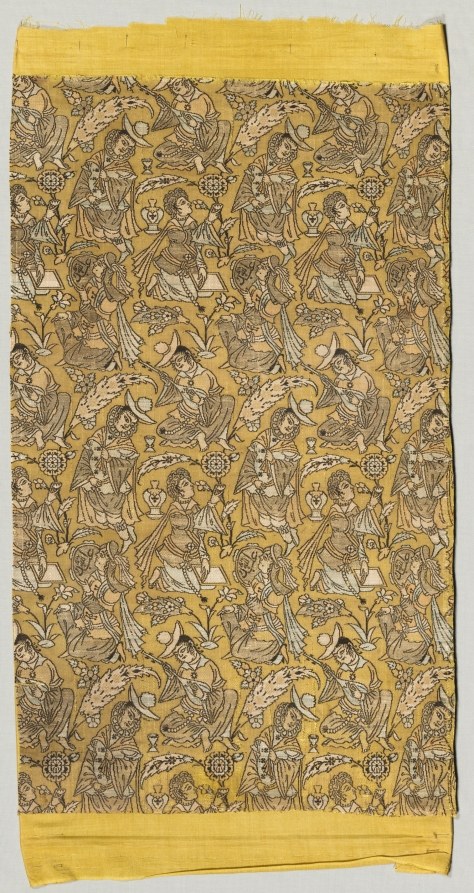
Lampas with dancers and musicians
Unknown artist
- Medium:
- silk and silver-metal thread: lampas, brocaded
- Collection:
- Textiles
- Source:
- Cleveland Museum of Art
- Rights:
- Public domain — free to use, share and adapt.
- Recorded as:
- CC0
This is one of the rare signed Safavid textiles, an artifact that captures a specific historical moment when Persian court dance and music encountered European visitors and when artists began to claim individual authorship of their work. The mixed costume and instruments provide direct visual evidence of how courtly entertainment was practiced and imagined in the cosmopolitan Safavid court. For dance historians, it shows the aesthetic principles governing the representation of movement in textile form and offers insight into which gestures and postures were felt to convey joy, music-making, and celebration.
What you are looking at
A densely patterned silk textile displays a lively court scene animated by figures in mixed dress. Against a golden ground, musicians and dancers move through a shallow landscape scattered with flowering plants and architectural fragments. The figures wear both Iranian garments—tall hats, flowing robes—and European dress, notably the curved-brim hats associated with Portuguese and Dutch merchants and diplomats of the early 17th century. Musicians hold various instruments: lutes, drums, and what appear to be wind instruments. The dancers move with lifted posture, their bodies arranged as if caught mid-gesture, creating a sense of continuous motion despite the repeating pattern. The composition treats figures and ornament with equal visual weight; no single narrative dominates, but instead the eye moves continuously across the textile following the interweaving of human figures, plants, and decorative forms.
The dancing
The figures are arranged in loose groupings across the field, standing or striding rather than in formal partnered holds. Bodies are shown in three-quarter view and profile, with arms raised, bent, or extended in gestures that suggest music-making and celebratory movement. The dancers' postures are upright and buoyant, with weight on the balls of the feet. No two figures are identical, yet their gestures create a visual rhythm: musicians lean slightly toward their instruments, dancers' arms curve and lift in attitudes of joy or accompaniment. The scale is consistent across the composition, preventing any figure from dominating; instead, their equal distribution creates a democratic, festive atmosphere.
The dance depicted
This textile documents a cosmopolitan court celebration of the Safavid period, likely depicting entertainment at a royal gathering of Shah 'Abbas's court. The mixed dress—Iranian courtiers alongside European visitors—suggests the kind of cultural exchange that was actively fostered during his reign. The figures do not form couples in a formal dance but rather appear as musicians and dancers participating in the same celebratory space, suggesting a court music and dance gathering rather than a single codified dance form. The lifted, joyful postures and the prominence of instruments indicate this was a scene of mixed instrumental music and movement characteristic of Safavid court entertainment, where Persian courtly dance traditions met with foreign visitors and their own performative practices.
How it was made
This is a lampas with brocaded silver-metal thread, a luxury textile technique that required the presence of multiple looms or a single loom operated by multiple weavers working in coordination. Lampas weaving creates a double-layer cloth in which the pattern is formed by one set of warps while another set creates a sturdy ground; the silver-metal thread (likely gilt-wrapped silk or silver-gilt thread) was introduced selectively to create points of gleam and luxury. This technique was expensive and reserved for court use and high-status trade goods. The presence of a signed textile—the name Abdallah appears in cursive script on the tambourines—indicates a shift in production, where weavers signed their work to establish reputation and facilitate marketplace sale rather than relying solely on royal patronage and the anonymity of workshop production.
About this work
This early 17th-century Safavid silk is a rare document of courtly dance and music in a moment of cultural openness. It records not a single dance but a gathering in which Persian court traditions and foreign visitors participated in shared celebration, their mixed dress marking the cosmopolitan moment that Shah 'Abbas cultivated. The textile's technique—complex weaving with precious metal thread—marks it as an object of high status, yet its signed presence suggests a transition toward individual artistic reputation and market circulation. For dance historians, it is valuable evidence of Safavid court performance practices and the visual codes by which joy, music, and movement were represented in early modern Islamic art.
How to look at it
Attend to the mixed dress: the tall Iranian hats and robes beside the curved-brim European hats, a visual record of the court's cosmopolitan moment. Follow the movement of the arms and the lift of the bodies; no figure is static, and the eye moves continuously across the textile in a rhythm created by repeated but varied gestures. Look closely at the instruments—the lutes, drums, and other music-makers—which anchor many of the figures and suggest that music and dance were conceived as inseparable. Notice also how the textile repeats its pattern without obvious seams; Abdallah's design creates a field of constant motion that does not lock into a rigid grid, suggesting a lively, improvised quality rather than formal choreography.
The artist
The designer Abdallah signed this textile—a significant act at a moment when Persian weavers were beginning to distinguish themselves from anonymous workshop practice. His name appears in cursive script on the tambourines, suggesting his intention to be recognized and his work identified in the marketplace. The shift from royal manuscript patronage to signed textiles reflects broader changes in Safavid artistic production during Shah 'Abbas's reign, as individual artists developed reputations and textiles became commodities exchanged beyond court boundaries. Little else is known of Abdallah's life or practice, but his signature marks him as part of this transitional moment in Persian art.
The period
Shah 'Abbas the Great (r. 1587–1629) deliberately cultivated cosmopolitanism in his court and capital, Isfahan. He invited foreign merchants, diplomats, and missionaries—Portuguese, Dutch, Italian, and others—and was intensely interested in European art, including engravings, which were copied and adapted by Persian artists. This textile dates to the height of his reign and reflects that openness: the European dress and the prominent presence of foreign visitors are not incidental but are central to its design. The shift from royal manuscript patronage to signed textiles was also underway during this period, as the rise of the luxury textile market allowed artists to sell work directly and establish individual reputation. In the visual arts more broadly, the early 17th century saw Persian artists experimenting with European perspective, anatomical study, and representational conventions—visible here in the figural anatomy and the spatial scattering of elements across the textile.
Where it lives
This textile is held in the Textiles collection at the Cleveland Museum of Art. It is a luxury object created for court use or high-status trade, representing the kind of precious goods that were exchanged between the Safavid court and European merchants during the early modern period. The textile's survival and institutional care mark it as an object deemed significant enough to preserve, reflecting both its original value and its later recognition as a document of cultural and artistic importance.
Questions about this work
Can you identify the specific dances shown in this textile?
No single codified dance form is identifiable. Instead, the textile documents the mixed music and movement that characterized Safavid court entertainment. The upright postures, lifted arms, and close proximity of musicians and dancers suggest courtly celebration and the interchange of music and movement rather than a formal dance with prescribed steps. The mixed European and Persian dress suggests this was a gathering that included visitors and courtiers participating together.
Why does this textile show European dress alongside Iranian dress?
Shah 'Abbas actively welcomed foreign merchants and diplomats to his court and was interested in European culture and technology. The presence of Portuguese and Dutch visitors (marked by their distinctive curved-brim hats) was a celebrated aspect of his cosmopolitan court. By including them in a scene of music and dance, the textile records this openness and the shared participation of foreign and Persian courtiers in courtly celebration.
What does it mean that Abdallah signed this textile?
The signature marks a significant shift in Persian textile production. Rather than remaining anonymous workshop artisans, designers like Abdallah began to sign their work and circulate it in the marketplace. This reflects the waning of exclusive royal patronage and the rise of textile commerce, in which an artist's reputation and recognizable style could command value. Signed Safavid textiles are rare, making this an artifact of artistic transition.
How was a textile like this actually made?
This is a lampas with brocaded silver-metal thread, one of the most labor-intensive and luxurious weaving techniques. Lampas involves multiple sets of warps and wefts creating layers; the pattern emerges as different colored threads and metal threads are introduced selectively. The silver-metal thread (likely gilt-wrapped or pure silver) was added to create points of gleam and luxury. Such textiles required highly skilled weavers and significant time and materials, making them objects of considerable cost and prestige.
More dance artwork





