49 works in this view — arrow keys or swipe to move between them.
Dance in Art
Dancer and Gazelles
Paul Manship (American, 1885–1966)
- Medium:
- bronze
- Collection:
- American Painting and Sculpture
- Source:
- Cleveland Museum of Art
- Rights:
- Public domain — free to use, share and adapt.
- Recorded as:
- CC0
For historians of dance in visual art, this work is crucial because it demonstrates how early twentieth-century sculptors used the figure of the dancer not to document actual movement, but to embody abstract ideals of grace, control, and beauty. The piece shows how orientalist and exoticist fantasies shaped dance imagery in fine art, even as modern dance was beginning to recover other vocabularies of the body. Manship's mastery of silhouette and decorative surface—the incised patterns on the skirt, the carefully modeled hair—reveals how dance in sculpture was often about the static, the ideal, and the ornamental rather than the kinetic.
What you are looking at
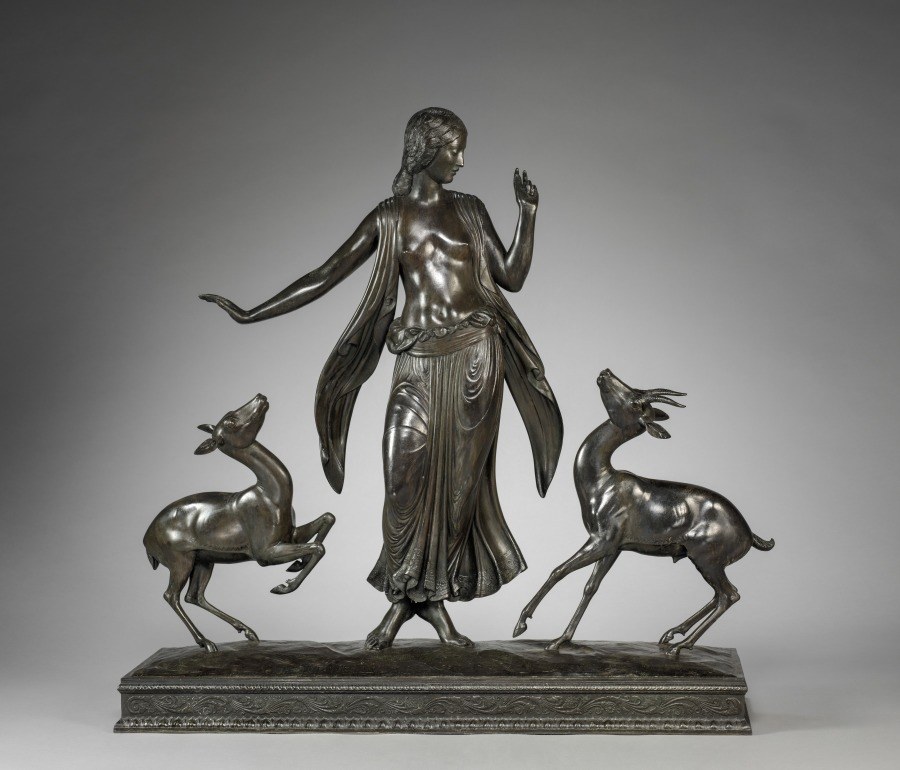
A bronze sculpture presents a graceful female figure in classical drapery, her body at ease in a gentle contrapposto stance. She wears a loosely wrapped skirt with elaborate linear patterning incised across the fabric, and her upper body is bare. Her long braided or textured hair falls down her back. Most striking is her engagement with two small gazelles positioned on either side of her: the animal on the left springs upward and back with hind legs raised, while the one on the right extends forward in a leaping motion. The woman's arms are opened outward and slightly raised, her right hand raised higher than the left, creating a composition of perfect bilateral symmetry broken only by the subtle differences in the gazelles' poses. The work sits on a rectangular bronze base with a decorated border. The surface is uniformly darkened, characteristic of aged bronze.
The dancing
The dancer's posture is upright and relaxed, weight evenly distributed through the legs in a stable stance. Both arms extend outward from the shoulders at roughly shoulder height, the right hand lifted marginally higher, with fingers gently articulated. The body shows no twist or contraction—the torso faces forward and remains open. There is no dynamic weight shift or lunge; instead, the figure projects calm authority. The two gazelles frame the composition symmetrically, their bodies in flight or agitation while the woman remains serene and centered.
The dance depicted
This appears to represent a form of exotic or orientalist dance, likely influenced by the aesthetic movements of the early twentieth century and the Western fantasy of Eastern or North African dance. The woman's pose—upright, open-armed, and commanding—suggests a figure of authority over the natural world, more akin to a classical deity or nymph than to a performer executing specific choreography. The absence of visible footwork, the stability of the stance, and the emphasis on silhouette over movement mechanics suggest this is a representation of dance as a graceful pose or ideal rather than a captured moment of active performance. The gazelles may reference orientalist tropes about exotic lands, making this more an allegory of grace and beauty than documentation of an actual dance practice.
How it was made
This is a bronze sculpture, a medium that allowed Manship to work in three dimensions and achieve the polished, elegant finish visible here. Bronze casting—particularly the lost-wax process common in this period—enabled the sculptor to render fine details in the hair, the patterning on the skirt, and the delicate articulation of the animals' bodies. The uniformity and darkness of the patina suggest a controlled aging or deliberate finishing choice. As a cast bronze work in the 1910s, this would have been a prestigious and expensive object, intended for gallery and museum display rather than public sculpture; it speaks to an educated audience already familiar with classical ideals and modern art movements.
About this work
This 1916 bronze by Paul Manship presents a female figure in classical drapery, her arms opened in a gesture of ease and control, flanked by two leaping gazelles. The work distills dance into a single perfected pose—what the existing description aptly calls a "gracefully posed" moment—rather than capturing movement or gesture specific to any documented dance tradition. Manship's sculpture belongs to the early twentieth-century Art Deco and neoclassical movements, which prized elegant silhouette, decorative patterning, and the idealized human form. The work established his reputation precisely because it synthesizes classical restraint with a sense of sensual grace, achieved through exquisite attention to line, proportion, and the play of light across bronze surface.
How to look at it
Observe the perfect stillness and symmetry of the composition, which is the opposite of what a dancer's body in motion would show. Notice how the woman's open arms and calm face seem to command the agitated gazelles—this is a relationship of dominion, not partnership or reciprocal gesture. The incised patterning on the skirt is purely decorative and bears no resemblance to the structural folds that would result from actual movement; instead, it demonstrates Manship's skill at ornamentation. The work asks you to admire the line and proportion of the body itself rather than to read a narrative of dance or to imagine the movement that might come next.
The artist
Paul Manship (1885–1966) was an American sculptor of the Art Deco period, trained in classical technique and deeply influenced by both Greco-Roman sculpture and the decorative arts of ancient cultures. He spent formative years in Rome and traveled extensively, absorbing influences from archaic Greek sculpture and Renaissance masters. Throughout his career, Manship was known for his ability to marry classical proportion with a modern sense of elegant design and simplified form. His work often featured graceful human and animal figures set in balanced, symmetrical compositions. He was prolific and highly sought after, creating both small decorative bronzes like this one and monumental public sculptures.
The period
In 1916, the dance world was fractured between classical ballet on one hand and the emerging avant-garde on the other. Sergei Diaghilev's Ballets Russes (founded 1909) was reshaping what audiences would accept as dance, introducing exoticist themes, cubist design, and greater freedom of movement. Simultaneously, the visual arts—including sculpture—were embracing modernism, art deco, and neo-classicism as reactions against Victorian academic excess. The figure of the exotic female dancer became a popular subject across media, appearing in sculpture, painting, and decorative arts, often coded as orientalist fantasy or classical allegory. Manship's work sits at this intersection: it employs the dancer as subject but frames her in the language of classical poise rather than modern movement.
Where it lives
The work is held in the American Painting and Sculpture collection of the Cleveland Museum of Art (CMA), indicating it was acquired into a major American museum as a significant work of early twentieth-century sculpture. Its presence in a painting and sculpture collection, rather than a decorative arts collection, underscores its status as fine art rather than object design.
Questions about this work
Is this a real dance?
Not in the sense of a documented practice or choreography. The sculpture represents an idealized fantasy of the exotic dancer that was popular in early twentieth-century European and American visual culture. Manship was creating an allegory of grace and beauty, using the figure of a dancer as a vehicle for classical proportion and elegant form, rather than representing how people actually danced.
Why are there gazelles with the dancer?
The gazelles likely reference orientalist and exoticist stereotypes about North African or Eastern dance and landscape. They frame the woman as a figure of commanding grace within an imagined exotic realm. The symmetrical leaping of the animals contrasts with her stillness, emphasizing her control and composure.
What does the patterning on the skirt represent?
The incised linear patterns are purely decorative, demonstrating Manship's mastery of ornamental surface detail. They are not meant to represent actual fabric draping or movement, but rather to create a visual richness and a sense of textile luxury consistent with Art Deco aesthetics.
What is the artistic tradition this belongs to?
Manship was working in the neoclassical and Art Deco movements of the early twentieth century, which revived classical subject matter and proportion but with a modern, streamlined sensibility. His work synthesizes ancient sculptural ideals with contemporary taste for elegance and decorative refinement.
More dance artwork





