49 works in this view — arrow keys or swipe to move between them.
Dance in Art
Buffalo Mask
Unknown artist
- Medium:
- Wood, plant fibers, paint, and iron
- Collection:
- African Art
- Source:
- Cleveland Museum of Art
- Rights:
- Public domain — free to use, share and adapt.
- Recorded as:
- CC0
For dancers and historians, this mask is crucial evidence of how African masquerade traditions embed dance in sculptural form. The mask does not depict a moment of dance; rather, it is the tool through which a dancer's body becomes a conduit for spiritual or ceremonial presence. Understanding this object requires recognizing that in many African traditions, the distinction between costume, sculpture, and dance is not categorical—the mask *is* part of the dance, and the dance cannot be understood without it.
What you are looking at
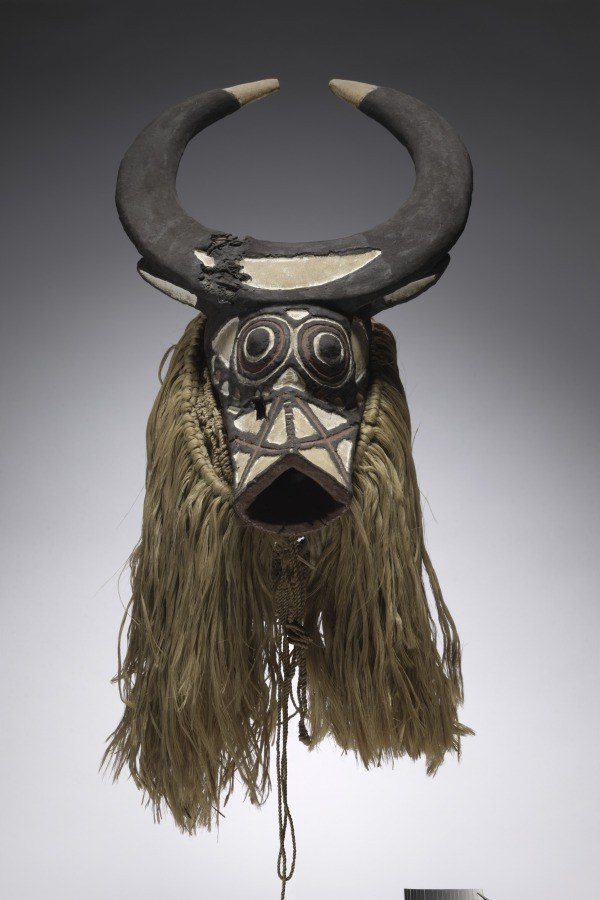
A frontal mask with pronounced curved horns sweeping upward and inward dominates the composition. The face is carved in dark wood with an angular muzzle forming a downward-projecting beak or snout, its edges and interior surfaces lighter in tone, creating sharp definition. Two large circular eyes are inlaid or carved in high relief, their centers dark and ringed with concentric circles. Below the eyes, a horizontal aperture opens the mouth. A dense beard or mane of coarse plant fibers—straw-colored, matted, and reaching nearly to the lower edge of the visible frame—hangs from the lower face. The fibers appear naturally aged and worn. The horns themselves show contrasting materials: the dark curved wood of the main shaft gives way to ivory or pale bone at the tapering tips, suggesting a composite construction. Iron appears to have been used in the construction or reinforcement, visible as darker metalwork, possibly around the eye area or structural joints. The mask is photographed against a neutral gray ground, lit from the front to emphasize the relief carving and the texture of the fiber beard.
The dancing
This is a sculptural mask object rather than a depiction of a dancer's body in motion. The mask is designed to be worn, with the aperture for the mouth and the fixed forward gaze indicating it was meant to cover a performer's face. The weight of the horns and the density of the fiber beard suggest considerable mass and visual projection—a wearer would be visually transformed into a zoomorphic form with enhanced scale and presence. The carving emphasizes frontality and symmetry, creating a confrontational expression.
The dance depicted
The mask depicts a bush buffalo (Syncerus caffer) and was created by the Bwa people of Burkina Faso. Among the Bwa, masks of this type are worn during seasonal community rituals—initiations, funerals of elders, market days, harvest celebrations, and annual renewal rites—by masked dancers who embody protective bush spirits. The mask's form announces the wearer as a powerful non-human entity. While the catalogue record does not specify the precise movements or choreography of the buffalo masked dance, Bwa masquerade traditions typically involve vigorous, embodied performances in which the costume's weight and visual impact are activated through the dancer's movement in community space. The mask itself is a costume element, not a representation of dance frozen in time.
How it was made
The mask is a composite sculpture in wood, plant fiber, bone or ivory, and iron, created by hand carving and assembly techniques standard to West African mask-making. The wood is carved from a single block or carefully fitted sections; the horns appear to be formed separately and inserted. Plant fibers (likely raffia or straw) are bundled and attached to the lower face to create the beard. The pale tips of the horns and any inlaid eye detailing suggest ivory, bone, or bleached wood, possibly set into drilled sockets. The use of iron—whether as nails, clasps, or decorative elements—indicates contact with metal-working traditions, though the extent and function of the iron cannot be determined from the image alone. The object shows age and use wear, consistent with active performance in ritual contexts.
About this work
This is a Bwa buffalo mask from Burkina Faso, created around 1900, now in the African Art collection. It is not a representation of a dance but an active costume component—the physical shell that transforms a performer into a protective bush spirit during community rituals. The mask's powerful zoomorphic form, with its sweeping horns, carved muzzle, and dense fiber beard, announces the presence of non-human power. The carving shows sophisticated understanding of facial anatomy distorted into an animal form, while the choice of materials—dark wood, bone, fiber, and iron—creates visual and tactile presence. Bwa masquerade is inseparable from the movements of masked dancers in ceremonial contexts, making this object a document of performance practice even when static.
How to look at it
Approach this mask as a tool for transformation, not a static sculpture. The heavy horns and dense beard shift the visual and physical center of gravity, forcing a wearer to move differently—the mask is not neutral but demands a particular kind of embodied presence. Notice how the carving emphasizes frontality and direct confrontation: the eyes stare straight ahead, the mouth opens directly forward. In performance, this frontal orientation would have addressed an audience or community directly. The asymmetries of age and wear in the fiber beard—the way some strands clump and others hang loose—suggest this mask has been danced in, handled, and lived with by many performers over time.
The period
The Bwa people of Burkina Faso have maintained masquerade traditions for centuries, and the dating of this mask to around 1900 places it in a period of colonial presence in French West Africa. Bwa masks of the buffalo type (representing the forest buffalo, a powerful and dangerous animal) have been documented in ethnographic literature as central to initiation rites and seasonal community performances. The early 20th century was a period of both continuity and transformation in West African masquerade traditions, as European collecting and ethnographic interest began to remove masks from active use into museum contexts. This particular object likely saw active performance before entering the collection.
Where it lives
The mask is held in the African Art collection at the Cleveland Museum of Art. It entered the collection as an example of Bwa sculptural mastery and is catalogued as an artifact of ritual performance practice, though the specific circumstances of its acquisition and the identity of its carver are not recorded.
Dance in this work
Questions about this work
Is this mask a representation of a dance, or part of an actual dance?
It is part of an actual dance. The mask is worn by a performer during Bwa community rituals. It is not a carved depiction of a dancer but the physical costume element through which a dancer's body becomes transformed into a bush spirit. In African masquerade traditions, the mask and the dance are inseparable.
What movements did the masked dancer make while wearing this?
The catalogue record does not specify the precise movements, and no video documentation of Bwa buffalo mask performance from around 1900 survives. However, the weight and projection of the horns and beard suggest vigorous, grounded movement in which the dancer's body would be in constant adjustment to the mask's mass and visual impact. The mask's frontality suggests direct address to community members gathered for the ritual.
Why is the beard made of plant fiber rather than carved wood?
Plant fiber creates visual and tactile texture that carved wood cannot achieve, and allows the mask to appear as if it has actual hair or fur. Fiber can be replaced or adjusted as the mask ages or is repaired, making the costume more durable for repeated performance. The combination of carved wood and fiber materials is characteristic of African masquerade aesthetics.
When and where would this mask have been worn?
The mask was worn during Bwa seasonal rituals in Burkina Faso: initiation ceremonies, funerals of elders, market days, harvest celebrations, and annual community renewal rites. These events brought the community together and served protective and regenerative functions. The mask's appearance announced the presence of a powerful protective spirit.
More dance artwork





