49 works in this view — arrow keys or swipe to move between them.
Dance in Art
Dancers
Unknown artist
- Medium:
- soft-paste porcelain
- Collection:
- Decorative Art and Design
- Source:
- Cleveland Museum of Art
- Rights:
- Public domain — free to use, share and adapt.
- Recorded as:
- CC0
The work reveals that 18th-century dance was inseparable from theater, fashion, and courtship; the gestures and dress on display here would have been taught, practiced, and valued as markers of refinement. Porcelain figurines were high-status objects that circulated images of performance and social ritual among Europe's elite, shaping taste and behavior in ways that printed dance notation could not reach.
What you are looking at
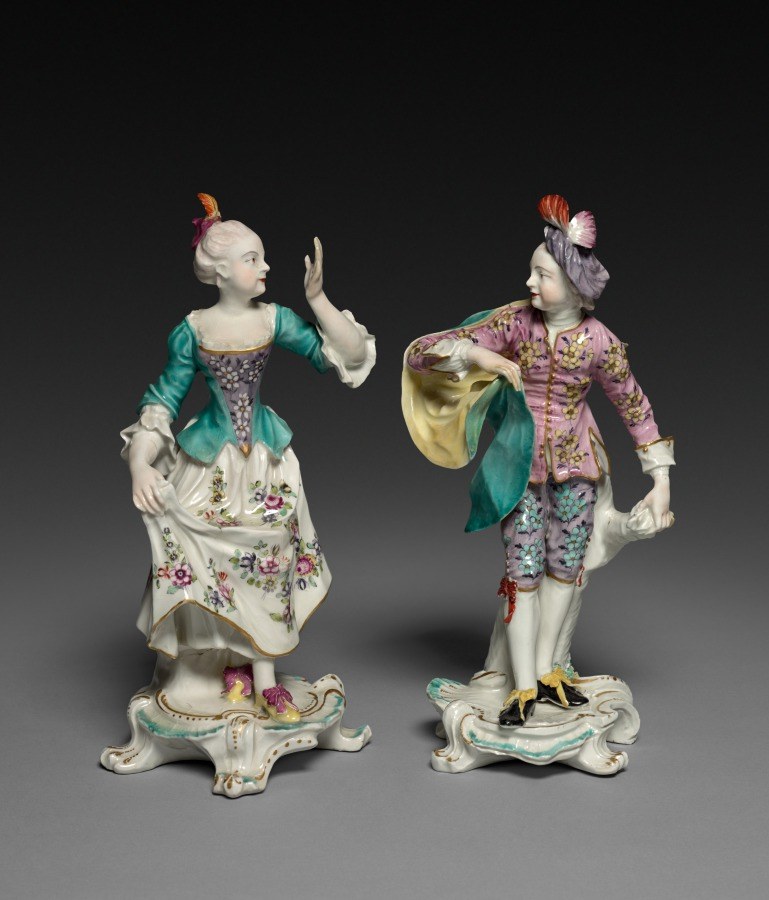
Two porcelain figures stand on rococo scroll bases against a neutral ground. The figure on the left is a young woman in a teal-green bodice with a white skirt decorated with delicate floral sprays in purple, pink, and green; her pale blonde hair is arranged up with a red-orange ribbon and feathered ornament. She raises her right hand in a gesture of surprise or greeting, her expression turned toward her companion. The figure on the right is a youth or young man in a pink coat with elaborate floral embroidery, teal-green breeches, white stockings, and red-heeled shoes; he wears his hair in similar blonde curls dressed with a red-orange and white ribbon. He holds a golden-yellow cape or cloak draped over his left arm and inclines his head toward the woman with an attentive, conversational posture. Both figures are rendered with the refined modeling and bright enameled palette characteristic of 18th-century soft-paste porcelain, their skin tones carefully distinguished from their elaborate dress.
The dancing
Neither figure is in a dance frame or closed hold. The woman's raised hand and slightly turned torso suggest a moment of social interaction—acknowledgment or mild astonishment. The man's forward lean and the drape of his cape suggest courtly address or flirtation rather than active dance movement. Both stand with upright posture on their ornamental bases, weight evenly distributed, in the formal stillness of porcelain figurines designed to be viewed from multiple angles. The gestures are theatrical and sociable rather than kinetic.
The dance depicted
This group does not depict active dance movement. Instead, it captures a moment of courtly social interaction—likely flirtation or greeting—between two aristocratic or stage figures. The theatrical dress, the formal but intimate spatial relationship, and the gestural vocabulary suggest this may represent a scene from 18th-century theatrical performance or operatic entertainment, where dance and social gesture were closely linked. The porcelain medium preserved such moments as refined genre scenes for the European luxury market rather than as documentary of actual dance practice.
How it was made
Soft-paste porcelain, which was technically demanding and expensive in 1755, was hand-modeled and hand-painted with enamel colors. This technique allowed fine detail in facial features and costume ornament, including the delicate floral sprays on the skirt and the embroidered coat pattern. The figures were designed to be assembled from separately cast parts—heads, arms, torsos, bases—and fired in a kiln before painting. Such pieces were luxury objects for aristocratic collections and represent a significant investment in materials and skilled labor; they were not meant to document actual dance but to celebrate refined taste and theatrical fashion.
About this work
This pair of porcelain figurines, dated 1755, represents a moment of courtly social exchange between two fashionably dressed figures of the mid-18th century. Rather than depicting active dance, the work captures the theatrical, gestural language of aristocratic interaction—the raised hand, the inclined posture, the draped cape—as it was performed on stage and in the drawing room. The figures embody the rococo fascination with elegant conversation, flirtation, and theatrical display, rendered in the most luxurious ceramic technique of the age.
For a gallery of dance in art, this work illuminates the inseparability of dance, theater, and social gesture in the 18th century. The boundary between a dance step and a courtly greeting was permeable; both were learned, performed, and aestheticized. Porcelain figurines like this one were among the most prestigious artworks a collector could own, and their subject matter—theatrical and amorous interaction—shaped how the educated European public imagined elegance and performance.
How to look at it
Examine the hand and arm positions as carefully as the face: the raised hand is a learned gesture, not a spontaneous one, executed with the formal refinement expected of aristocratic performance. Notice the precision of the dress—every ribbon, every embroidered flower, every shade of enamel—speaks to the importance of visual spectacle in this culture. The bases and the separate modeling of each figure underscore that this is a permanent, collectible object, not a moment captured from life but a distilled, repeatable image of refined interaction.
The artist
The artist is not recorded. This type of figure was produced in multiple European porcelain factories in the mid-18th century—Meissen, Sèvres, Vienna, and others—often by teams of modelers and painters rather than a single hand. The rococo taste for theatrical figures of actors, dancers, and courtiers became a major production category, with forms frequently copied and adapted across workshops.
The period
In the 1750s, European courts and wealthy collectors developed an intense appetite for porcelain figurines depicting theatrical and operatic subjects. This coincided with the height of rococo taste, which prized asymmetry, theatricality, and the blending of high and decorative arts. Simultaneously, formal dance in the aristocratic context was becoming increasingly theatrical and codified; the distinction between ballet d'action, social dance, and courtly gesture was becoming more defined even as all three drew on shared gestural and postural vocabularies. Porcelain figurines froze and consecrated these fleeting, learned behaviors.
Where it lives
The work is held in the decorative arts and design collection at an American museum (source recorded as CMA, Cleveland Museum of Art). It is catalogued as an object of unknown maker, a common situation for porcelain figurines of this period, which were often produced in workshops and copied widely across European factories.
Questions about this work
Is this actually a dance scene?
Not in the sense of depicting active choreography or footwork. It shows a moment of social and theatrical interaction—flirtation, address, or greeting—rendered in the formal, gestured language of the 18th-century stage. For this period, such moments were closely related to dance as learned, performed behaviors of the body.
What does the yellow fabric the man is holding represent?
Most likely a cape or a length of silk cloth, which was a common prop in 18th-century theatrical and aristocratic dress. It adds movement and drama to his silhouette and may suggest a role from comedy, opera, or the commedia dell'arte tradition.
How do we know these are meant to represent theater or courtly society rather than ordinary people?
The elaborate costume—the embroidered coat, the ribboned hair, the precise color coordination—far exceeds what ordinary dress would have been. The porcelain medium itself signals luxury and theatricality; these are iconic, collectible images of refined behavior, not domestic or workaday life.
Where would an 18th-century collector have displayed this pair?
In a porcelain cabinet or on a mantelpiece in a drawing room or gallery, where other figurines, paintings, and decorative arts were arranged to demonstrate taste and knowledge of theater and fashion. Such displays were studied and discussed by visitors as expressions of refinement.
More dance artwork





