49 works in this view — arrow keys or swipe to move between them.
Dance in Art
Dancer
Unknown artist
- Medium:
- marble
- Collection:
- Greek and Roman Art
- Source:
- Cleveland Museum of Art
- Rights:
- Public domain — free to use, share and adapt.
- Recorded as:
- CC0
This is among the most direct visual evidence we have of what ancient dance actually looked like in practice. The sculptor understood the dancer's body—the balance, the arm work, the way fabric interacts with movement—and chose to preserve not a moment of rest but the quality of motion itself. For historians and practitioners, it offers rare documentation of a performance tradition otherwise known only through literary sources and vase paintings.
What you are looking at
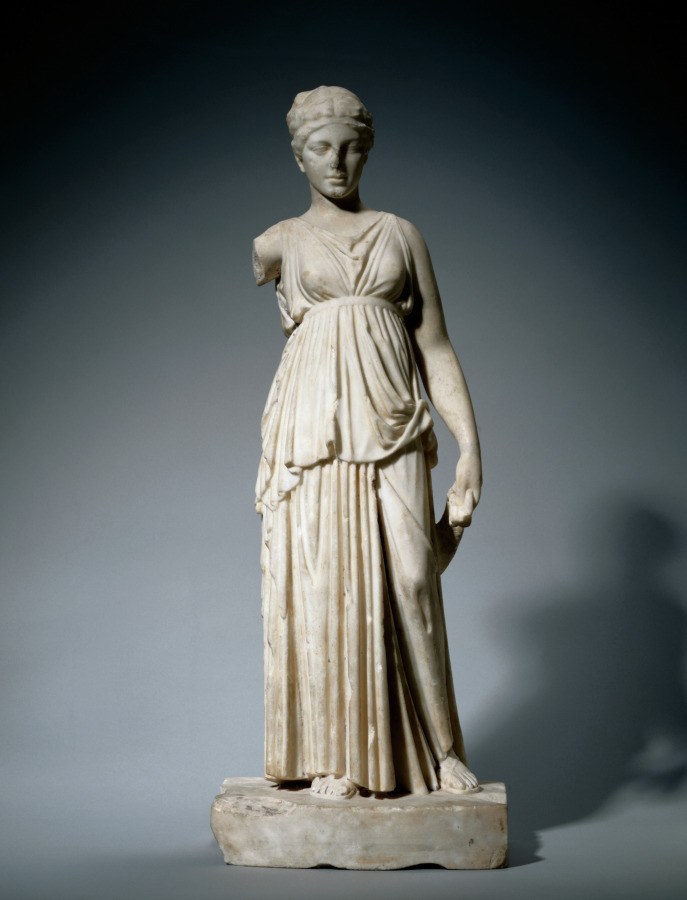
A marble statuette depicts a single female figure in a graceful contrapposto stance, her weight resting on one leg while the other bends slightly. She wears a high-belted chiton that falls in deep, regular pleats to her ankles, with a generous overfold cascading from her shoulders. Her hair is bound in a flat band across her head in the Classical manner. In her lowered left hand, she holds a length of sash or drapery that curves behind her body; her right arm, now lost, originally held the opposite end aloft. Her feet rest on a simple rectangular base. The marble is pale, finely finished, and the figure stands in three-quarter view against a neutral ground.
The dancing
A single standing female figure with weight shifted to one bent leg in a relaxed contrapposto. The torso inclines slightly; the arms frame the body with one extended downward holding drapery while the other originally extended upward and outward. The pose suggests controlled movement rather than static rest—the drapery work and arm position indicate the captured moment of a turning or swaying motion. The figure's scale suggests this was a portable, intimate object rather than a monumental sculpture.
The dance depicted
This statuette most likely represents a performer in Hellenistic dance, possibly a maenad, thymelica (theatrical dancer), or participant in dionysiac ritual performance. The high contrapposto, the graceful handling of drapery as a prop or costume element, and the delicate, refined facial features point to theatrical or entertainingly performed dance of the Greco-Roman world rather than formal cultic dance. The sash or mantle is integral to the movement, suggesting a dance that involved draped costume, arm work, and body rotation. Without the right arm, we cannot see the full geometry of the pose, but the existing fragments indicate sophisticated understanding of how fabric moves through three-dimensional space during performance.
How it was made
This is carved marble in the round, finished with fine detail work on the drapery and face. The marble was worked with chisels to achieve the fluted pleats of the chiton, the softly modeled flesh, and the calm, idealized facial features characteristic of Hellenistic portraiture of performers or divine attendants. Marble sculpture at this scale and quality was expensive and time-consuming, indicating the dancer—or the dance type—held enough cultural significance to merit permanent commemoration. The statuette's portable size suggests it was made for private collection or a shrine, not monumental display.
About this work
This marble statuette of a dancer from around the 1st century BCE or earlier is a rare direct representation of Hellenistic performance. The figure holds a length of drapery and assumes a relaxed contrapposto pose that captures a moment of graceful, swaying movement. The work belongs in dance art history because it is evidence of how performers of the ancient Mediterranean world were understood and valued: the artist chose to represent not a static pose but the quality of motion, the interplay of weight and balance, and the dancer's deliberate handling of costume as an expressive tool. The statuette testifies to a period when dance was sophisticated enough, and dancers visible enough socially, to warrant marble commemoration by skilled sculptors.
How to look at it
Notice first the weight distribution and the bent leg—the artist is showing you the instant of a weight shift or turning motion. Watch how the drapery responds: it hangs and curves according to where the body leans. The arms were essential to the composition; the missing right arm probably balanced the downward-held sash, creating a geometry of opposition and grace. The sculptor has idealized the face and body in the Classical tradition, but the pose itself is naturalistic—this is how a human body moves, not how a statue usually stands. The work rewards study of the feet and legs especially, where you can see the dancer's balance.
The artist
Unknown. The work shows the refined technique and idealizing aesthetic of Hellenistic marble carving, suggesting it was made by a workshop attuned to theatrical and religious subjects. The sculptor understood both anatomy and the mechanics of draped costume in movement, suggesting familiarity with actual performance practice or close study of dancers.
The period
This statuette was created during the Hellenistic period (323–31 BCE) or the early Roman Imperial era, when Greek performance culture remained highly valued and dancers—particularly female performers—were prominent in theater, ritual, and private entertainment. The figure may represent a thymelica (professional theatrical dancer), a devotee of Dionysus, or a performer in mimes or pantomime. Dance in this period was sophisticated and codified, and the visibility of dancers in material culture—sculpture, vases, mosaics—reflects their cultural importance. The high finish of this work, and the choice to represent a specific dramatic moment rather than a generic pose, suggests the patron and sculptor regarded this dancer or dance type as worthy of careful aesthetic attention.
Where it lives
Held in the Greek and Roman Art collection of the Cleveland Museum of Art. This is a free-standing marble statuette, likely originally part of a private collection or sanctuary deposit. The catalogue record offers no information on excavation site or acquisition history beyond the museum attribution.
Dance in this work
Questions about this work
What is the figure holding?
A sash, mantle, or length of drapery held in the lowered left hand and originally extending upward through the raised right hand (now lost). This was likely either costume—worn over or under the chiton—or a prop that formed part of the performance. The way the fabric is carved suggests it moved dynamically as the dancer performed.
Who would have danced like this in ancient Greece or Rome?
Most likely a professional female performer: a thymelica (theatrical dancer), a maenad (perhaps a trained actor in Dionysiac theatre), or a performer in pantomime or mimes. Female dancers were prominent in Hellenistic and Roman entertainment, and the refinement of this statuette suggests the subject held some prestige. Wealthy households commissioned such works to display in private collections.
Why is the right arm missing?
Marble projecting elements—thin arms, extended fingers—are vulnerable to breakage over time. The arm was originally carved separately or projected far enough from the body that it fractured at some point in the object's history. We can infer its position from the pose and the way the drapery was carved to be held aloft.
Is this a portrait of a real dancer?
Probably not a portrait in the modern sense. The face and body are idealized in the Classical manner, meaning they represent a type or ideal rather than a recognizable individual. However, the pose and the focus on movement suggest the sculptor was interested in representing a real, observed practice of performance.
More dance artwork





