49 works in this view — arrow keys or swipe to move between them.
Dance in Art
Ornamental Shoulder Bands from a Tunic
Unknown artist
- Medium:
- tapestry weave with supplementary weft wrapping; undyed linen and dyed wool
- Collection:
- Textiles
- Source:
- Cleveland Museum of Art
- Rights:
- Public domain — free to use, share and adapt.
- Recorded as:
- CC0
This textile is rare evidence of recreational and social dancing in Roman Egypt, rendered by an unknown artisan in a medium that survives far less often than stone or papyrus. It demonstrates that dance was considered worthy of visual commemoration in everyday clothing, and that dancers—alongside hunters and shepherds—held a recognizable place in representations of human activity and social life. For dance historians, it offers a window into a period and region where images of dance are scarce.
What you are looking at
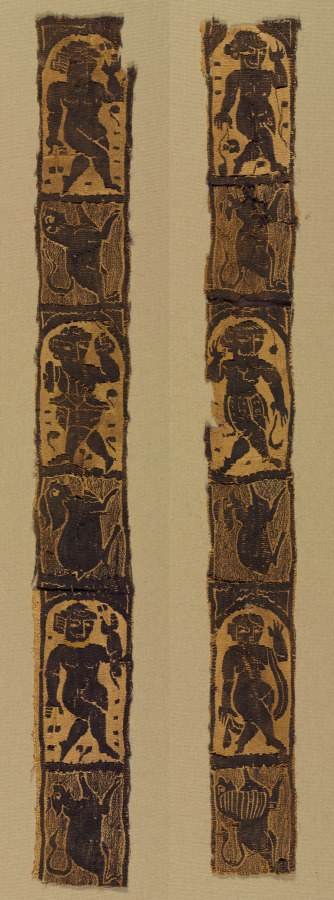
Two narrow vertical bands of tapestry weave, each divided into six rectangular panels arranged in alternating patterns. The bands would have descended from the shoulders of a tunic as decorative trim. The figures are silhouetted in dark brown against a lighter ground, creating a stark linear rhythm across the cloth. Three distinct types of human figures alternate with animal motifs: a standing figure in dynamic posture appears in the uppermost panel of each band; below it sits a crouching or seated figure within an arched frame; then a standing or striding figure; then an animal—a dog, rabbit, or lion rendered in profile. The human figures are rendered with simplified, almost schematic bodies: small heads, elongated torsos, and limbs caught in active, often asymmetrical positions. The arches that frame some figures create visual compartments, giving the bands a rhythmic, compartmentalized structure. The palette is limited to the natural tones of undyed linen and dyed wool in brown and tan, applied in flat tapestry weave.
The dancing
The bodies are small and highly stylized, their poses suggesting motion rather than anatomical precision. The standing figures display splayed or crossed legs, raised arms, and twisted torsos—postures that suggest energetic movement or dancing rather than static stance. One recurring figure type appears with arms raised and legs in an asymmetrical stride. A crouching figure type recurs in the lower registers of each compartment, sometimes rendered with bent knees and forward-leaning torso. The figures are isolated from one another, each contained within its own panel or arch, yet the repetition of active poses creates a sense of sequential action—almost a narrative of movement unfolding down the band.
The dance depicted
The catalogue record identifies human figures including dancers, a hunter, and a shepherd, suggesting that this textile depicts multiple types of human activity. The poses and contexts—particularly the standing figures with raised arms and asymmetrical leg positions—are consistent with representations of social or recreational dancing in Roman Egypt. The interleaving of dance figures with hunting and shepherding scenes suggests a record of daily life and entertainment in a Greco-Roman Egyptian context. Without more specific iconographic markers (costumes, instruments, or inscriptions), it is difficult to name a particular dance form, but the active, playful postures and the prominence of human figures in motion suggest social or celebratory dancing rather than ritual or formal theatrical performance.
How it was made
This work is a tapestry weave with supplementary weft wrapping, a technique that creates figured patterns by interlacing colored wool and linen threads. The supplementary weft technique allows the weaver to build up layers of color and create the silhouetted, compartmentalized design visible here. Tapestry weave was a durable and prestigious technique, suitable for high-wear areas like shoulder bands on tunics. The flat, graphic quality of the design—bold silhouettes and strong compositional division—is characteristic of how narrative or decorative subjects appear in woven textiles, where complexity is achieved through repetition and compartmentalization rather than through shading or perspective. This technique and aesthetic were well suited to small-scale domestic production and to the constraints of weaving on a loom.
About this work
This is a fragment of decorative trim from a Roman Egyptian tunic, woven in the first century CE using tapestry weave to create a lively, rhythmic display of daily and social activity. The two bands would have hung from the shoulders, visible to anyone encountering the wearer. The artist—likely a professional weaver working within a well-established tradition—created a vocabulary of small, energetic human figures and animals, repeating them in a formal, compartmentalized structure. The shoulders and upper chest of the wearer became a tableau of movement and activity: hunters, shepherds, and dancers alternate with animals, creating a statement about the wearer's life or status. The work belongs to a rich tradition of figured textiles in the Greco-Roman world, where clothing itself became a canvas for narrative and social meaning.
How to look at it
Look at the variety of postures within the repeating structure: while the compartments are regular and almost mechanical, each human figure is caught in a different moment or gesture. Notice how the standing figures with raised arms differ from the crouching or seated figures below them—the artist has captured distinct types of movement or action rather than rigid repetition. Attend to the negative space created by the pale ground: the dark silhouettes of the figures create visual rhythm precisely because they are so spare and graphic. The presence of animals alongside human figures suggests a world of activity and social engagement that includes both entertainment (the dancers) and practical work (the hunter and shepherd).
The period
By the third to fifth centuries CE, Egypt had been under Roman rule for three centuries. The tunic had become the primary garment worn by people of all classes in the Roman Empire, replacing the earlier draped Greek styles. In this period, decorative textiles—particularly those with figured designs—were produced in workshops throughout the Mediterranean and Near East, often using standardized iconographic repertoires that allowed for rapid production and wide circulation. The designs on this band are characteristic of the simplified, compartmentalized style of figured textiles from this era, where strong silhouettes and repeating patterns created visual impact from a distance. Dance, hunting, and pastoral life were popular subjects on domestic textiles of this period, representing idealized or celebratory visions of daily leisure and abundance.
Where it lives
This fragment is held in the Textiles collection of the Cleveland Museum of Art. It is a fragment of a larger garment, likely from the shoulder area of a tunic; other panels or bands from the same tunic may exist in other collections. Textiles of this type were produced in significant quantities in Roman Egypt and survive in museum collections worldwide, often as fragments retrieved from burials or settlements.
Questions about this work
How do we know these figures are dancers?
The standing figures display asymmetrical, energetic postures—raised arms, bent or crossed legs, twisted torsos—that are characteristic of movement and physical activity. In the iconographic language of Greco-Roman textiles, such dynamic poses are associated with dance, celebration, or entertainment. The catalogue record identifies some of these figures as dancers, a reading supported by their contrast with the more static poses of the hunter and shepherd figures on the same bands.
Who wore garments with these decorative bands?
By the Roman period, tunics with ornamental shoulder bands were worn by people of various social classes, though the quality and elaborateness of the weaving might reflect the wearer's status or wealth. The presence of such figured decoration suggests a wearer who could afford fine textiles and wished to display imagery of leisure, entertainment, and abundance. The bands would have been visible when the tunic was worn, making them a form of social display.
What does the interleaving of dancers, hunters, and shepherds suggest?
The mixing of recreational and practical activities—dance alongside hunting and shepherding—suggests a vision of the good life in which entertainment, provision, and labor all have a place. For a wearer to display such imagery on their shoulder bands was to claim or celebrate a world of abundance and leisure. The compartmentalized, repetitive design allowed the weaver to convey a sense of plenty and variety without narrative complexity.
Why are some figures crouching or seated?
The crouching and seated figures likely represent a different category of activity or a different moment in an action sequence. They create visual variety and rhythm within the compartmentalized design. Some may represent resting or preparation, while others may depict specific postures associated with particular activities or entertainments.
More dance artwork





