49 works in this view — arrow keys or swipe to move between them.
Dance in Art
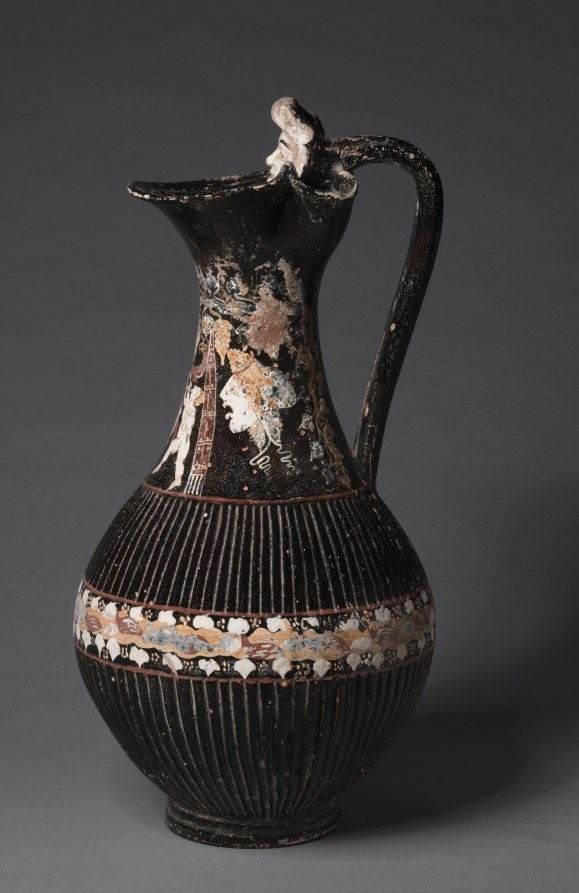
Gnathian Ribbed Oinochoe (Wine Jug): Masks, Dancer, and Flute-Player
Unknown artist
- Medium:
- ceramic
- Collection:
- Greek and Roman Art
- Source:
- Cleveland Museum of Art
- Rights:
- Public domain — free to use, share and adapt.
- Recorded as:
- CC0
This vessel documents a kind of dance—comic, theatrical, popular—that left almost no other trace in Greek art, which tends to memorialize the dignified and the sacred. The image of the youthful dancer in motion, captured mid-performance beside musician and masks, is rare evidence of how ordinary people entertained one another in the Hellenistic world. For historians of dance, it is proof that playful, unscripted movement existed alongside the formal dances we know from literature and more prestigious art.
What you are looking at
This is a ceramic wine jug (oinochoe) from the Hellenistic period, decorated in the Gnathian style with a glossy black ground and inlaid ornament in white, red, and yellow. The vessel is bulbous, standing on a flared foot with pronounced vertical ribbing that runs in bands around the lower body and shoulder. A trefoil-lipped pouring mouth rises at the top, and a curved handle arcs from the rim to the shoulder. The neck presents the most lively imagery: two plump, youthful figures cavort in relief—one a dancer, one a pipe-player—flanked by theatrical masks in white inlay. Above the neck, a male theater mask with prominent features sits at the point where the handle meets the rim, gazing outward. Below the figural scene, a decorative band of ivy leaves and berries twines around the widest part of the body in red and yellow, providing botanical contrast to the black field. The work is a functional drinking vessel, but one whose ornament transforms it into a record of theatrical life.
The dancing
The two figures on the neck are rendered in high relief and appear to be chubby putti or youthful performers rather than adult dancers. The dancer's body twists in an energetic posture, limbs extended in what reads as a playful, exuberant movement; the pipe-player beside him holds an aulos or double-pipe aloft. Both figures are nude or lightly draped, a convention for theatrical imagery. Their positioning is frontal and narrative rather than technical—the artist is recording a moment of entertainment rather than codifying a formal dance technique. The theatrical masks flanking them are static, watching the performance; the mask at the handle is a three-dimensional portrait head.
The dance depicted
This vessel documents comic and theatrical dance in the Hellenistic Mediterranean, likely 4th–3rd century BCE. The imagery refers to the world of mime, satyr play, and comic drama rather than formal dramatic dance. The pipe-player indicates musical accompaniment, the masks signal the theatrical context, and the youthful, energetic gesture of the dancer suggests the kind of comic or grotesque movement associated with lower dramatic genres—the antithesis of the tragic or ceremonial dances that appear in other Greek art. This is popular entertainment, the kind of performance that would have been seen in marketplace performances or comedic theater rather than civic or religious occasions.
How it was made
This is a ceramic vessel formed on the wheel and decorated using the Gnathian technique, a post-classical Greek method combining molded relief ornament with inlaid colored clays and slips. The theatrical masks are mold-made and appliquéd to the vessel before firing; the figures on the neck are similarly relief-applied. The inlaid details—ivy, berries, and facial features—were achieved by pressing colored clay or slip into carved or impressed lines, then firing the whole vessel. This technique allowed fine linear detail and bright color on a black ground without painting in the fragile tempera or fresco manner. The technique was labor-intensive but produced durable, visually striking vessels suited to trade and display.
About this work
This Gnathian oinochoe is a functional wine jug whose ornament preserves a vivid snapshot of Hellenistic theatrical entertainment. The dancing figure shown on the neck, energetic and youthful, performs in the company of a pipe-player and flanked by theatrical masks—a visual shorthand for the world of comic and popular dramatic performance. The vessel itself, with its bold black ground and inlaid ornament, is both a product of Hellenistic Greek craft and a window into the social life and entertainment practices of the period. It belongs in a gallery about dance because it documents not the formal, dignified dances of ritual or court, but the playful, bodily exuberance of entertainment.
How to look at it
Look first at the pose of the dancing figure: the body is relaxed, energetic, unselfconscious, caught mid-stride rather than in a held position. This is not the formal contrapposto or the geometric symmetry of earlier Greek dance imagery. The presence of the masks—both the appliquéd portrait head and the flanking mask faces—is a visual statement about context: this dance belongs to the theater, to performance, to spectacle. The pipe-player's gesture, lifting the aulos aloft, anchors the scene in the world of live performance. The overall composition is playful and narrative rather than monumentalizing, which tells us something important: by the Hellenistic period, theatrical dance and comic performance had become subjects worthy of fine craft and domestic display.
The period
The Gnathian technique flourished in southern Italy in the 4th and 3rd centuries BCE, after the great age of Athenian red-figure pottery and during the Hellenistic expansion following Alexander. It emerged in a world where Greek culture had spread eastward and where theatrical performances—comedy, mime, satyr play, and popular entertainment—had become central to urban life. The technique itself may have been developed by Greek potters working in the Italian colonies, adapting their craft to new markets and new tastes. By this period, the theater was no longer the monopoly of Athens; performances were a feature of civic life across the Mediterranean and Near East, and vessels decorated with theatrical imagery advertised the sophistication of their owners.
Where it lives
Held in the Greek and Roman Art collection of the Cleveland Museum of Art. This is a functional drinking vessel that once held wine, but its ornate decoration suggests it was also a display object, a piece through which a wealthy household advertised its access to fine imported goods and its familiarity with theatrical culture.
Questions about this work
Is this dancer performing a recognizable Greek dance form?
No—this is comic or theatrical dance, not a formal ceremonial or dramatic form. The style is playful and exuberant, designed to entertain rather than to exemplify a technique. The artist has captured a moment of movement and personality rather than codifying a dance type.
Why are the figures nude or partially draped?
Nudity and light drapery were conventions for theatrical performers, especially in comedy and mime, and for satyrs and other mythological creatures. It signaled to the viewer that these were performers in a theatrical context, not ordinary citizens.
What is the Gnathian technique?
A post-classical Greek ceramic method in which relief ornament and inlaid colored clays are applied to a black-glazed vessel before firing. It allowed fine linear detail and bright color without fragile paint, and it produced durable, visually striking vessels well-suited to trade and export.
Who would have owned this vessel?
A relatively wealthy household with access to imported Greek goods. The ornate decoration suggests it was a display piece as much as a functional wine jug, advertising the owner's sophistication and knowledge of theater and entertainment.
More dance artwork





