49 works in this view — arrow keys or swipe to move between them.
Dance in Art
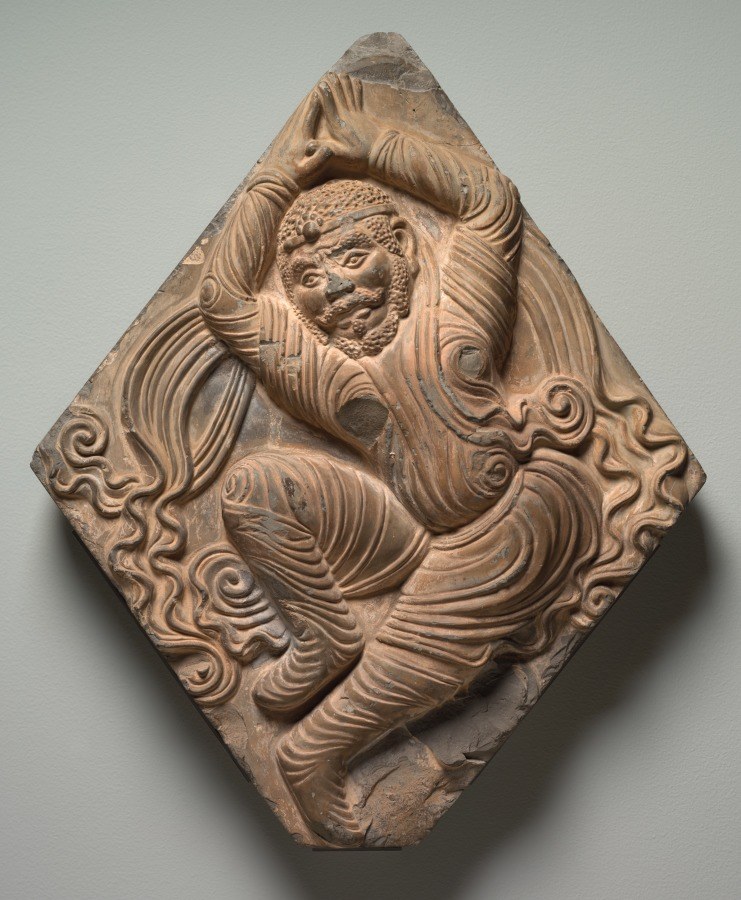
Architectural Brick with Dancer in Relief
Unknown artist
- Medium:
- molded terracotta with slip coating
- Collection:
- Chinese Art
- Source:
- Cleveland Museum of Art
- Rights:
- Public domain — free to use, share and adapt.
- Recorded as:
- CC0
This brick demonstrates that by the 8th century, dance was considered sufficiently powerful and spiritually significant to merit prominent placement on sacred architecture in China. The survival of the Xiudingsi pagoda—the only structure remaining from a large monastic complex—makes this one of the few intact examples of how Buddhist communities used dance imagery to shape the devotional experience of worshippers.
What you are looking at
This molded terracotta brick depicts a single figure in high relief against an ornamental ground. The dancer is rendered in profile, facing left, with an elaborately braided or coiffed head and distinctive facial features including what appears to be a mustache or beard. The body is draped in flowing, deeply carved garments with pronounced vertical pleats and ridges that suggest movement. The figure's arms are raised and positioned behind the head in a classical pose. The entire composition is framed by ornamental borders featuring spiral and scroll motifs typical of decorative architectural elements. The terracotta has a warm, earthen tone with subtle surface variations from the molding and slip coating process. This brick once formed part of the exterior wall of a Buddhist pagoda, serving both architectural and devotional purposes.
The dancing
The single figure displays an elevated, classical pose with arms raised and drawn back behind the head, a gesture suggesting either celebration, reverence, or an ecstatic state. The posture is upright and dignified, with the weight appearing centered. The elaborate treatment of the garments—particularly the deep vertical pleating—creates a sense of volume and movement around the torso and lower body, as if the cloth itself is in motion. The facial rendering and coiffure suggest this may represent a specific cultural or religious identity rather than a generic dancer.
The dance depicted
The identity of this dance cannot be determined with certainty from the image alone. The pose—arms elevated and drawn back with an upright carriage—is consistent with various sacred or ceremonial traditions, but the specific style, cultural context, and religious or secular purpose of the dance are not evident from the visual evidence. The figure's elaborate headdress and grooming suggest high status or ritual significance. As part of a Buddhist monastery's architectural program, this dancer likely represents either a celestial being, a mythological figure, or a personification of devotion rendered through bodily gesture. The date and geographic origin (Tang Dynasty China, circa 800 CE) narrows the context, but the dance style itself remains unidentified.
How it was made
This is molded terracotta with a slip coating, a technique allowing for mass production of architectural ornaments while maintaining fine detail in the relief carving. The molding process permitted the deep, crisp definition visible in the garment pleats and facial features, while the slip coating provided a smooth surface for firing. This technique was standard for Chinese Buddhist monastery decoration in the Tang period, allowing sculptural imagery to be distributed across large architectural surfaces without the expense of individually carved stone. The durability of fired clay ensured these devotional images could withstand exposure to the elements while remaining legible.
About this work
This architectural brick is a fragment of a larger devotional program at the Xiudingsi Buddhist monastery in Henan province, dating to before 870 CE. It presents a figure in a pose of apparent reverence or ecstatic movement, rendered with the formal elegance and decorative density characteristic of Tang Dynasty ceramic work. The brick functioned simultaneously as structural element and visual sermon, communicating religious meaning through the body of the dancer to those who passed by the pagoda.
The work exemplifies how dance imagery served Buddhist monasteries as a means of expressing celestial joy, cosmic harmony, or divine presence. The figure's elevated pose and elaborate grooming situate it within a tradition where bodily gesture carried spiritual significance. As one of the few surviving artifacts from the Xiudingsi complex, this brick provides direct evidence of how dance was visualized and valued in Tang religious architecture.
How to look at it
Attend to the pose: the arms are not lowered in restraint but raised and drawn back, a gesture of openness, elevation, or surrender. Notice how the garment pleating has been carved with such depth and regularity that the drapery itself appears to move independently of the body—a deliberate choice to suggest animation and weightlessness. The ornamentation framing the figure (spirals, scrolls, and formal borders) locates this dancer within a cosmos of decorative order, suggesting this is not a portrait of an individual but an embodiment of a principle or celestial state. The profile view is typical of architectural narrative in Tang art, presenting the figure in its most legible aspect to a viewer approaching from below.
The period
The Xiudingsi pagoda dates to the Tang Dynasty, the golden age of Buddhist art in China (618–907 CE), when monasteries commanded vast resources and celestial imagery saturated both painting and sculpture. Dance occupied a central place in Tang court culture and Buddhist ritual alike; celestial beings and bodhisattvas were characteristically depicted in movement, embodying joy and divine energy. This brick belongs to a tradition in which architectural surfaces became galleries of devotional imagery, with each figure contributing to a larger theological program. The technique of mass-molded ceramic decoration allowed monasteries to distribute such imagery across extensive surfaces, making the sacred visible to pilgrims and worshippers at scale.
Where it lives
The brick is held in the Chinese Art collection of the Cleveland Museum of Art. It is catalogued as an architectural fragment from the Xiudingsi Buddhist monastery near Anyang, Henan province, which survives as the only remaining structure from what was once a large monastic complex.
Dance in this work
Questions about this work
How do we know this brick came from the Xiudingsi pagoda?
An inscription carved on another brick from the same structure is datable before 870 CE, and archaeological context confirms the provenance of bricks from this site. The Xiudingsi pagoda survives as the sole architectural remnant of the monastery, making it possible to link surviving fragments to the original complex.
Was the dancer a real person or a mythological figure?
Almost certainly mythological or celestial. The elaborate headdress, formal pose, and integration into a Buddhist architectural program suggest this represents a bodhisattva, celestial being, or divine personification rather than a historical dancer. The pose itself—arms elevated in reverence or ecstasy—is characteristic of how celestial joy was visualized in Tang art.
Why would a Buddhist monastery include dance imagery on its walls?
Dance was understood as a manifestation of cosmic harmony and divine joy in Buddhist theology. Celestial beings were characteristically depicted in motion, and the sight of these figures was believed to inspire devotion and understanding in worshippers. Imagery of dancing bodhisattvas and celestial attendants was common in Tang Buddhist art across all media.
How were these bricks made and installed?
Each brick was individually molded in clay, carved with fine detail, coated with slip, and fired. The molding technique allowed multiple copies to be produced efficiently, and the bricks were then set into the exterior surface of the pagoda as part of the structural and decorative program. This method was standard for ornamental ceramic work on large religious buildings.
More dance artwork





