49 works in this view — arrow keys or swipe to move between them.
Dance in Art
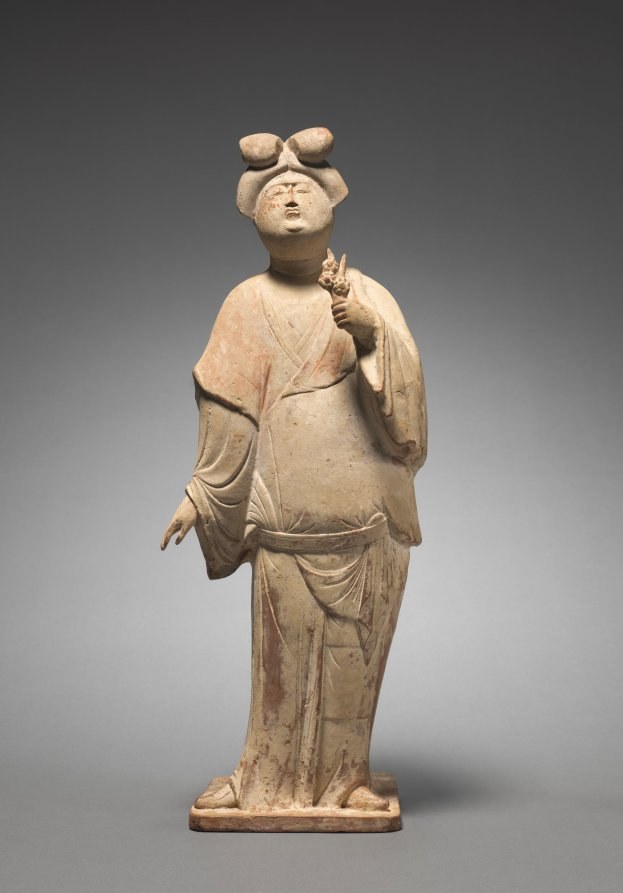
Woman Holding Plum Blossoms
Unknown artist
- Medium:
- earthenware covered in white slip with traces of pigment
- Collection:
- Chinese Art
- Source:
- Cleveland Museum of Art
- Rights:
- Public domain — free to use, share and adapt.
- Recorded as:
- CC0
For historians of costume, hairstyle, and court culture, this figurine is invaluable visual evidence of what a fashionable woman of the 8th century actually wore and how she presented her body—information available from no other source. For dancers and choreographers interested in historical reconstruction or cultural context, it documents the ideal of elegant bearing and refined posture that formed the backdrop against which Tang court dances were performed.
What you are looking at
A terracotta figurine of a standing woman, modeled in the round and rendered with careful attention to costume and bearing. She wears a long robe with draped sleeves that fall generously from her shoulders, gathered at the waist with a belt, and a short jacket or overjacket layered across her chest and upper torso. Her hair is elaborately arranged in a high chignon or topknot, crowned by what appear to be two spherical ornaments or perhaps hair pins—a fashionable arrangement of the mid-8th century. In her right hand, held at roughly waist height, she grasps a sprig of blossoms, likely plum blossoms as the title suggests. Her expression is serene and gently smiling, her gaze slightly downward. The figure is burnished white slip covers the earthenware body, with traces of pigment still visible on the robe and details. The base is a simple rectangular plinth. The pose is fundamentally still and dignified—this is not a figure captured mid-dance or in extreme movement, but rather a figure standing in graceful repose, the weight evenly distributed, the bearing upright and composed.
The dancing
The single figure stands with weight distributed evenly on both feet, in a neutral standing position with no suggestion of shifted weight or dynamic movement. The shoulders are relaxed and level. Both arms hang naturally, with the right arm bent slightly to hold the flowering branch at belly-height. There is no contrapposto, no torsion of the spine, no indication of stepping or traveling through space. The posture is formal and frontal—designed to be viewed from the front and sides in a static display.
The dance depicted
This figurine does not depict a dancer or an active dance movement. It is a fashionable court lady in formal dress, standing in a posed, dignified position typical of Tang tomb sculpture. While the catalogue record notes that Tang figurines document "elegant ladies in various hairstyles, costumes, and activities," this particular example shows a lady at rest rather than in motion. The plum blossoms she holds are a symbolic attribute of elegance and refined taste, not props for a specific dance or performance. The figurine may represent the ideal of beauty and courtly bearing that would have been admired in performance contexts, but the pose itself is not choreographed or recognizable as any known dance form.
How it was made
The work is modeled earthenware covered with white slip, a technique standard for high-quality Tang tomb figures. The slip provides a smooth, pale surface that mimics more precious materials and allows for fine detail and painted ornament. The figure was likely hand-modeled in sections (head, torso, limbs) and joined together, then refined with carving and scraping tools to define drapery folds and facial features. Traces of pigment—likely red or ochre—remain on the robe, indicating that the figure was originally painted in colors that have largely worn away over thirteen centuries. This technique of slip-covered earthenware allowed for rapid production in workshops while achieving a refined appearance, making such figurines accessible to elite burials across a large region.
About this work
This is a Tang dynasty tomb figurine of a fashionable court lady, datable to around 740 CE on stylistic and archaeological grounds. She exemplifies the idealized beauty and courtly bearing documented in mid-8th-century burials, particularly from cosmopolitan centers like Xi'an. The careful rendering of her elaborate costume and coiffure speaks to the importance of visual display and sartorial refinement in Tang court culture. While the catalogue notes that such figurines accompanied musicians, dancers, and officials in the afterlife, this particular figure is portrayed in static dignity rather than active performance. She belongs in a gallery about dance in art not as a dancer, but as an artifact documenting the aesthetic ideals, costume practices, and bodily bearing that framed performance contexts in Tang China.
How to look at it
Observe the deliberate composition of the costume: the layered robes, the precise arrangement of the drapery folds, the ornamental hair ornaments. These details were meant to be read as markers of status, taste, and courtly sophistication. Note the stillness and formality of the pose—this is not the frozen moment of a leap or turn, but rather the standard posture of a dignified standing figure. The slight smile and downward gaze suggest an inner composure and modest refinement rather than performative energy. This is how the Tang court wished to remember and represent feminine elegance in the afterlife.
The period
The Tang dynasty (618–907 CE) was a period of cosmopolitan splendor and extensive international trade along the Silk Road. The mid-8th century saw the height of Tang cultural and political power, and Chinese court culture absorbed influences from Central Asia, the Middle East, and South Asia. Dance was a vital courtly art: both indigenous Chinese forms and exotic foreign dances (especially from Central Asia) were performed for the emperor and nobility. Large tomb figurines—including musicians, dancers, acrobats, foreign attendants, and animals—were burial goods meant to recreate the visual pageantry of the living court in the afterlife. This figurine is one of hundreds of thousands produced for tombs during the 7th and 8th centuries; the consistency of type across many examples attests to established workshop practices and aesthetic conventions.
Where it lives
The figurine is held in the Chinese Art collection of the Cleveland Museum of Art (CMA). It is one of many Tang tomb figures in Western museums, acquired in the early-to-mid 20th century when large numbers of Chinese antiquities entered Western collections.
Questions about this work
Is this figure a dancer?
No. While the Tang dynasty was celebrated for its court dances and produced thousands of tomb figurines depicting musicians and dancers, this particular figure is a fashionable lady in formal standing pose. She is not captured mid-movement, and her pose does not correspond to any documented dance form. She represents the aesthetic ideal of courtly beauty rather than a specific performance.
What do the plum blossoms mean?
In Chinese culture, plum blossoms are a traditional symbol of elegance, resilience, and refined taste. Holding flowering branches was a common attribute in portraiture and decorative arts, signaling the subject's cultivation and aesthetic sensibility. The blossoms are not a performance prop, but an emblem of virtue and beauty.
Why are so many of these figurines in museum collections now?
Tomb figurines like this were mass-produced for burials during the Tang dynasty and were not considered precious or unique by later Chinese standards. In the early 20th century, large quantities were excavated and exported to Western museums and private collections. Today they are recognized as invaluable historical documents of clothing, daily life, and courtly culture.
More dance artwork





