49 works in this view — arrow keys or swipe to move between them.
Dance in Art
Ornamental Shoulder Band from a Tunic
Unknown artist
- Medium:
- tapestry weave with supplementary weft wrapping; undyed linen and dyed wool
- Collection:
- Textiles
- Source:
- Cleveland Museum of Art
- Rights:
- Public domain — free to use, share and adapt.
- Recorded as:
- CC0
This is one of relatively few surviving textiles that preserves the movement vocabulary of ancient Greek dance in visual form. The distinction between the dancers' forward-leaning, mobile torsos and the shepherds' vertical, staff-anchored postures teaches us how ancient weavers thought about dance as distinct embodied practice. For historians of dance costume, this band is evidence that decorated garments themselves were part of the visual language of performance, and that dancing bodies were prestigious enough to warrant expensive dye and skilled labor.
What you are looking at
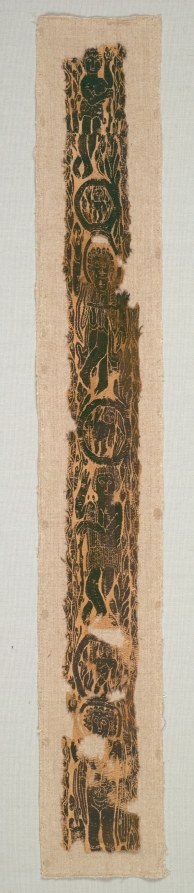
This is a vertical band of tapestry woven in undyed linen with supplementary weft wrapping in dyed wool, depicting a procession of four figures alternating between dancers and shepherds set among stylized leafy plants. The composition reads from top to bottom as a continuous narrative ribbon. The first figure is a shepherd wearing a spotted animal-skin garment and holding a wooden staff; below him is a female dancer in a short draped peplos with her body in a forward-leaning posture. The third figure is another shepherd in matching spotted attire with staff; the fourth, at the bottom, is a nude female figure with only a scarf draped over her shoulders. The wool has been dyed with kermes (a bluish-red insect-derived dye) and indigo in an attempt to achieve purple, producing a brown-purple tone throughout. The figures are rendered in silhouette against the lighter linen ground, with plant scrolls and tendrils filling the negative spaces and framing each figure.
The dancing
All four figures are shown in profile or three-quarter view, allowing the viewer to read their postures clearly. The dancers display a distinctly forward inclination of the torso with what appears to be a bending or flexing of the knees, suggesting active movement rather than static poses. The upper dancer's peplos falls short, exposing the legs and emphasizing mobility. The lower dancer's bare shoulders and the scarf draped loosely suggest freedom of movement through the upper body. The shepherds stand more vertically, anchored by their staffs as attributes of their role rather than movement aids. All figures appear isolated within the plant frame rather than paired or interacting, reading as sequential vignettes rather than a coupled dance.
The dance depicted
These appear to be scenes from ancient Greek social or ritual dancing, likely from the Classical period (5th–4th century BCE) based on the garment types and compositional conventions. The peplos-wearing dancer is consistent with depictions of female chorus dancers or participants in symposium entertainment. The nude male figure with only a scarf suggests a different dance tradition or possibly a mythological context—such dances appear in Greek pottery and sculptural contexts as fertility or processional rituals. Without inscriptions or more specific iconographic markers, the precise dance genre cannot be identified with certainty, but the alternation of dancers with staff-bearing figures suggests a narrative procession, possibly part of a religious festival or theatrical performance. The artist has understood the dancers' bodies as capable of forward propulsion and flexible torsos, quite distinct from the static postures of the shepherds.
How it was made
This is a tapestry woven using supplementary weft wrapping—a technique in which colored wool is wrapped around the linen warps to create pattern without fully interlocking wefts. This labor-intensive method produces durable, reversible imagery well-suited to garment decoration. Tapestry weaving requires advance design and carries the fabric through repeated wear and cleaning, making it a prestige medium for high-status dress. The choice of this technique for a tunic shoulder band indicates the wearer's wealth and the significance of the imagery. The attempted purple dye—a historically expensive and restricted color—further confirms this as an elite object. The technique constrains the artist to bold silhouettes and linear pattern; modeling and perspective are impossible, emphasizing instead clarity of profile and rhythmic repetition.
About this work
This shoulder band from a tunic dated to around 600 CE represents a moment when Greco-Roman dance traditions were being translated into the decorative language of textile production. The alternation of dancers and shepherds suggests either a theatrical narrative or a mythological procession, preserved in weave rather than paint. The garments and body postures place the imagery in the orbit of Classical Greek dance practice, even if the specific occasion—and the exact cultural context of this object's production—remain uncertain. The work belongs in a dance gallery because it documents both the aesthetic of ancient Greek dancing and the cultural value placed on dance imagery: important enough to commission, costly enough to weave in precious dye, and placed at the shoulder where it would be seen and admired by those in proximity to the wearer.
How to look at it
Attend first to the different postures: the dancers lean forward and lower their centers, while the shepherds stand upright and planted. This contrast tells you that the weaver recognized dance as a specific way of using the body, distinct from ordinary standing. Notice the small scale and the density of the plant ornament around each figure—the figures are not meant to fill the field but to punctuate it, like a written text with spacing. The linear, silhouetted style is not crude; it is the inevitable result of the tapestry weave technique, which demands bold, readable profiles. Follow the figures from top to bottom as a sequence, as a reader would follow text, rather than trying to find a single moment.
The period
Around 600 CE, tapestry weaving was practiced across the Mediterranean and Near East, with particularly rich traditions in Egypt and the Eastern Roman Empire. By this date, Classical Greek cultural forms—including dance—were known through literary sources, pottery, and sculptural remains that had circulated for over a thousand years. Textile production was among the most valued and regulated crafts; purple dye especially was controlled and expensive. The attempt to achieve Tyrian purple through a combination of kermes and indigo speaks to both the prestige of the color and the technical limitations of achieving it in peripheral production centers. Dance imagery on garments served to assert both the wearer's cultural sophistication and their access to rare materials and skilled craftspeople.
Where it lives
This work is held in the Textiles collection of the Cleveland Museum of Art. It is catalogued as a tunic decoration, indicating it was originally sewn or attached as a functional element of a garment rather than conceived as an independent artwork. Its survival as a removed band suggests it was either disassembled for conservation or separated in antiquity.
Dance in this work
Questions about this work
How do we know these figures are dancing?
The forward lean and bent knees of the two central figures contrast sharply with the upright, planted posture of the staff-bearing figures. In ancient visual culture, this postural distinction was a consistent marker of active movement. The peplos worn by the upper figure was standard dress for Greek female dancers, reinforcing this reading.
What does the spotted garment mean?
The spotted pattern suggests an animal skin (likely a fawn or goat skin), a costume element worn by shepherds, satyrs, and other pastoral or theatrical figures in Greek tradition. It marks these figures as belonging to a specific narrative or social role distinct from the dancers.
Why is one dancer nude and one clothed?
The nude or nearly nude figure may represent a male dancer, mythological figure, or a dancer in a different ritual context. Nudity in Greek art carried different meanings depending on context—athletic, divine, or performative. Without an inscription, the specific meaning here cannot be certain, but it indicates the weaver was drawing on a rich visual vocabulary of Greek dance traditions.
Is this an Egyptian or Greek object?
The garment types, figural style, and imagery are consistent with Classical Greek conventions, though the date (600 CE) and the technique of tapestry weaving suggest production in the Late Antique Mediterranean, possibly Egypt or the Eastern Roman Empire. The object draws on Greek cultural memory and artistic tradition rather than contemporary Greek dance practice.
More dance artwork





