49 works in this view — arrow keys or swipe to move between them.
Dance in Art
Dancing Dwarf
Unknown artist
- Medium:
- bronze
- Collection:
- Greek and Roman Art
- Source:
- Cleveland Museum of Art
- Rights:
- Public domain — free to use, share and adapt.
- Recorded as:
- CC0
This figure is one of the few surviving material records of ancient comic or entertainment dance, and one of the very few that documents the performance bodies of people with dwarfism in antiquity. It shifts the history of dance away from the staged, monumental, and literary toward the intimate, the popular, and the marginal—toward the entertainers whose performances were woven into daily life. The figure also raises urgent questions about disability, spectacle, and the uses of the human body in ancient cultures.
What you are looking at
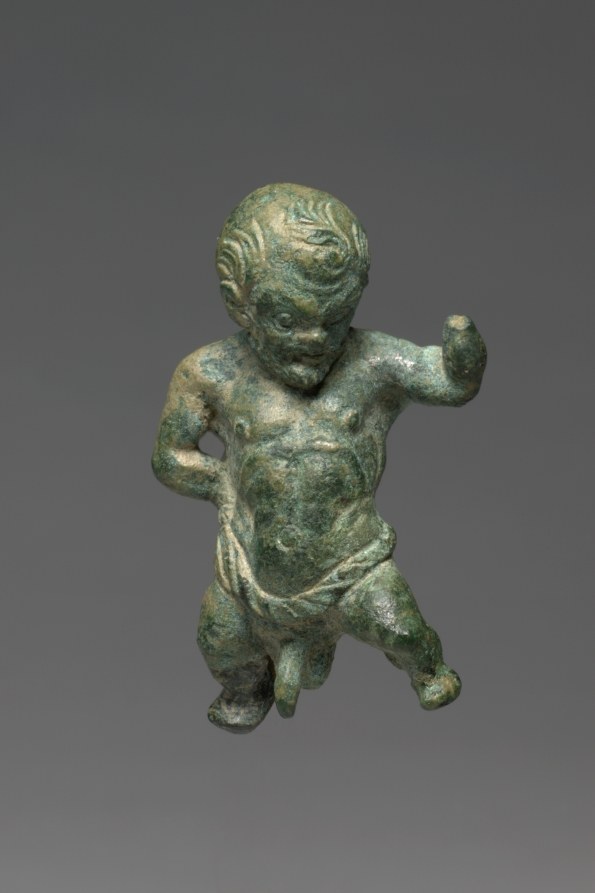
A small bronze figure, cast solid and patinated to a green-gray tone, stands alone against a neutral background. The figure is nude except for a twisted sash or band at the hips. He is captured mid-movement, with his left arm raised to shoulder height (the hand now missing) and his right arm bent at the elbow with the hand placed on or near the hip. His left leg is extended forward in a walking or lunging stride, while his right leg supports the weight of the body. The figure's face is animated and direct, with exaggerated facial features: a broad brow, widely spaced eyes, sharply raised eyebrows, and a depressed nasal bridge. A beard frames the lower face. The genitals are rendered with anatomical prominence. The scale is intimate—small enough to hold in one hand—and the patina suggests considerable age.
The dancing
A single standing male figure in a dynamic asymmetrical pose. The raised left arm and forward-stepping left leg create a forward momentum, as if the body is mid-stride or mid-leap. The right arm anchors the composition at the hip, a gesture of confidence or provocation. The weight is distributed unevenly, with the torso tilted slightly forward and the legs in an open, active relationship. The missing left hand suggests it may once have held an object—krotala (clappers), castanets, or another percussion instrument are documented in comparable examples.
The dance depicted
This figure almost certainly represents a comic or entertainment dance of Greco-Roman antiquity. Dwarfism (achondroplasia) was a documented feature of court dancers, entertainers, and satirical performers in the ancient Mediterranean world, who performed in sympotic (banquet) contexts and public spectacles. The dynamic, forward-stepping pose and the anatomical exaggeration suggest this was a fertility or apotropaic figure—one designed to amuse, protect, or ward off evil through its transgressive or grotesque character. The missing hand may have held clappers or percussion to accompany the movement. The style and material point to Hellenistic or Greco-Roman manufacture, likely 1st century BCE–1st century CE.
How it was made
This is a solid-cast bronze, likely created by the lost-wax process. The small scale and technical finish indicate professional manufacture. The green patina is the result of centuries of oxidation and burial. The solidity of the casting and the precision of detail—the carved facial features, the gesture of the limbs—suggest this was a valued object, not a casual toy. Bronze objects of this class circulated among elites and were collected as curiosities, amulets, or mementos of the ancient world.
About this work
This is a miniature bronze figure of a dancing dwarf from the Greco-Roman period, cast to capture a moment of forward-striding movement and exuberant gesture. The figure embodies a long ancient tradition of entertaining or protective performance by individuals with dwarfism, whose bodies were read as sites of comedy, fertility, and apotropaic power. The missing left hand once likely held percussion instruments—clappers or castanets that accompanied the dance. The object belongs to a category of small bronzes that circulated in elite contexts as curiosities, talismans, and records of popular entertainment.
The work sits at the intersection of dance history, disability history, and the material culture of entertainment. It documents a form of performance and a social role—the dwarf entertainer—that was woven into the fabric of ancient life but is rarely visible in monumental or literary sources. The intimate scale and animation of the figure invite the viewer to imagine the sound, the rhythm, the laughter, and the protective power that surrounded such performances.
How to look at it
Look at the asymmetry of the pose: the raised left arm and forward-stepping left leg create a diagonal thrust across the body, while the right hip is anchored, creating tension and movement. The facial expression is direct and animated, with exaggerated features that read as humorous or grotesque rather than naturalistic. The anatomical precision of the genitals and the careful rendering of the twisted sash suggest the maker understood the body as a source of both comedy and power. Attend to what is missing: the left hand, now broken off, would have completed the gesture and likely held an object that made sound. The small scale means the original owner held this object, turned it over in the hand, felt its weight—a tactile, intimate encounter with a record of ancient entertainment.
The period
In the Hellenistic and Greco-Roman periods, small bronzes of this kind were luxury objects, collected and circulated among wealthy households and sanctuaries. Comic or grotesque figures—satyrs, dwarfs, deformed performers—were popular subjects, reflecting both entertainment practices and apotropaic beliefs. Ancient texts (Pliny, Martial, Juvenal, Petronius) document the presence of dwarf entertainers in aristocratic and imperial households, performing dances, acrobatics, and comic routines at banquets and public spectacles. These figures were prized for their otherness, their fertility associations, and their protective power against the evil eye. The manufacture and circulation of such bronzes reflects a vibrant material culture of entertainment and superstition in the ancient Mediterranean.
Where it lives
This bronze is held in the collection of Greek and Roman Art at the Cleveland Museum of Art (CMA). It is classified as a small decorative or votive bronze, a category of objects that were widely produced and collected in antiquity and remain common in museum collections today.
Dance in this work
Questions about this work
What was a dancing dwarf in ancient times?
Individuals with dwarfism were documented performers in ancient Mediterranean households and courts, where they entertained at banquets, festivals, and public spectacles. They were valued for their novelty, their association with fertility and protection, and their skill in dance, acrobatics, and comedy. Ancient texts name specific performers and describe their acts. They occupied an ambiguous social role—celebrated and mocked simultaneously—and their bodies were read as sources of both laughter and protective power.
Why is the left hand missing?
The hand broke off in antiquity or during burial and has been lost. However, archaeological and art-historical evidence suggests the original hand held an object—likely clappers (krotala) or castanets, percussion instruments used to accompany dance. Comparable bronze figures of dwarf performers in museums worldwide show similar poses with clappers in the raised hand, making it probable this figure originally held such an instrument.
What does the twisted sash mean?
The sash, or himation, is a draped cloth worn around the hips. It appears in representations of comic and satirical performers, and its twisted, off-center placement emphasizes the exuberance or transgressive character of the dance. It may also signify a specific costume or role associated with entertainment or fertility performance.
Is this object an amulet or a toy?
Likely both. Ancient small bronzes of grotesque or comic figures served multiple purposes: they were collected as curiosities, used as protective amulets (apotropaic figures were believed to ward off evil), and kept in households as reminders of entertainment or spectacle. The intimate scale invites handling, suggesting the owner held and perhaps carried it, gaining protection or amusement from its presence.
More dance artwork





