49 works in this view — arrow keys or swipe to move between them.
Dance in Art
Dancing Sailors
Charles Demuth (American, 1883–1935)
- Medium:
- watercolor over graphite
- Collection:
- Drawings
- Source:
- Cleveland Museum of Art
- Rights:
- Public domain — free to use, share and adapt.
- Recorded as:
- CC0
This work documents the history of queer social dancing and male intimacy in early 20th-century American culture at a moment when such representation was rarely made public or preserved. For dance historians, it is primary evidence of how bodies moved together in non-theatrical settings and of the artist's understanding of the body as the central subject. The deliberate privacy in which Demuth kept these works—a decision made by a respected modernist artist—speaks to the censorship and social danger surrounding queer representation in that era.
What you are looking at
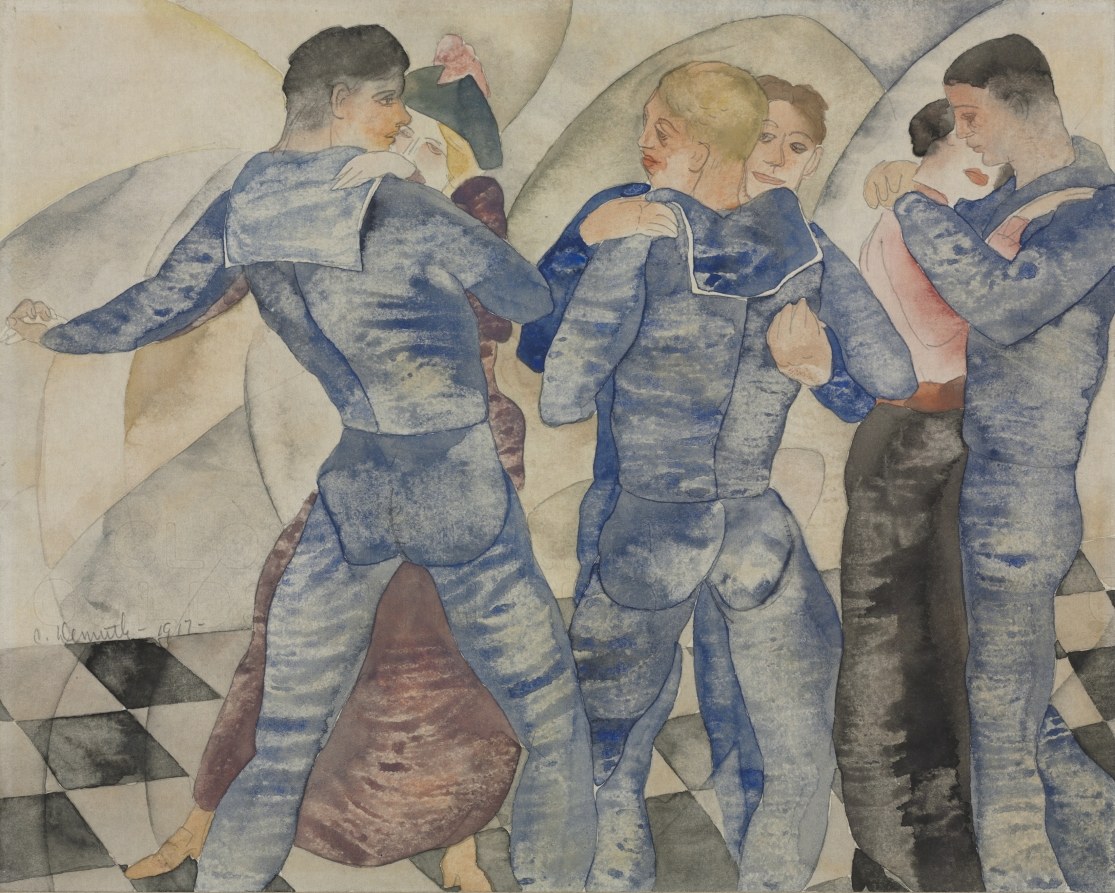
Five male figures in close proximity occupy a shallow, compressed space defined by pale geometric planes of watercolor wash. The figures wear matching blue-grey patterned garments—tight-fitting, full-body suits that suggest either underwear or dancewear—rendered in subtle textures of blue and grey watercolor. Two pairs dance together in the center and left foreground; a fifth figure stands slightly apart on the right. The composition moves laterally across the sheet rather than receding in depth. One figure in the left foreground wears a maroon or rust-colored undershirt beneath the blue suit. The background dissolves into soft, abstract planes of beige, grey, and blue-grey watercolor that blur the distinction between figures and setting. The overall mood is intimate and private, with soft edges and muted tonality throughout.
The dancing
The dancers are positioned in close physical contact, with bodies oriented toward one another in pairs. Weight appears distributed between partners in what suggests a ballroom closed or semi-closed frame, though the actual hand positions are not clearly defined. The standing figure on the right places a hand on another's shoulder or back in a gesture of affection or proximity. Arms are bent and engaged with partners rather than extended; the geometry is compact. The figures lack anatomical definition—they are suggested through silhouette and the patterned surface of their clothing—which emphasizes the abstraction of form over naturalistic representation.
The dance depicted
This appears to depict social or ballroom dancing in an intimate, non-theatrical setting, most likely in a bathhouse, nightclub, or private gathering in 1910s New York. The close paired holds, muted setting, and the documentary interest in male bodies dancing together suggest this records a moment from the queer social dance culture of Greenwich Village. The artist has chosen to render the dancers as nearly abstract forms, obscuring individual identity while emphasizing the physicality of the embrace and the relationship between bodies. This is not identifiable as any formal ballroom style—the postures are too compressed and informal—but rather as vernacular social dancing captured in a moment of private intimacy.
How it was made
Watercolor over graphite on paper, a technique that allowed Demuth to work quickly and maintain the fluidity and spontaneity of observation. The textured watercolor creates a unified visual field in which figure and ground are nearly coterminous, achieved through layering translucent washes and allowing the paper to show through. This technique was well-suited to the documentation of transient social moments and allowed for the kind of rapid notation that captures feeling and gesture rather than anatomical precision. Watercolor's intimacy and portability made it the medium of choice for private, personal observation in this period.
About this work
This is a watercolor study of male dancers in close embrace, made by Demuth in 1917 during his documentation of the queer nightlife and bathhouse culture of New York's Greenwich Village. The work is one of two nearly identical compositions, both of which remained private during the artist's lifetime, suggesting that Demuth understood the image as too candid or socially transgressive for public display. The painting captures a moment of social dancing—not a theatrical performance—rendered through abstracted form and muted color. It belongs in a dance gallery as evidence of vernacular queer social practice and as an artwork that privileges the body, gesture, and physical intimacy over narrative or spectacle.
How to look at it
Attend first to the compression of the composition: the figures do not recede into illusionistic space but instead flatten against the picture plane, their bodies pressed together and to the surface. The artist has chosen to freeze a moment of sustained physical contact rather than a high point of movement or virtuosity. Notice how the blue-patterned suits unify the figures while the textured watercolor surface keeps them from reading as individual bodies with clear boundaries—they merge slightly into one another and into the background. This formal strategy—the abstraction of individual identity into a unified field of color and gesture—mirrors the social invisibility and privacy that queer dancers required and sought.
The artist
Charles Demuth (1883–1935) was an American modernist painter and watercolorist based in Lancaster, Pennsylvania, who spent much of his time in New York. He was deeply engaged with both European modernism and the bohemian cultural life of Greenwich Village. Though he was a respected painter of architectural subjects and still life in his public practice, Demuth also made a substantial body of watercolors documenting the erotic and social life of the city—nightclubs, theaters, bathhouses, and intimate moments—which he kept largely private. These works reveal an artist equally invested in capturing human desire and the modern urban experience as in formal abstraction.
The period
In 1917, American social and theatrical dance was undergoing rapid modernization. Ballroom dancing was becoming increasingly popular and codified, while simultaneously queer subcultures in cities like New York were developing their own social dance practices in bathhouses, speakeasies, and private venues. This was the era of Diaghilev's Ballets Russes and American responses to European modernism in dance, but it was also a period of intense social surveillance and criminalization of same-sex desire. Demuth's works document a layer of dance history—vernacular, queer, male-centered, and decidedly non-theatrical—that was otherwise invisible in the public record.
Where it lives
This work is held in the Drawings collection of the Cleveland Museum of Art. It is one of two nearly identical compositions on this subject; the other is in the Museum of Modern Art, New York. The existence of two versions suggests Demuth deliberately recorded this subject, though the reasons for the duplication—whether a study and a finished version, or a record of preference for the composition—are not documented. Both remained in private collections during Demuth's lifetime.
Questions about this work
Why did Demuth keep these paintings hidden?
Demuth lived in an era when homosexuality was illegal, heavily stigmatized, and subject to criminal prosecution. Public display of homoerotic imagery would have exposed him to legal risk and social ruin. Many artists of his generation maintained dual practices: a public body of work acceptable to galleries and collectors, and a private body of work that documented their lived experience and desire. These watercolors were part of Demuth's private archive—a record for himself and trusted friends of the queer social world he inhabited.
Is this ballet or ballroom dancing?
Neither, formally. The figures are not en pointe, and the postures are too compressed and informal for codified ballroom technique. This depicts vernacular social dancing—the way people danced together for pleasure and intimacy in non-theatrical settings like bathhouses and private gatherings. The embrace and closeness are the point; the technique is secondary.
How do we know this depicts men dancing together?
The catalogue record notes that the composition shows 'two sailors dancing together while others dance with women,' and the artist's documented practice of attending bathhouses and male-centered venues in Greenwich Village supports this reading. However, the watercolor itself abstracts the figures sufficiently that biological sex cannot be definitively established from the image alone. The historical record and Demuth's known interests provide the context.
What does the blue-grey patterned suit represent?
The suits likely represent underwear or minimal dancewear worn in bathhouse or intimate settings. The patterning and texture suggest fabric studied closely; Demuth was interested in the surface and material reality of cloth. The uniform blue-grey color across multiple figures creates visual unity while the texture differentiates them subtly.
More dance artwork





