49 works in this view — arrow keys or swipe to move between them.
Dance in Art
Kottabos Element of a Dancing Satyr
Unknown artist
- Medium:
- bronze
- Collection:
- Greek and Roman Art
- Source:
- Cleveland Museum of Art
- Rights:
- Public domain — free to use, share and adapt.
- Recorded as:
- CC0
This work documents how dance vocabulary and the body in motion were embedded in Greek everyday social practice, not confined to the stage. The satyr's pose testifies to an aesthetic of ecstatic, vulnerable embodiment that informed both theatrical performance and domestic ritual, offering rare evidence of how movement, play, and bodily display functioned together in symposium culture.
What you are looking at
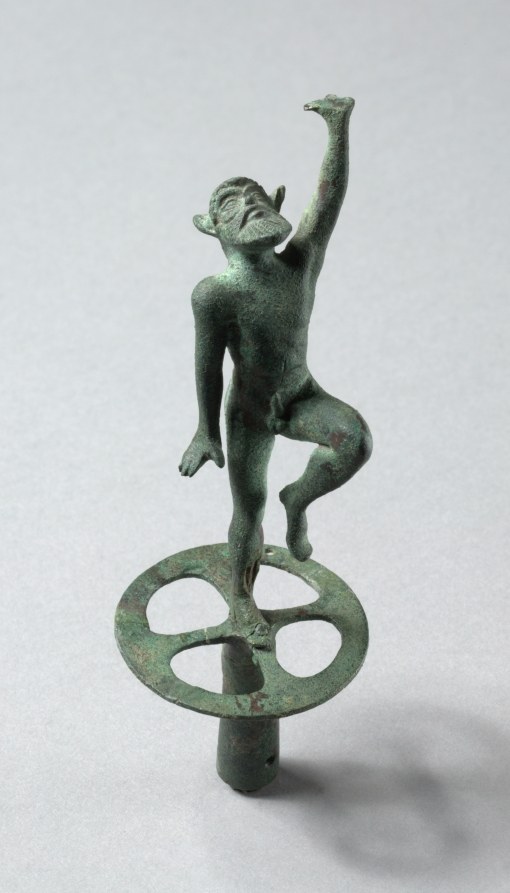
A small bronze figure of a satyr frozen mid-dance stands atop a hollow disc mounted on a cylindrical post. The satyr's body twists upward in exuberant motion: one leg is lifted high, the torso arches backward with arms reaching skyward, the head tilts back. The figure displays the satyr's characteristic snub nose and pointed ears. His musculature is delicately rendered in the bronze, showing definition across the chest, abdomen, and limbs. The hollow disc beneath him, pierced with four circular openings, would have supported a larger vessel or dish above—now lost—which the satyr appears to be reaching toward with his raised arm. The patina of the bronze is dark green, typical of Greek metalwork.
This object functioned as both sculpture and game apparatus. In the drinking game kottabos, players would flick wine dregs from their cups attempting to dislodge the dish from the satyr's hand. The dynamic pose captures the exact moment of playful interaction: the satyr's body language conveys motion and vitality, his raised leg and extended arm creating an unstable, precarious balance that invites the destructive flick of wine. The diminutive scale—this is a small object, made to sit on a table—emphasizes its domestic, convivial purpose.
The dancing
A single male figure in an exaggerated contrapposto stance, weight on one leg with the other lifted high and bent at the knee. The torso arches sharply backward, with both arms extended upward—the upper arm lifted toward the shoulder, the forearm reaching vertically. The head tilts back in line with the spine's curve, creating a unified arc through the entire body from knee to crown. This is not a static pose but a captured moment of dynamic motion, with the figure appearing to lurch or sway. The stance is inherently unstable and playful, emphasizing vulnerability to the flick that would topple the perched dish.
The dance depicted
This is a satyr figure associated with symposium culture and the game of kottabos, not a depiction of formal dance in the theatrical sense. However, the pose contains recognizable dance vocabulary: the lifted leg, extended arms, and arched torso resemble the vocabulary of ecstatic, uninhibited movement associated with satyrs in Greek art and drama. The figure captures the performative, bodily exuberance of Dionysian revelry. While not a specific named dance, the satyr's posture embodies the aesthetic of satyr-plays and Dionysian festivals, which involved mimetic and rhythmic bodily expression. The object transforms the satyr into an interactive participant in the social and competitive ritual of wine-drinking, where movement and vulnerability are essential to the game's appeal.
How it was made
This is a cast bronze sculpture, likely made by the lost-wax process standard in Classical Greek metalworking around 470 BCE. The technique allows for fine detail and delicate modeling of musculature and facial features, as visible in the definition of the satyr's torso and the precise carving of his distinctive features. The hollow interior of the figure and the precisely engineered hollow disc with its four circular apertures suggest skilled craftsmanship and planning for functional durability. The small scale and the modular construction—a figure mounted on a post-and-disc assembly—indicates this was a luxury domestic object made for symposium use, circulating among educated, wealthy Greek households rather than serving a public or religious function.
About this work
This small Greek bronze casting from around 470 BCE presents a satyr in a pose of exuberant, precarious motion. The figure stands atop an architectural base and would have originally held a dish in its raised hand, functioning as both sculpture and the focal point of kottabos, a competitive drinking game popular in Classical Greece. The satyr's dynamic arched posture, lifted leg, and skyward-reaching arms capture the aesthetic of uninhibited bodily movement associated with Dionysian celebration and satyr-plays.
The object belongs to a category of Greek domestic luxury goods that merged aesthetic and functional concerns. It records not staged performance but the ritualized social choreography of the symposium—the all-male drinking party that was central to Greek civic life. The satyr's vulnerable balance and exaggerated pose invite destruction: part of the game's pleasure lay in toppling him, making the sculpture both a work of art and a consumable prop in social competition.
How to look at it
Observe how the artist has captured a moment of maximal instability: the satyr leans back radically, one leg high, arms reaching, the entire torso an arc. This exaggeration is intentional—it communicates not graceful balance but precarious, vulnerable motion. The pose invites the eye to complete the narrative: imagine the flick of wine that will topple the dish from his hand and send his body into further chaos. The backward arch of the body and the skyward reach of the arms echo the vocabulary of ecstatic religious movement and satyr-play choreography, translating theatrical exuberance into a domestic object. The diminutive scale makes the figure's vulnerability and exposure more acute—it is small enough to hold in one's hand, yet claims the space of attention through the intensity of its posture.
The period
In Classical Greece (c. 470 BCE), satyrs were stock characters in satyr-plays, a theatrical genre performed at festivals alongside tragedies. These works celebrated Dionysus and featured satyrs as figures of uncontrolled appetite, lewdness, and physical exuberance. The same aesthetic—satyrs as embodiments of uninhibited motion—permeated symposium culture, where elite men gathered to drink, discuss philosophy, and compete in games. Kottabos was one such game, combining skill with the spectacle of bodily movement and destruction. Bronze vessels and figurative sculpture for symposium use were luxury crafts, often depicting satyrs, maenads, and scenes of Dionysian revelry. The figure captures a moment when high art (refined bronze casting) and social play (the competitive game) intersected in the aestheticized body of the satyr.
Where it lives
The work is held in the Greek and Roman Art collection at the Cleveland Museum of Art, catalogued as a kottabos element—that is, a component of a larger drinking-game apparatus. As a functional object designed for repeated use and competitive destruction in symposium settings, its survival is remarkable.
Dance in this work
Questions about this work
What is kottabos and how does this object fit into the game?
Kottabos was a Greek drinking game in which symposium participants flicked the dregs of wine from their cups at a target, aiming to knock it off a precarious perch. This bronze satyr would have stood atop a tall post with a dish balanced in his upraised hand; the goal was to hit the dish hard enough to dislodge it. The game combined skill, competition, and the pleasure of destroying a beautiful object.
Why is the satyr in such an exaggerated pose?
The extreme arch of the back, the lifted leg, and the reaching arms communicate instability and vulnerability—essential to the game's appeal. An object in precarious balance is more satisfying to topple. The pose also references the aesthetic of satyr-plays and Dionysian ritual, where satyrs embodied uncontrolled, ecstatic movement. The exaggeration is both functional and evocative of performance.
Is this a depiction of actual dance?
Not formal theatrical dance, but rather the bodily vocabulary of satyr characters in Greek drama and Dionysian festival culture. The pose contains recognizable elements—the lifted leg, extended arms, arched torso—that communicate ecstatic, uninhibited movement. The object exists at the intersection of art, performance aesthetics, and social ritual.
What does the hollow disc beneath the satyr do?
The disc with four circular apertures would have been part of the kottabos apparatus, likely resting atop a tall bronze post. The whole assembly allowed the dish to sit high and precarious in the satyr's hand, making it a challenging target for wine-flicking players. The engineered hollow structure was both practical and elegant.
More dance artwork





