49 works in this view — arrow keys or swipe to move between them.
Dance in Art
Dancing Satyr Group
Unknown artist
- Medium:
- painted terracotta
- Collection:
- Greek and Roman Art
- Source:
- Cleveland Museum of Art
- Rights:
- Public domain — free to use, share and adapt.
- Recorded as:
- CC0
For dancers and historians, these figures offer rare visual evidence of how Greek artists understood and depicted performative movement—not as refined or composed, but as physical, earthy, and exuberant. The poses tell us what satyr dancing looked like in practice: low, wide, expansive, and deliberately excessive.
What you are looking at
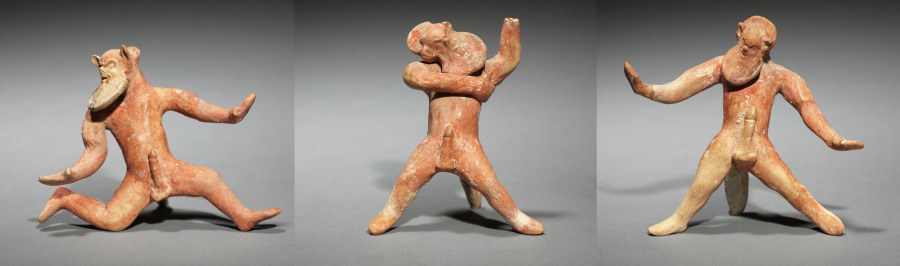
Three terracotta figures in dynamic poses, shown from multiple angles. Each figure is a nude male form with exaggerated musculature and an animal head—goat or horse ears prominent, with traces suggesting tails. The bodies are rendered in warm orange-brown clay with visible surface texture and occasional darker patches from firing or age. The figures adopt lively, splayed stances: one lunges forward with arms spread wide, one stands with legs apart and arms raised high, and one stretches sideways with limbs extended. These were originally attached to the rim of a large vessel, as shown by the flat or beveled attachment points at their bases. The poses suggest energetic, uninhibited movement.
The dancing
All three are anatomically exaggerated male figures with pronounced abdominal and chest musculature. Their legs are splayed in wide, grounded stances with bent knees that suggest weight shifting and forward momentum. Arms extend outward and upward in open, expansive gestures rather than any closed frame. The bodies lean and twist, creating a sense of play and instability—none are vertically centered. The animal heads are small relative to the bodies, emphasizing the human form and its physicality.
The dance depicted
These figures depict satyrs, the woodland creatures of Dionysian cult and Greek theatrical practice. Satyrs appear frequently in satyr plays and Dionysian processions, and these clay versions likely decorated a wine vessel used in symposium or ritual contexts. The poses—lunging, spreading, twisting—capture the exuberant, often sexual choreography associated with satyr performance: movement that is grounded and earthy but explosive and uninhibited. The artist has chosen arrested moments of dynamic action rather than static poses, suggesting a sequence or frenzy of movement.
How it was made
Painted terracotta, hand-modeled and fired. The figures were created as separate elements and attached to a vessel rim, a technique that required precision in balance and structural planning. The paint layer is largely lost, but traces remain. Terracotta production allowed for crisp detail in anatomical carving and movement gesture while remaining affordable and reproducible—these were likely decorative elements on a functional object for symposium use, not precious art objects. The durability of clay preserved the dynamic poses across centuries.
About this work
This is a set of three sculptural figures from around 500 BCE, originally part of the rim decoration of a large terracotta wine vessel. They depict satyrs—hybrid creatures of Dionysian myth—in poses of uninhibited movement and play. The work sits at the intersection of Greek dramatic tradition, ritual practice, and domestic ceramic art. Satyrs were central to satyr plays and processions honoring Dionysus, and their depiction in vigorous, splayed poses on drinking vessels reinforced the vessel's association with wine, festivity, and the transgressive freedom those contexts allowed. The artist understood and rendered the physical grammar of satyr performance: grounded, spread-legged stances, explosive arm gestures, and a sense of barely contained energy.
How to look at it
Notice the wide, splayed leg positions and the forward lean of the torsos—these are not standing poses but caught moments of movement. The raised and extended arms suggest exuberance or mimicry rather than any formal hold. The small animal heads and emphasized musculature create a visual joke: the body is all human and all appetite. The artist has chosen the most expansive, physically open moments to freeze, maximizing the sense of activity and transgression.
The period
The satyr play was a recognized dramatic form in 5th-century Athens, performed after tragedies at major festivals. Satyrs were stock characters—lusty, foolish, and physically exaggerated—and their choreography reflected and amplified the bodily excess associated with Dionysian cult and wine consumption. On decorated vessels, satyr imagery reinforced the object's ritual and social function: these were vessels for wine service in symposia and sacred contexts. The style and execution suggest a workshop production rather than a unique commission, indicating that satyr imagery was conventional and in steady demand.
Where it lives
The work is held in the Greek and Roman Art collection at the Cleveland Museum of Art (CMA). It is a functional decorative element, originally one of a set that adorned a large drinking vessel.
Dance in this work
Questions about this work
What is a satyr?
In Greek mythology and drama, satyrs are woodland creatures—part human, part animal (usually with goat ears and a tail)—associated with Dionysus, wine, fertility, and chaos. Satyrs appear in satyr plays, a recognized genre of Greek drama performed alongside tragedies, and in Dionysian processions and rituals. They were comic, physically uninhibited characters central to the performance of transgression and excess.
Why are these on a wine vessel?
Satyrs were the natural inhabitants of the Dionysian world, so their images were appropriate and popular decoration for vessels used in wine service and symposia—formal drinking parties where men gathered. The satyr imagery reinforced the vessel's association with pleasure, ritual, and the suspension of normal social rules that wine and Dionysian practice enabled.
How do these poses compare to other Greek dance depictions?
Greek vase painting more commonly shows formal dances in upright, composed postures—maenads in ecstatic ritual, or paired figures in geometric balance. These satyrs are deliberately exaggerated and sprawling by contrast, emphasizing the physical excess and lack of restraint that satyr performance embodied. The low, wide stances and open arm gestures are radically different from the posed elegance of classical Greek figure representation.
More dance artwork





