49 works in this view — arrow keys or swipe to move between them.
Dance in Art
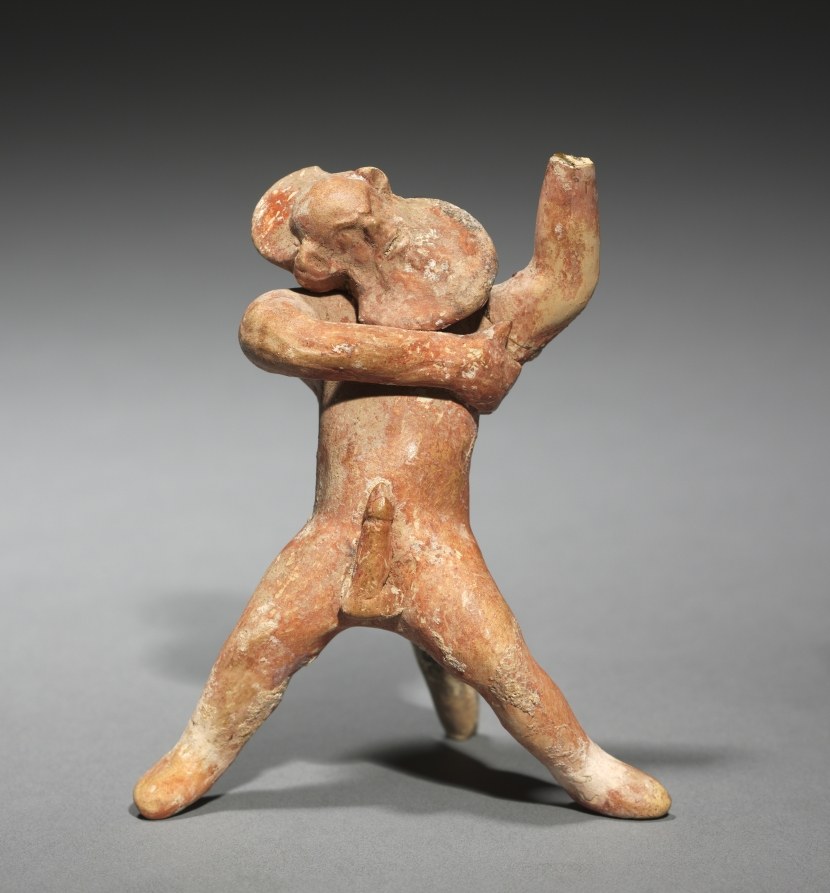
Dancing Satyr
Unknown artist
- Medium:
- painted terracotta
- Collection:
- Greek and Roman Art
- Source:
- Cleveland Museum of Art
- Rights:
- Public domain — free to use, share and adapt.
- Recorded as:
- CC0
This figure is rare evidence of how ancient Greek artists depicted ecstatic, non-codified movement—the kind of unbridled bodily expression associated with religious ritual and divine possession. It shows that movement, in the ancient Greek visual imagination, was not always choreographed or formal; satyrs embody the physical vocabulary of intoxication and abandonment. For historians of dance and embodiment, the satyr provides a crucial counterpoint to more formal, athletic, or ritualized movement.
What you are looking at
A terracotta figure carved in the round depicts a satyr in a dynamic, exuberant pose. The creature stands with legs splayed wide in a stable, grounded stance, the musculature of the thighs and calves clearly articulated. The torso twists upward with one arm raised high and bent, the other held across the body at chest height, creating an open, expansive silhouette. The head is rendered with prominent features: pointed ears, a bearded face with a pronounced nose, and an expression of energy or revelry. The patina is warm terracotta with areas of darker staining and mineral deposits from age. The small scale and refined detail suggest this was one of a series of ornamental figures, likely modeled separately and attached to a vessel rim. The figure conveys unbridled movement and abandon—the body language of a creature mid-celebration.
The dancing
A single satyr figure, approximately 3–4 inches tall, dominates the composition. The pose is fundamentally unstable in appearance yet carefully balanced: the wide leg stance anchors the figure, while the raised arm and twisted torso create a spiraling energy upward. The carving shows understanding of anatomical structure—the calf and thigh muscles are distinct, the shoulder girdle is rendered with definition, and the raised arm creates a sweeping arc that draws the eye skyward. This is not a static pose but one frozen mid-gesture, capturing the momentum of ecstatic movement.
The dance depicted
This figure does not depict a codified dance style but rather the embodiment of *ecstatic movement* as it would have been understood in ancient Greek culture. Satyrs in Greek art are vehicles for depicting uninhibited, physically exuberant behaviour associated with Dionysian ritual and wine-drinking revelry. The raised arm and twisted posture suggest the kind of free, gestural movement performed during symposia and processions honoring Dionysus—not choreographed dance but rather the bodily expression of intoxication, joy, and animal-like liberation. The figure belongs to the visual vocabulary of Dionysian imagery rather than to any specific performance tradition.
How it was made
This is molded terracotta, likely hand-modeled in separate sections (head, torso, limbs) and joined together with slip. The surface shows tool marks consistent with carving and finishing after initial modeling. The warm orange-buff clay color and mineral deposits indicate firing in an oxidizing kiln atmosphere. As one of three satyr figures that decorated the rim of a large drinking vessel (krater or punch-bowl), this was a domestic luxury object for an educated, wine-drinking household. The technique of small ornamental figures applied to vessel rims was widespread in Greek workshops, allowing fine detail and individual expressiveness while serving functional decoration.
About this work
This small terracotta satyr is a fragment of ancient Greek visual culture devoted to the god Dionysus and the ecstatic states he embodied. Dating to approximately 500 BCE, it is a work of skilled ceramic craftsmanship, probably from an Athenian or related workshop, designed to ornament a large communal drinking vessel. The figure captures not a dance in the formal sense but the uninhibited bodily abandon associated with Dionysian revelry—a key subject in Greek art and religion. For viewers interested in how ancient cultures represented movement, intoxication, and the relationship between the human and animal body, this object offers direct evidence of those concerns expressed in three dimensions.
The satyr appears alongside two companions, all three originally mounted on the rim of a large wine-drinking vessel. Together, they formed a narrative frieze celebrating the god and his entourage. The work exemplifies the Greek interest in marginal, transgressive figures as subjects for visual elaboration, and the use of small, precious ceramic objects as vehicles for sophisticated mythological content in domestic ritual.
How to look at it
Attend to the pose as a frozen moment of movement rather than a static stance. The wide-set legs and raised arm create a spiral or swaying energy that suggests the figure is mid-stride or mid-gesture. The artist has chosen not a moment of repose but one of maximum physical expressiveness. Notice how the small scale and the incised details—the individual curls of beard, the sharp ears, the defined musculature—create liveliness and personality. The figure was designed to be seen from multiple angles as one approached the vessel, so walk around the pose mentally and observe how the silhouette changes.
The artist
Unknown. The work is a product of a Greek ceramic workshop, likely Athenian or Attic, working in the early Classical period around 500 BCE. Such ornamental vessels were made by specialists in figure modeling who worked within established conventions of satyr iconography while exercising considerable individual skill in pose, proportion, and expression. The quality of carving and anatomical understanding suggests a workshop of some reputation.
The period
In early 5th-century Greece, satyrs were becoming increasingly central to artistic representation of Dionysian culture. This period saw the stabilization of satyr imagery in vase painting and sculpture—they appear in processions, dancing, playing music, and attending the god in states of revelry. The symposium, the all-male drinking party for which vessels like this one were made, was a central institution of Greek elite culture, and Dionysus was its patron deity. Imagery of satyrs and other followers of Dionysus functioned as both decoration and moral commentary on the symposiasts' own behavior. The representation of ecstatic, animal-like movement was culturally valued as expressing freedom from social constraint and connection to divine power.
Where it lives
The work is housed in the collection of Greek and Roman Art at the Cleveland Museum of Art (CMA). It represents the type of decorative ceramic sculpture produced for domestic use in ancient Greek households, specifically for wine-drinking contexts. Three such figures once ornamented a single vessel, making this a fragment of a larger, integrated sculptural composition.
Dance in this work
Questions about this work
Is this actually a dancer, or just a mythical creature?
It is both. In ancient Greek art, satyrs were used to represent uninhibited, ecstatic movement and bodily expression associated with Dionysian ritual. While not a human dancer in a formal sense, the satyr embodies a cultural understanding of what ecstatic, liberated movement looked like. The figure was part of the visual language used to depict the kind of dancing and revelry that occurred during symposia and religious festivals.
What was this object actually used for?
This satyr was one of three ornamental figures applied to the rim of a large terracotta vessel used for mixing or serving wine during symposia—the elite all-male drinking parties central to Greek social life. The decoration reinforced the Dionysian context of the gathering and the kinds of behavior (intoxication, revelry, transgression) that the vessel and its contents were expected to facilitate or commemorate.
How do we know this is 500 BCE?
The style of the figure—the rendering of anatomical detail, the treatment of the beard and ears, the proportions of the body—matches closely with other firmly dated Greek ceramic works from the early Classical period (roughly 480–450 BCE). The clay, firing technique, and decorative approach are consistent with Athenian workshop production of that era.
More dance artwork





