49 works in this view — arrow keys or swipe to move between them.
Dance in Art
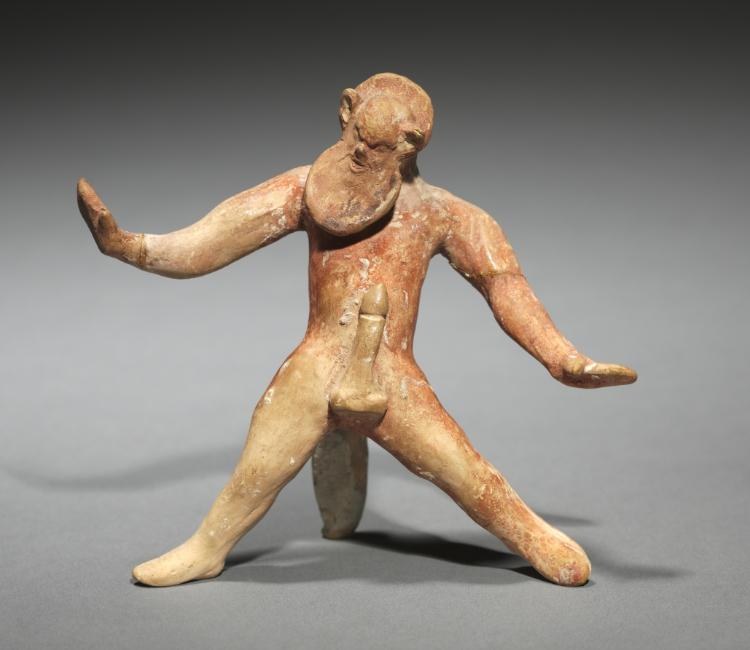
Dancing Satyr
Unknown artist
- Medium:
- painted terracotta
- Collection:
- Greek and Roman Art
- Source:
- Cleveland Museum of Art
- Rights:
- Public domain — free to use, share and adapt.
- Recorded as:
- CC0
For dancers and historians, this image documents how the ancient Greeks understood and represented ecstatic, non-normative movement—neither the regulated grace of athletic or choral practice, but the wild, unbalanced, sexually explicit physicality of ritual possession. It also shows that in the Dionysian context, such movement was considered fitting and praiseworthy, not corrupt. This challenges modern assumptions about 'classical' Greek dance as restrained or decorous.
What you are looking at
A nude male figure in terracotta, painted with earth-tone pigments, frozen mid-stride in a posture of theatrical exuberance. The satyr strides forward with his left leg extended and bent, his right leg planted, his weight distributed dynamically across a wide stance. His torso twists and leans backward slightly, creating counterbalance; his arms are raised asymmetrically—the left arm extended outward at shoulder height with palm forward in a restraining or blessing gesture, the right arm lowered and bent. His head is tilted back, eyes downcast or closed, features coarse and bestial. A prominent phallus stands erect, rendered without modesty: this is deliberate iconography of satyr fertility and wine-god revelry, not incidental anatomy. The surface shows warm tan and rust ochre pigments, worn and spotted with age. The figure is compact and densely modeled, designed to sit at rim height on a large vessel—likely a wine krater or psykter—where it would catch light and shadow as the vessel turned.
The dancing
A single standing male figure in a wide, open stance with the weight shifted forward onto the bent left leg. The extended left arm reads as an emphatic gesture—a wave, a push, or an offering. The backward tilt of the head and torso creates a sense of abandon or ecstatic release. The artist has understood the satyr's movement as a moment of drunken revelry and sexual display: the body is neither tensioned nor graceful, but loose-limbed, sprawling, and unashamed. The posture suggests rapid, asymmetrical weight transfer rather than the balanced, symmetrical stance of formal dance.
The dance depicted
This is not a depiction of structured dance but of ecstatic movement associated with Dionysian revelry and satyr worship. Satyrs do not 'dance' in the classical Greek sense—they capered, reeled, cavorted, and engaged in uncontrolled movement born of wine, sexuality, and proximity to the god of intoxication. The satyr's posture here reads as a moment of theatrical abandon within a ritual or festive context. The image belongs to the visual language of Dionysian procession and symposium decoration rather than to the world of choral dance or athletic competition.
How it was made
Painted terracotta, hand-modeled and fired. The figure was likely press-molded or hand-built from clay coils, then attached to the vessel rim as an ornamental attachment. Traces of pigment—ochre, earth red, perhaps white slip—survive on the surface, evidence that Greek terracotta was routinely painted, not left bare. This technique was ideal for vessel decoration: three-dimensional, economical to produce, and capable of bold, readable gesture. The warmth and fragility of terracotta made it suitable for vessels meant for display and pouring rather than transport, and for contexts of elite consumption—the symposium.
About this work
This is one of three satyr attachments that once adorned the rim of a large Greek wine vessel, datable to around 500 BCE on stylistic grounds. It exemplifies the Greek practice of animating functional objects with narrative and mythological content. The satyr's exuberant, asymmetrical posture and sexual display are not anomalies but central to the image: this is a figure designed to amuse, unsettle, and entertain the drinkers gathered below. The work belongs to the wider Dionysian visual culture of Archaic and Early Classical Greece, where satyr imagery decorated symposium wares, and where wine-drinking was framed as an ecstatic, transgressive, and transgenerational ritual. It demonstrates how dance and movement were deployed in Greek art not as formal accomplishment but as a vehicle for expressing otherness, excess, and divine presence.
How to look at it
Attend to the asymmetry and the backward tilt. This is not a figure moving forward in a straight line; the body is twisted, the weight is uneven, and the gesture is emphatic and open. The artist has chosen a moment of maximum expressiveness—not repose or preparation, but climax. The raised, splayed arms and the tilted head read as ecstasy or drunkenness, not discipline. Notice also the matter-of-factness of the sexual display: it is neither hidden nor exaggerated, but integral to the satyr's identity and the meaning of the vessel.
The period
Early Classical Greece, circa 500 BCE. This was the era of the symposium as the dominant form of elite male gathering, where wine, music, and erotic play were ritually reenacted. Satyr imagery proliferated in this period—on vessels, in vase painting, and in dramatic festivals. The satyr was a liminal figure: part human, part animal; servant and rival of Dionysus; wise and foolish; sexual and vulnerable. In the symposium context, satyrs embodied permission for behaviors otherwise constrained by social convention. By the same period, Greek choral dance and athletic competition were becoming increasingly codified and masculine-dominated. The satyr offered a counterpoint: a figure of uncontrolled, feminized, and ecstatic movement.
Where it lives
The Cleveland Museum of Art. The work is catalogued as Greek and Roman Art and was likely acquired in the early-to-mid twentieth century as part of the broader expansion of American museum collections of Greek vases and terracotta. Such vessel attachments were common finds in Greek archaeological contexts and entered Western collections in large numbers during the nineteenth and twentieth centuries.
Dance in this work
Questions about this work
What is a satyr and why does it appear on wine vessels?
In Greek mythology, satyrs were woodland creatures—part man, part goat or horse—associated with Dionysus, the god of wine, ecstasy, and theater. They symbolized the transgressive, liberating potential of wine and ritual. Satyrs appeared on wine vessels because they embodied the spirit of the symposium: a space where normal social rules could be suspended, where men could gather to drink, philosophize, and revel. The satyr was a figure of permission.
Is this object designed to be looked at or used?
Both. This is a functional wine vessel—a krater or psykter designed to hold wine or cool it. But it is also a decorated object meant to be admired, displayed, and discussed. The satyr attachment serves both purposes: it makes the vessel more visually interesting and more valuable, while also commenting on the contents and the ritual use of the vessel. In ancient Greece, functional objects were not separated from aesthetic or narrative meaning.
What does the satyr's posture tell us about Greek dance?
The satyr's stance is deliberately un-classical: asymmetrical, unbalanced, and openly sexual. It represents ecstatic or Dionysian movement, not the restrained, formal dance of the theater or the gymnasium. The artist is showing us that the Greeks recognized different kinds of movement—disciplined and wild, masculine and feminine, human and bestial—and valued them for different contexts and meanings.
Why is the satyr's genitalia depicted so prominently?
Sexual potency was a defining attribute of the satyr in Greek thought and art. It was not considered obscene or inappropriate to depict, but rather essential to the figure's identity and meaning. On a wine vessel meant for symposium use, the satyr's sexual display reinforced the association between wine, desire, and transgression. The image invited the drinker to imagine himself in a space where normal rules did not apply.
More dance artwork





