49 works in this view — arrow keys or swipe to move between them.
Dance in Art
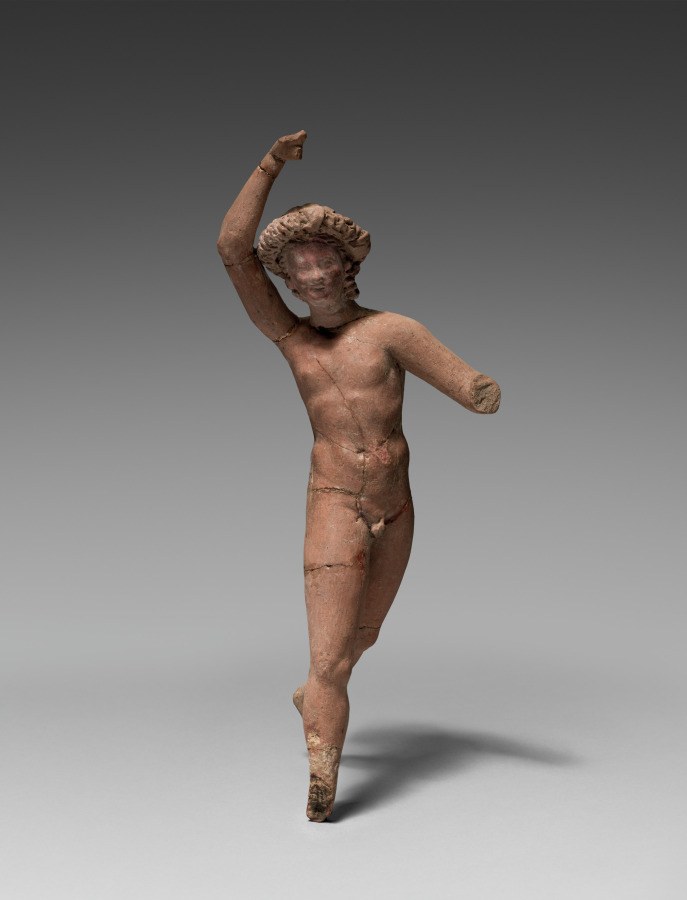
Dancing Eros
Unknown artist
- Medium:
- terracotta
- Collection:
- Greek and Roman Art
- Source:
- Cleveland Museum of Art
- Rights:
- Public domain — free to use, share and adapt.
- Recorded as:
- CC0
This figurine is rare visual evidence of how the ancient Greeks represented divine dance and celestial joy. It shows that even in small, mass-produced objects, artists invested care in capturing a specific moment of movement—the spiraling torso, the raised arms, the lifted leg—that conveys personality and mood rather than just anatomy. For historians of dance, it demonstrates that the Greeks conceptualized dance as a vehicle for expressing transcendence and divine emotion, not merely as social or martial practice.
What you are looking at
A small terracotta figurine depicts a youthful male nude in a dynamic, exuberant pose against a neutral gray background. The figure stands on one extended leg while the other is lifted and bent, the torso twisting in counterbalance. One arm is raised high overhead in an arc, the hand gesturing upward; the other arm extends outward at shoulder height, palm open. The head is turned slightly upward and to the side, framed by long, elaborately curled hair crowned with what appears to be a floral wreath. The figure's face shows fine modeling, with traces of reddish pigment still visible on the cheeks and lips. The musculature is delicately articulated across the chest, abdomen, and limbs, emphasizing the youthful idealization of the form. The terracotta surface shows the warm, earthy orange-brown coloring typical of ancient Greek pottery, with visible wear and minor surface loss consistent with archaeological recovery.
The dancing
The single figure is entirely nude and unnaturally elongated, with disproportionately long, slender limbs that extend far beyond anatomical realism. The weight appears momentarily suspended between the two legs, with one foot planted and the other raised in a high, energetic lift. The upper body is free and open, the torso untwisted in a spiraling movement. Both arms are active and separated, creating an expansive silhouette. The overall impression is of weightless, unbounded motion—the body articulated to suggest perpetual motion rather than stable stance.
The dance depicted
This is Eros, the Greek god of love, depicted in what the record describes as a carefree dance. The figure's exaggerated proportions and the apparent impossibility of the pose suggest this is not realistic dance but rather a playful, mythological representation. The raised arms, lifted leg, and spiraling torso are consistent with the unbridled, joyful movement associated with divine or celebratory contexts in ancient Greek art—the kind of dancing that might accompany festive rites, victory, or divine pleasure. The floral crown and the overall mood suggest celebration. This is almost certainly not a representation of a codified social or theatrical dance form, but rather a visualization of divine joy and abandon.
How it was made
This is a hand-modeled terracotta figurine, a technique widely practiced in the Greek world for small votive and decorative objects. The artist worked the clay to create distinct formal features—the curling hair, the musculature, the delicate facial expression—and then fired it. The small scale and portability of terracotta figurines made them ideal for domestic display, votives left at sanctuaries, or grave goods. This figurine's deliberate elongation and stylization would have been achievable and conventional in clay modeling, where the artist can stretch and exaggerate form without the structural constraints of stone carving.
About this work
This Myrina terracotta figurine represents Eros in a state of dynamic, joyful movement—a god suspended in an impossible, weightless dance that celebrates love and divine pleasure. Dating to around 300 BCE, it belongs to a rich tradition of Hellenistic figurines from the region of Myrina in Asia Minor, where potters specialized in depicting mythological figures and everyday scenes with remarkable expressiveness and humor. The figure's exaggerated proportions, animated pose, and celebratory crown suggest this was made as a votive offering—a gift to Eros or his mother Aphrodite in hopes of blessing in love or marriage. It reveals how ancient Greeks imagined divine motion: not restrained or formal, but exuberant, weightless, and utterly free.
How to look at it
Observe the moment of the pose: the figure is caught mid-movement, neither grounded nor in repose, with one leg fully extended and the other lifted as if captured mid-leap or mid-spin. The upraised arm and open torso emphasize the expansiveness of the gesture—this is not contained movement but exultant overflow. The floral crown and the slight upturn of the head complete the picture of joy and celebration. The elongated limbs are not a failure of anatomical knowledge but a deliberate stylization meant to emphasize weightlessness and boundless motion.
The artist
Unknown. This figurine belongs to the Myrina tradition of Hellenistic terracotta production, a workshop culture that flourished in Asia Minor roughly from the 4th to 1st century BCE. Myrina potters developed a reputation for technically skilled, expressive figurines of gods, heroes, and everyday figures, often with sophisticated modeling of drapery, hair, and gesture. These were made for both religious dedication and private collection, suggesting a developed market for small, portable art objects.
The period
This figurine dates to the Hellenistic period, when Greek culture expanded across the eastern Mediterranean following Alexander's conquests. In this era, representations of gods became more playful, human, and emotionally expressive than in earlier Classical periods. Dancing figures appear frequently in Hellenistic art—in relief sculpture, on vessels, and especially in small terracotta figurines—often celebrating fertility, pleasure, and divine abundance. The custom of leaving votive offerings at sanctuaries remained widespread, and Eros as a focus of worship and artistic attention was particularly popular among Hellenistic audiences.
Where it lives
This figurine is held in the Greek and Roman Art collection of the Cleveland Museum of Art (CMA), identified as coming from Myrina, an ancient city in Asia Minor (modern-day Turkey) famous for its terracotta production. The Myrina figurines constitute a well-studied corpus, and this example is representative of the workshop tradition.
Dance in this work
Questions about this work
Why are the arms and legs so long?
This is deliberate stylization, not anatomical error. The exaggeration emphasizes weightlessness, freedom, and divine nature. By elongating the limbs, the artist conveys the idea that this is not ordinary human movement but the unfettered motion of a god.
What is the floral crown?
It is a garland or wreath, likely of ivy or flowering plants—symbols of celebration, fertility, and divine favor. Such crowns were worn in religious rites and festive contexts in ancient Greece, and they signal Eros's divine status and the joyful occasion.
Was this used in religious ritual?
Probably as a votive offering rather than in active ritual. A worshiper would leave this figurine at a sanctuary of Eros or Aphrodite as a prayer or thanksgiving, especially in contexts of courtship, marriage, or fertility. It was portable and affordable, making it accessible to people of modest means.
What does this tell us about how Greeks understood dance?
It suggests that Greeks associated dance with divine pleasure, abandon, and transcendence. Unlike martial or social dances, which were governed by convention, divine dance was imagined as weightless and unbounded—a physical expression of joy and freedom.
More dance artwork





