49 works in this view — arrow keys or swipe to move between them.
Dance in Art
Dancing Satyr
Unknown artist
- Medium:
- painted terracotta
- Collection:
- Greek and Roman Art
- Source:
- Cleveland Museum of Art
- Rights:
- Public domain — free to use, share and adapt.
- Recorded as:
- CC0
This satyr captures an ancient aesthetic of ecstatic movement that has no direct parallel in formal dance notation or literary description. It shows us how the Greeks visualized frenzy, libido, and Dionysian possession as a bodily practice—and it does so through a figure designed to be grasped, used, and inhabited by drinkers. For historians of dance and embodiment, the satyr is evidence that not all movement was meant to be orderly, symmetrical, or controlled; some was meant to be wild, asymmetrical, and expressive of states beyond rational self-governance.
What you are looking at
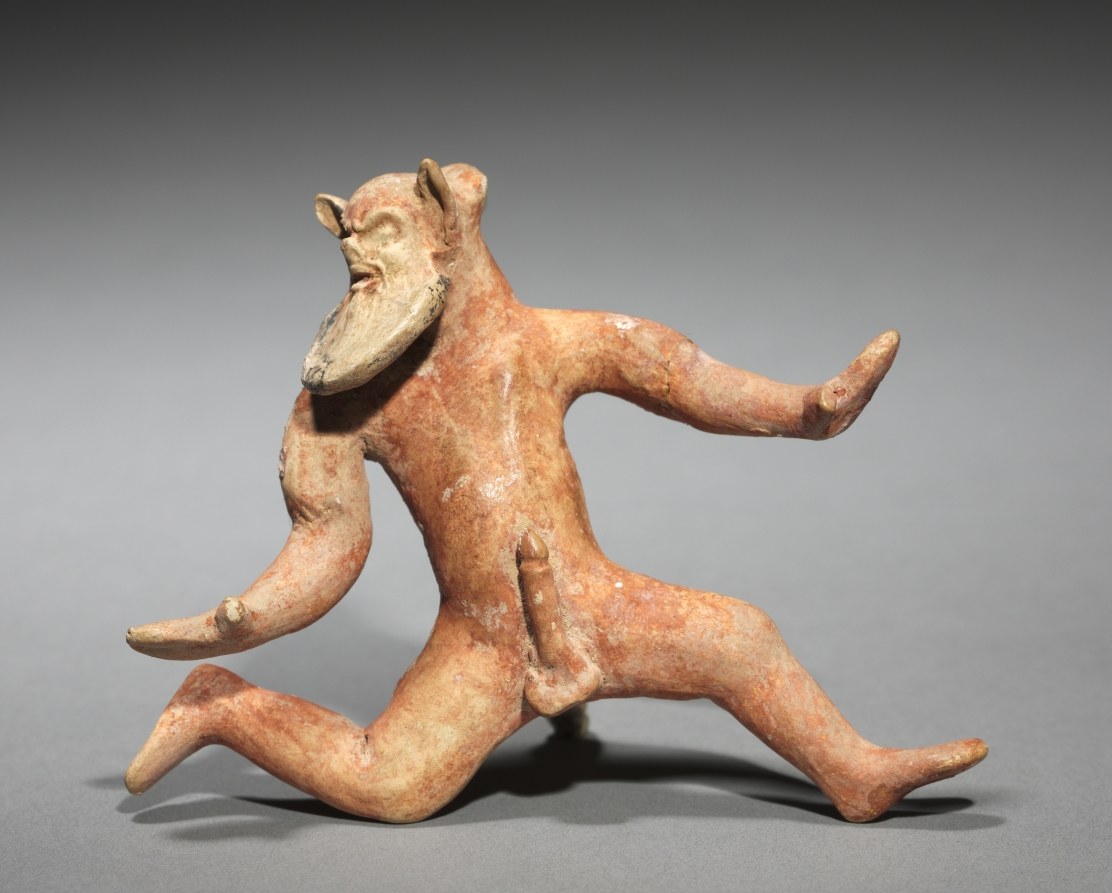
A terracotta figure captured in dynamic motion, frozen mid-leap or dance move. The satyr is modeled in the round with warm ochre and rust tones characteristic of fired clay. His body is powerfully built and unmistakably masculine, with a pronounced phallus. He wears pointed, animal-like ears and a goat's tail extending behind him. His weight is thrown forward onto his lower legs, which bend beneath him in a posture suggesting vigorous movement. One arm is extended outward at shoulder height, the other bent, both gestures expressive and emphatic. His bearded face is animated, the mouth open as if shouting or singing. The figure is compact, perhaps 20–30 cm tall, and shows the hand-modeling and surface finish typical of vessel decoration rather than a free-standing sculpture intended for display.
The dancing
A single male figure in a dramatically asymmetrical pose: weight forward and downward, knees deeply bent, the body twisted as if mid-pirouette or leap. The extended arm reaches away from the body in a gesture of abandon or exultation; the other arm bends closer to the torso. The posture suggests a ballistic forward momentum—the dancer is not planted but airborne or about to be. The head is thrown back, mouth open, creating a sense of ecstasy or effort. The satyr's animal features—ears, tail, and explicit sexuality—mark him as a creature of instinct and revelry, not constrained by human propriety.
The dance depicted
This is a satyr in the Dionysian revels, participants in the wine-god's retinue. Satyrs were standard figures in Greek theatrical tradition, appearing in satyr plays (a form of comedy performed after tragic trilogies) and in representations of Bacchic processions and maenadic scenes. The pose—energetic, unbalanced, forward-thrusting—captures the aesthetic of ecstatic movement associated with Dionysian worship and intoxication. The satyr is not dancing a codified form but rather embodying frenzy, libido, and divine possession. The figure likely decorated the rim of a wine vessel (psykter or similar), placing the drinker within the mythological scene of revelry.
How it was made
Modeled terracotta, hand-built and likely attached to a larger vessel form. The sculptor used additive techniques—building up the figure from coils or solid chunks of clay, then carving and refining the surface with tools. The warm color variation and slightly weathered surface are consistent with ancient Greek pottery firing. Because this is a functional appliqué for a drinking vessel, it was made to be seen from multiple angles and to withstand handling and use, suggesting a robust, well-proportioned form rather than delicate detail work.
About this work
This is a Dionysian satyr, a stock figure of Greek revelry and transgression, captured in a moment of wild motion. Dating to around 500 BCE, the figure belongs to the tradition of satyr plays and Bacchic imagery that flourished in Classical Greece. The dynamic, forward-thrusting pose and emphatic gesture convey a moment of ecstatic dance or frenzy—the kind of movement associated with wine, altered states, and the breakdown of social constraint. As a vessel attachment, it invited drinkers to imagine themselves within the mythological scene of divine intoxication and abandon. The work testifies to the Greek fascination with depicting transgressive bodies and ecstatic states through the dancing satyr, a figure that would persist through Hellenistic and Roman art.
How to look at it
Attend to the asymmetry and forward momentum of the pose. The satyr is not standing still or in a composed position; he is caught in the instant of a leap or convulsive movement. The bent knees, forward-thrusting pelvis, extended arm, and thrown-back head all work together to create a sense of velocity and abandon. Note how the sculptor has exaggerated the sexual features (phallus, muscularity) and animal characteristics (ears, tail) to mark the satyr as a creature of instinct rather than reason. The open mouth and animated facial expression suggest sound—shouting, singing, or panting—adding to the impression of ecstatic exertion. This is movement that breaks rules and hierarchies, and the artist has made that breaking visible through dynamic, off-balance gesture.
The period
In Classical Greece (5th century BCE), satyr imagery was at the height of its cultural prominence. Satyr plays, which followed the performance of tragic trilogies at major festivals, provided comic relief and allowed poets and audiences to explore themes of desire, stupidity, and the animal within civilization. Vase painters and sculptors responded by producing vivid, often obscene depictions of satyrs—dancing, copulating, pursuing maenads, getting drunk. This terracotta figure belongs to that explosion of satyr imagery, a moment when Greek artists were deeply invested in depicting the body in states of abandon and transgression. The figure's placement on a wine vessel suggests that the drinker was meant to identify with, or at least contemplate, the satyr's state of ecstasy.
Where it lives
The figure is part of the Cleveland Museum of Art's Greek and Roman Art collection. As a vessel attachment (likely from a psykter or similar wine vessel), it would have been a functional object within a symposium setting, used and seen by drinkers in ancient Greece. The fact that it survives as a fragment—possibly one of three similar figures that once decorated a vessel's rim—speaks to the vessel's breakage and the survival of fired clay through millennia.
Dance in this work
Questions about this work
What is a satyr?
A satyr is a mythological creature, part man and part goat or horse, belonging to the retinue of Dionysus, the god of wine. Satyrs were associated with wildness, lust, drunkenness, and transgression. They appear frequently in Greek art, literature, and theater as figures of comedy and as embodiments of the animal impulses that civilization is meant to suppress.
Why is the satyr in such an exaggerated pose?
The pose conveys ecstatic movement—the kind of uncontrolled, forward-thrusting motion associated with divine possession, intoxication, and sexual arousal. The bent knees, extended arm, and thrown-back head suggest a moment of frenzy or abandon, capturing the aesthetic of Dionysian revels. This is not orderly dance but wild, transgressive movement.
What is this object made of and why?
It is modeled from terracotta (fired clay) and was likely attached to the rim of a large wine vessel. The function—to decorate a drinking cup or mixing bowl—meant the satyr was meant to be handled, seen from multiple angles, and associated with the act of consuming wine. The material was durable enough to withstand use and breakage in a symposium setting.
How do we know this was used as a dance reference?
We don't know that directly. What we know is that satyrs appear in satyr plays, which were comic dramatizations of mythological scenes involving dancing, singing, and transgressive behavior. The vivid, dynamic pose suggests that the sculptor was representing an actual convention of satyr performance—a style of movement associated with theater. The vessel context places the image within a social setting (the symposium) where performance, song, and ecstatic states were celebrated.
More dance artwork





