49 works in this view — arrow keys or swipe to move between them.
Dance in Art
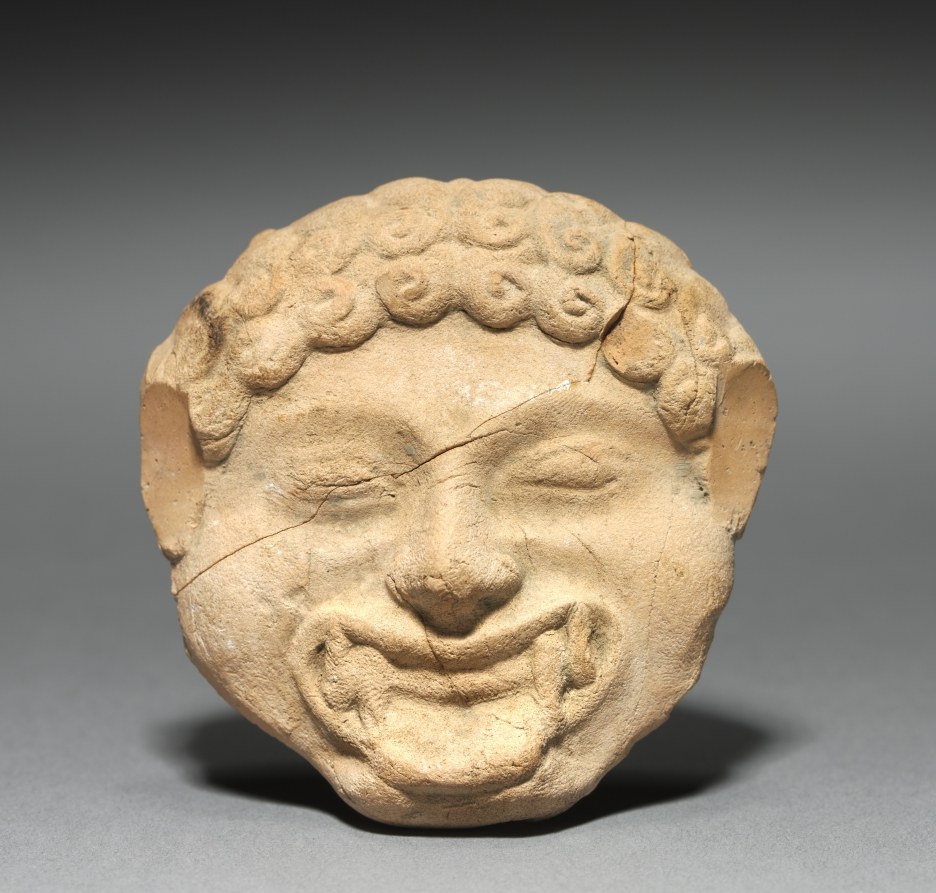
Gorgoneion Plaque with Incised Figure of a Dancing Satyr
Unknown artist
- Medium:
- terracotta
- Collection:
- Greek and Roman Art
- Source:
- Cleveland Museum of Art
- Rights:
- Public domain — free to use, share and adapt.
- Recorded as:
- CC0
This object is a rare surviving document of how satyrs actually moved in ancient Greek performance. While satyr plays are known only through dramatic texts, this image provides direct visual evidence of the body vocabulary these performers deployed—exuberant, explosive, uninhibited. It also raises an unanswered question about ancient craft and spirituality: why would an artisan place a dancing figure where no one would see it, and what did that gesture mean?
What you are looking at
This small terracotta plaque presents two distinct images separated by the front and back surfaces. The front face dominates visually: a large, frontal Gorgon head with a broad, powerful countenance fills the composition. The Gorgon's features are rendered with sharp definition—wide-set, staring eyes with incised pupils; a prominent nose; a gaping mouth with bared teeth and a protruding tongue thrust downward in a grimacing expression. Most striking is the hair: rendered as a mass of snakes curling outward around the head in a dense, writhing design that frames the face like a corona. The back of the plaque, incised rather than molded, shows a satyr in dynamic motion. Though less visually prominent than the front image, the satyr is captured mid-stride or mid-leap, with limbs extended and body animated—the figure embodies the spirited, uninhibited movement associated with satyr imagery in ancient Greek art.
The dancing
The satyr's pose suggests vigorous forward movement or ecstatic dance. The figure's limbs are extended and splayed, conveying the exuberant, often frenzied energy typical of satyr choreography in Greek art. The incised technique allows less anatomical precision than the molded front, but the sculptor has clearly prioritized capturing the essence of dynamic, uninhibited motion over refined detail. This contrasts sharply with the static, confrontational fixity of the Gorgon's frontal gaze.
The dance depicted
The satyr image most likely represents the kind of ecstatic, phallic dancing associated with Dionysian ritual and theatrical satyr plays (*satyrikà dramata*), a genre central to Greek theatrical festivals. Satyrs were stock characters in these plays—lustful, drunken, anarchic figures whose choreography emphasized wild leaping, animal-like vitality, and sexual aggression. The extended limbs and dynamic pose suggest the acrobatic, high-energy movement vocabulary these performers developed. Without surviving choreographic notation, we cannot say precisely what steps or holds were used, but the image testifies to a dance idiom of exuberant physicality quite unlike the formalized movement of other Greek theatrical genres.
How it was made
This is a mold-made terracotta plaque—the front impressed from a mold to create the Gorgon in high relief. The back satyr was incised (carved into the unfired clay with a sharp tool) before the plaque was fired in a kiln. The mold-making process allowed mass production of protective apotropaic images, while the incised back surface suggests a secondary, playful addition by the artisan—a technique far less time-consuming and visible than the formal molded front. The combination suggests a complex workshop practice: the front served a protective religious function suitable for funerary display, while the back may have been either a workshop joke or a separate magical purpose for the deceased's protection.
About this work
This small terracotta plaque juxtaposes two powerful Greek images of excess and transgression: the Gorgon's petrifying stare on the front, and on the back, a satyr caught in the dynamic, frenzied movement of Dionysian dance. The Gorgon was a standard apotropaic device on tomb furniture, believed to ward off harm from the dead and the living. The satyr's presence on the hidden back surface is more enigmatic. It may represent another form of magical protection—the satyr's association with Dionysian power and fertility deployed to safeguard the deceased—or it may simply record the artisan's impulse to fill blank space with the kind of spirited, transgressive image that fascinated Greek culture. Either way, the plaque embodies the belief that the boundaries between the living world and the realm of the dead required active supernatural guardianship.
How to look at it
Examine first the Gorgon's frontal intensity: the wide stare, the bared teeth, the protruding tongue, the coiled serpent hair. This is a face designed to strike fear and stop sight—to arrest the viewer's gaze. Then turn the plaque over and study the satyr's limbs: notice how the legs extend, how the arms reach, how the entire body seems to strain outward in a single direction. The contrast is total—one image says *look at me and be frozen*, the other says *I cannot be contained*. This may be intentional: the Gorgon's static power balanced against the satyr's dynamic transgression, both deployed to protect.
The period
This plaque dates to approximately 525 BCE, a period of intense theatrical innovation in Athens. The satyr play was still developing as a genre—it would become a standard feature of dramatic festivals, paired with tragic trilogies. The Gorgon apotropaic image was ubiquitous in Greek funerary art by this date, particularly on tomb markers and grave goods, reflecting widespread belief in protective magic. The coincidence of the two images—one a standard religious formula, one a theatrical scene—suggests that by the early Classical period, theatrical imagery (and the social energies it carried) was beginning to infiltrate funerary contexts, perhaps as a form of protection or as a statement about the deceased's social identity.
Where it lives
The plaque is held by the Cleveland Museum of Art, part of their Greek and Roman Art collection. It is one of two related Gorgoneion plaques in the collection (see accession 1996.34). Such objects were mass-produced in terracotta workshops and distributed widely as tomb goods and household protective amulets.
Dance in this work
Questions about this work
Why is there a dancing figure on the back if no one would see it?
Two theories: (1) The artisan may have viewed the back surface as magically equivalent to the front—both protective, even if the satyr was invisible to viewers. Satyr imagery carried associations with Dionysian power, fertility, and transgression; placing it on the back may have been a supplementary protective gesture. (2) The back may simply record workshop practice and the artisan's pleasure in filling space—a kind of informal humor or creative outlet between formal commissions. Ancient craft was not always solemn.
What do satyrs have to do with death and tombs?
Satyrs were associated with Dionysus, god of transformation, boundary-crossing, and liminality. These powers made them useful magical figures—capable of warding off threats and protecting the threshold between the living and the dead. The satyr's unbounded energy may also have been believed to vitalize or protect the deceased's spirit.
Is this a rare image of actual satyr-play choreography?
It is the closest thing we have. Satyr plays survive only as dramatic texts; no notation of their movement exists. This image shows a sculptor's understanding (or convention) of how satyrs moved—with explosive energy and extended limbs. Whether it reflects actual stage practice is unknowable, but it is valuable evidence of how the Greeks imagined and valued satyr motion.
How do we know the satyr figure is really dancing?
The extended limbs, splayed posture, and sense of dynamic forward momentum all align with Greek conventions for depicting movement, joy, and Dionysian ecstasy. In Greek art, such exuberant poses signify drunken or ecstatic movement. The context—a satyr, Dionysian being—reinforces the reading.
More dance artwork





