49 works in this view — arrow keys or swipe to move between them.
Dance in Art
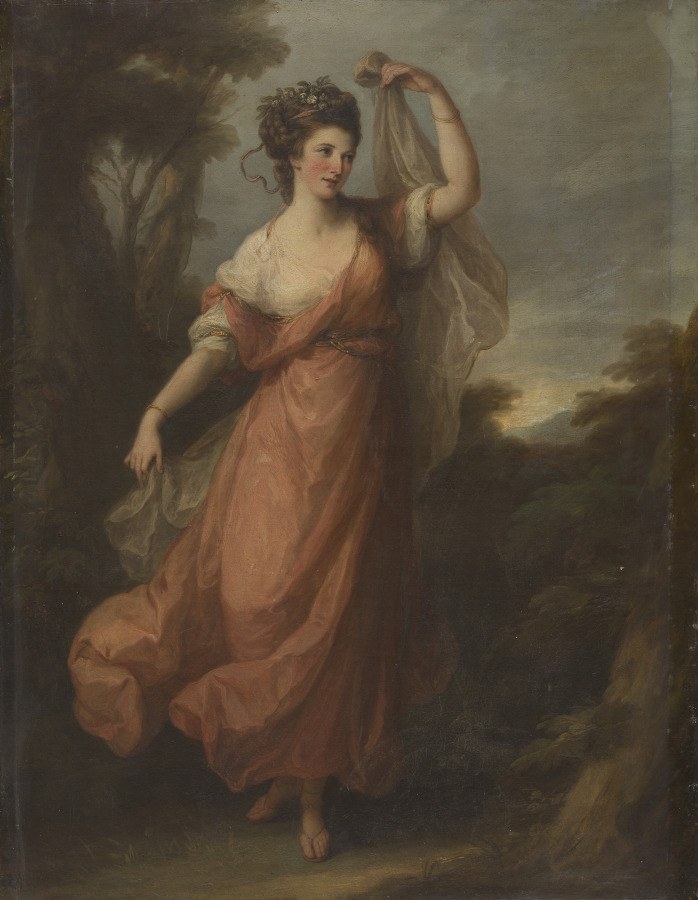
A Dancing Young Woman as Terpsichore
Angelica Kauffmann (Swiss, 1741–1807)
- Medium:
- oil on canvas
- Collection:
- European Painting and Sculpture
- Source:
- Cleveland Museum of Art
- Rights:
- Public domain — free to use, share and adapt.
- Recorded as:
- CC0
This work is a primary document of how the 18th-century visual arts imagined dance in the classical past, and what that imagination reveals about contemporary taste and education. For historians of neoclassicism, it shows how archaeological discovery shaped aesthetic ideals; for dance historians, it demonstrates the period's hunger to locate dance in an idealized antiquity rather than in living performance.
What you are looking at
A young woman in classical drapery stands alone in a wooded landscape, her body in graceful motion. She wears a rust-orange chiton that falls to her ankles, with a pale chemise visible at the shoulders, and her dark hair is bound in a classical style. Her left arm is raised and extended, holding a length of translucent fabric—a scarf or veil—that billows behind her in an arc. Her right arm hangs at her side, and her weight appears to rest on her right leg while her left leg extends forward in a gentle stride. The setting is pastoral and atmospheric: dark trees frame the left side of the composition, and the background fades into warm, cloudy sky. The overall effect is of arrested motion—the moment captured between steps, with the fabric suspended as if caught mid-flutter.
The dancing
The single figure occupies the center of the canvas, her stance suggesting forward movement with a subtle contrapposto weight shift. Her raised left arm extends gracefully upward and back, while her right arm provides balance at her side; the posture is open and expansive rather than tightly controlled. The extended fabric creates a secondary line of movement that echoes and amplifies the gesture of the body. Her gaze is directed downward and to the side, contemplative rather than performative. There is no partner or ensemble; she dances alone.
The dance depicted
This is not a depiction of theatrical dance as performed in the 18th century, but rather a classical allegory: the figure represents Terpsichore, the muse of dance, identifiable by her pose and the fine fabric she holds. The artist has chosen to show not a recognizable contemporary dance but an ideal of dance as ancient aesthetic principle—graceful, solitary, and ethereal. The flowing drapery and classical setting invoke the newly excavated frescos of Herculaneum rather than any living dance tradition. This is dance imagined through antiquity, not dance as it was actually performed.
How it was made
Oil on canvas, worked with the luminous translucency characteristic of late 18th-century neoclassical painting. The artist has used soft modeling and careful attention to fabric texture—the weight and flow of the heavy chiton contrasts with the gossamer scarf. The brushwork is precise in the figure and increasingly loose and atmospheric in the landscape, a technique that focuses attention on the dancer while placing her in an timeless, dream-like setting. This is a work of finished exhibition quality, not a sketch.
About this work
This is a neoclassical allegory in which the muse of dance is depicted as a solitary figure in classical dress, frozen at the moment of movement. Painted in 1770 at the height of neoclassical fashion, it represents the intellectual ideal of dance as refined aesthetic principle rather than as a social or theatrical practice. The work draws inspiration from recently excavated Roman wall paintings and embodies the period's fascination with antiquity as a model for grace and beauty. It appears in a major American collection and exemplifies how the visual arts of the Enlightenment engaged with dance not as spectacle but as philosophy.
How to look at it
Look first at the moment of motion the artist chose: not a leap or turn, but the sustained, floating quality of a single step, with the fabric creating a visual echo of the gesture. Notice how the drapery follows and extends the body's line—this is classically trained painting, not an impression but a carefully composed study of how cloth moves with the body in motion. The artist was clearly familiar with how ancient sculpture suggested movement through drapery; the effect here is borrowed from relief sculpture and vases, translated into paint. The setting—the dim trees, the warm clouded sky—is treated almost as an afterthought, placing all emphasis on the idealized purity of the figure.
The artist
Angelica Kauffmann (1741–1807) was a Swiss painter of international reputation and one of the founding members of the Royal Academy in London—one of only two female founders. She worked primarily in history painting and portraiture, genres dominated by men, and achieved remarkable success in both. Highly educated and fluent in multiple languages, she was also an accomplished musician who had weighed a career in music against one in visual art. Her classical learning is evident in her allegorical works, many of which drew on ancient literature and newly available archaeological material. She was celebrated across Europe and maintained an active studio practice well into her sixties.
The period
In the 1770s, neoclassicism was at the height of its influence in the visual arts, driven by the excavations at Herculaneum (begun 1738) and Pompeii (begun 1748), which made Roman daily life and artistic practice visible in unprecedented detail. The period saw intense interest in ancient dance as an ideal form, partly through prints and scholarly studies of Roman wall paintings and relief sculpture. In actual dance practice, the period was dominated by ballet and by the minuet and country dances of the social ballroom, but the visual arts increasingly turned to classical sources for authority and beauty. Kauffmann's contemporaries—Reynolds, West, Kauffman herself—regularly painted classical allegories and mythological subjects, treating them as the highest form of art.
Where it lives
The work is held in the European Painting and Sculpture collection at the Cleveland Museum of Art, entered through the CMA. It is a finished oil painting of exhibition scale, created for the international art market of the late 18th century.
Questions about this work
Why is this titled 'as Terpsichore' rather than 'Terpsichore'?
The phrasing suggests that the subject is a dancer or woman posed *as* the muse, not the muse herself—a portrait in classical character rather than a mythological scene. This was a common form of allegorical portraiture in the period, in which a contemporary person (usually a woman of rank) was painted in the guise of a classical figure. The title acknowledges that ambiguity.
Is she dancing? What dance is this?
She is moving, but this is not a depiction of any recognizable social or theatrical dance of the 18th century. The pose is classically inspired, drawn from ancient sculpture and painting rather than from ballroom or stage practice. The artist is showing an ideal of movement as eternal and transcendent, not the particular steps of minuet or cotillion.
What is the fabric she is holding?
Most likely a scarf, veil, or length of silk kept for display and gesture—a common attribute of Terpsichore in classical and neoclassical art. It serves multiple purposes: it identifies the figure, it extends the line of her arm, and it creates the visual effect of motion even in a static painting.
What do the Herculaneum excavations have to do with this painting?
The excavations at Herculaneum (and Pompeii) had revealed Roman wall paintings and mosaics depicting figures in classical dress. These images became models for artists seeking authenticity and beauty in the classical world. Kauffmann and her contemporaries studied these materials closely; the drapery style and stance in this work reflect direct study of such sources.
More dance artwork





