49 works in this view — arrow keys or swipe to move between them.
Dance in Art
Peasant Children Dancing
Le Nain (French)
- Medium:
- oil on canvas
- Collection:
- European Painting and Sculpture
- Source:
- Cleveland Museum of Art
- Rights:
- Public domain — free to use, share and adapt.
- Recorded as:
- CC0
This is one of the few surviving visual records of how ordinary, non-elite people danced in the 17th century: without instruction, without formal holds, without choreography, but with evident joy and immediate response to music. For dance historians, it documents the gap between courtly and folk dancing and the social function of music-making in village life. The painting also shows an artist of considerable skill attending seriously to the bodies and expressions of people who were not patrons—a shift in what European art considered worthy of careful representation.
What you are looking at
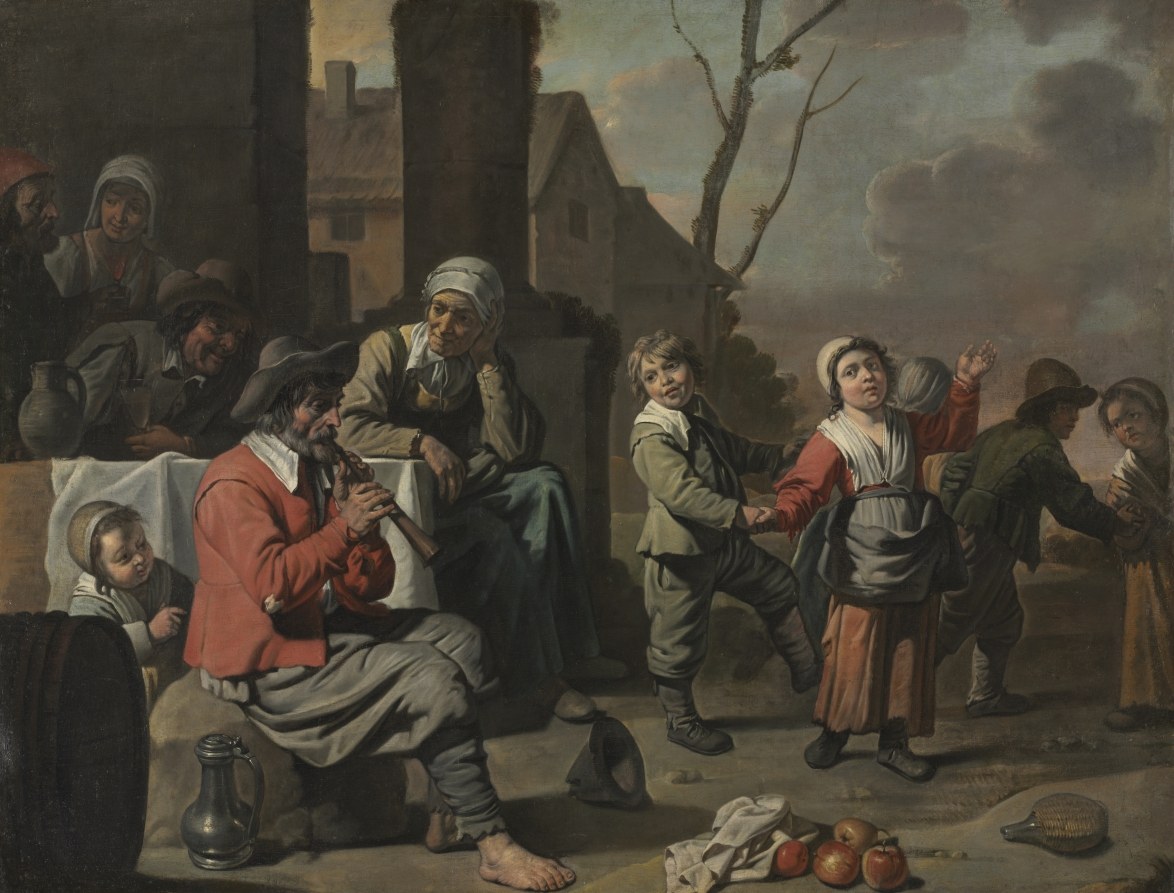
A village gathering occupies a dusty square before modest stone buildings under a gray, overcast sky. A barefoot piper in a red coat sits prominently in the left foreground, piping while children and villagers dance and move around him. The composition is dense with figures: some children are already dancing, others watch or prepare to join, while adults—women in white linen caps, men in coarse clothing—supervise or clap. In the immediate foreground lie scattered apples and a reflective pewter or ceramic drinking vessel, suggesting a harvest celebration or village feast. The light is cool and flat, emphasizing the earthiness of the scene. The figures' clothing is deliberately humble—worn fabrics with heavy folds, bare feet, patched coats—and their expressions convey a mix of joy, concentration, and naive directness that emphasizes the rustic, unpolished character of the gathering.
The dancing
Children dominate the action: one boy in the center-right lifts his arm in an open, uninstructed gesture of movement, while others around him adopt looser, more freeform positions. None display the controlled alignment or formal posture of trained dancers. The piper's posture is anchored—seated, legs extended—while his instrument commands attention; the dancers around him are oriented toward him as the music source rather than toward each other or a partner. Movement appears individual and uncoordinated rather than synchronized, with arms and legs in varied positions suggesting improvisation or play rather than learned choreography.
The dance depicted
This depicts folk dancing, most likely a peasant village dance of the mid-17th century Northern European tradition, though the specific style is not formally named in the image. The dance is communal and unstructured: children dance to a piper's music in an open space without formal holds, figures, or sequence. This is social dancing in its simplest form—music-driven movement by non-professionals for pleasure and community gathering rather than performance or courtly refinement. The painting records how dance functioned among rural, non-elite populations: as spontaneous musical response, often led by a musician and joined by whoever wished to move.
How it was made
Oil on canvas, a medium allowing for subtle naturalism in the rendering of textures, light, and facial expression. The technique shows careful attention to humble details—the worn hole in the piper's elbow, the specificity of fabric folds and the reflection in the metal vessel—that would have been difficult to achieve in faster media like engraving. This technique also allowed the artist to work with a warm, earthy palette and muted light that suits the provincial mood. The size and format suggest this was a gallery or collector's piece, not a print for wide circulation, making it a record of peasant life created for a more affluent urban audience.
About this work
This is a genre scene of peasants dancing to pipe music, painted in the mid-17th century in a Flemish or Northern European tradition. It belongs to a flourishing market in scenes of everyday rural life—drinking, feasting, dancing—that appealed to wealthy urban collectors in Paris and Flanders during this period. The painting sits at the intersection of two artistic traditions: the comic, rollicking peasant scenes of Flemish art (descended from Bruegel) and the French interest in carefully observed, realistic depiction of lower-class life. The work records not the dancing of the elite—no courtly measure or formal choreography—but the spontaneous movement of children and villagers responding to music in a village square, and in doing so makes dance visible as a social and communal activity rather than a learned art.
How to look at it
Notice the piper as the still center and authority of the scene: the dancers orient themselves toward him and his instrument, not toward each other or toward any formal pattern. Watch the children's bodies—no two are in the same position, no sequence is repeated—to understand how music-driven movement differs from learned choreography. Look at the foreground details: the apples and drinking vessel ground the scene in the reality of a harvest gathering or village feast, not a performance or spectacle. The artist has chosen the moment of spontaneous motion—not the formal beginning of a dance, not a climax, but the everyday middle when people are simply moving to music with pleasure and without self-consciousness.
The artist
The work is attributed to the Le Nain circle or possibly the 'Master of the Béguins,' a Flemish painter working in Paris in the mid-17th century who capitalized on the success of the Le Nain brothers' peasant scenes. The artist is characterized by a consistent visual vocabulary: wide eyes, round cheeks, white peasant linen caps (béguins), sturdy figures in coarse fabrics, and an interest in the textures and details of rural poverty. The style is realistic but never satirical or cruel; the peasants are depicted with dignity and their pleasure in music and movement is taken seriously. This represents a moment when Paris-based artists were competing to meet a wealthy urban appetite for scenes of rural and working-class life.
The period
The mid-17th century was a moment of intense artistic and theological interest in the representation of the poor. The Le Nain brothers and their circle were painting at a time when the Catholic Church in Paris—particularly at Saint Sulpice—was debating the treatment of the poor and the proper representation of humble life. Northern European art had long included peasant scenes drawn from Pieter Bruegel's tradition of comic, densely populated village gatherings; French collectors were adapting this tradition, but with greater interest in naturalistic detail and psychological presence. Dancing at this level of society was largely unregulated, musicianly, and community-centered—part of work rhythms, feast days, and informal gathering rather than courtly entertainment. This painting captures that world at a moment when it was becoming exotic enough to be worthy of serious artistic attention from the urban elite.
Where it lives
The work is held in the European Painting and Sculpture collection at the Cleveland Museum of Art. It is catalogued as a work of the Le Nain circle or the Master of the Béguins, a Flemish imitator of the Le Nain brothers active in Paris around the 1650s.
Dance in this work
Questions about this work
Is this a real dance or did the artist invent it?
This is a real peasant dance of the 17th century, though without a recorded name or formal description. What we see is the unstructured, music-led dancing typical of village life and celebrations among non-elite populations. The piper provides the music; people respond by moving. The lack of formal holds, synchronized steps, or choreography is authentic to how dancing actually worked in rural communities, not a failure of the artist's knowledge.
Why are the children barefoot?
Barefoot dancing was common among peasants and children of the period because shoes were expensive and easily damaged. The artist is recording a material reality of rural life—poverty and practicality—not making an artistic choice. Barefoot movement was also more comfortable for extended dancing and allowed better ground contact for rhythmic movement.
Could girls and women dance alongside children?
Yes. While the foreground focuses on children, adult women in the background appear to be participating or supervising. Village dancing was inclusive across gender and age; it was a community activity, not a formal courtship ritual or entertainment for an audience. The women's white caps and modest dress mark their status as adults and villagers.
What instrument is the piper playing?
The piper is playing bagpipes or a similar folk pipe instrument common to Northern Europe in this period. These were the primary instruments for dance music in village settings, easily portable and loud enough to fill an outdoor space. The bagpipe was associated with folk celebration and peasant culture.
More dance artwork





