49 works in this view — arrow keys or swipe to move between them.
Dance in Art
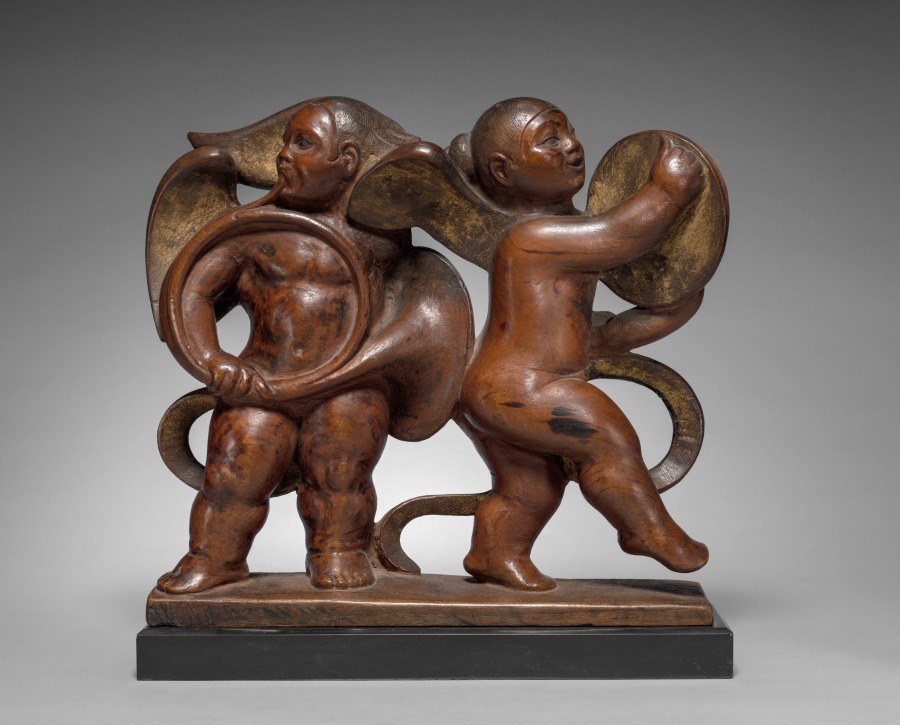
Dancing Children
Gaston Lachaise (American, born France, 1882–1935)
- Medium:
- wood with traces of gilt and polychrome
- Collection:
- American Painting and Sculpture
- Source:
- Cleveland Museum of Art
- Rights:
- Public domain — free to use, share and adapt.
- Recorded as:
- CC0
Lachaise was a major sculptor of the twentieth century whose work frequently explored movement and eroticism through the human form. This relief reveals how artists of the modernist moment looked back to classical and Renaissance traditions of depicting the body in motion while creating works that spoke to contemporary aesthetics of primitivism and formal abstraction.
What you are looking at
Two robust male putti or cherubs dominate this wooden relief sculpture, carved in warm brown wood with gilt and polychrome accents now largely worn away. The figures are depicted in vigorous, playful motion: the left-hand putto crouches forward with one arm extended, while his companion stands more upright to the right, both with muscular bodies rendered in full three-dimensional form. Between and behind them, large scrolling ornamental forms—perhaps wings or decorative shields—rise vertically, creating a frame that suggests movement and energy. The composition is frontal and symmetrical, designed to be read as a unified group. The wooden base is dark, grounding the figures against a neutral background. The carving shows confident anatomical understanding and a Mannerist delight in musculature and dynamic poses.
The dancing
Both putti are rendered with pronounced muscularity and weight. The left figure appears to lean or spring forward with one leg bent, one arm gesturing, suggesting momentary suspension or effort. The right figure stands with a wider stance and raised arm. Their bodies are not in formal contact or hold; instead they occupy the same energetic space as independent actors. The sculptor has paid careful attention to the anatomy of young male bodies—the articulation of limbs, the modeling of torso and shoulder—and positioned them to suggest simultaneity of action rather than synchronized partnering.
The dance depicted
This is not a depiction of any recognizable historical dance form. Instead, it represents the allegorical or decorative tradition of putti engaged in playful, acrobatic movement—a genre that recurs throughout Renaissance and Baroque ornament but is not tied to actual dance practice or performance. The figures move for their own sculptural and compositional reasons rather than to illustrate a dance step or style. Contemporary viewers would have read this as a celebration of youthful vigor and the artist's mastery of anatomical form in motion.
How it was made
Carved wood with traces of gilt and polychrome paint, mounted on a dark base. The three-dimensional carving allows the forms to project fully into space, creating multiple sight lines and a sense of volume that a painted image could not achieve. The tool marks and finish suggest hand carving, and the scale—roughly 18–24 inches—indicates this was a gallery or interior decoration rather than architectural ornament. The wear to the paint suggests considerable age and handling.
About this work
This early twentieth-century wooden relief by Lachaise depicts two exuberant putti in dynamic, acrobatic poses. It exemplifies the artist's lifelong interest in the human body in motion and his engagement with classical sculptural tradition. The work belongs in a dance collection not because it documents a specific dance, but because it represents the visual celebration of bodily movement, muscularity, and vitality that recurs throughout the history of dance imagery. Lachaise was intensely attuned to the choreographed and balletic presentation of the body, and these dancing children embody his fascination with form, weight, and the sculptural possibilities of the moving figure.
How to look at it
Approach this work from the front and then move around it to see how the forms project and recede. Notice how the carver has used musculature and posture to suggest effort and play rather than static repose. The raised arms and bent legs create a sense of instability and momentary pose—the figures appear caught mid-gesture, mid-play. The ornamental scrollwork behind them amplifies the sense of movement rather than framing it. Pay attention to the proportions: these are emphatically not the dainty cherubs of Baroque decoration, but robust, powerful young bodies treated with anatomical seriousness.
The artist
Gaston Lachaise (1882–1935) was a French-born sculptor who emigrated to the United States and became central to American modernist sculpture. He studied under Henry Hudson Boughton and worked as an assistant to Paul Manship before establishing his independent practice. Lachaise is best known for his monumental, sensual female nudes—works that celebrated the body with an almost ecstatic energy. His interest in movement, volume, and the expressive potential of the human form extended to smaller works and reliefs. He was influenced by both classical sculptural tradition and contemporary European modernism, and his work sits at the intersection of abstraction and figuration.
The period
In the 1920s, sculptors in both Europe and America were reassessing the relationship between the body, abstraction, and classical form. Lachaise's work emerged during a period when dance and sculpture were in close dialogue—the influence of Diaghilev's Ballets Russes was global, and artists across media were exploring new ways to depict movement and the clothed and unclothed body. The fascination with primitivism, with the art of African and Oceanic cultures, and with the simplified, energetic forms possible in carved wood made relief sculpture a vital experimental ground. Lachaise's putti draw on Renaissance and Baroque precedent but rendered in a more modern formal language.
Where it lives
The work is housed in the American Painting and Sculpture collection at the Cleveland Museum of Art. It was acquired by CMA as part of its representation of twentieth-century American modernist sculpture and reflects the institution's commitment to Lachaise's artistic legacy.
Questions about this work
Is this actually a depiction of a real dance?
No. This is allegorical or decorative sculpture in the classical tradition—putti engaged in playful, acrobatic movement for compositional and aesthetic reasons rather than to illustrate a specific dance style or historical practice. However, it belongs in a dance collection because it represents the visual language of movement and the human body in action, which is central to how dance has been represented in art history.
What are the scrolling shapes behind the putti?
These are likely decorative architectural or ornamental elements—perhaps stylized wings or shields. They echo the forms of Baroque and Renaissance ornament and serve to amplify the sense of motion and energy surrounding the figures, framing them without confining them.
Why did Lachaise carve putti?
Putti were a classical motif that allowed Lachaise to explore the youthful body, muscularity, and movement within a tradition that carried cultural prestige. For modernist artists of his generation, returning to classical forms while treating them in a more direct, energetic way allowed a dialogue between tradition and innovation.
More dance artwork





